The persecution of Catholics in Vietnam began in 1640 and escalated into 1798 when the Nguyen Dynasty decreed Catholicism as “a religious sect introduced by foreigners to rally the working class to revolt against the ruling dynasty.” All 37 parishes in Dinh Cat were attacked and churches were destroyed, and more than 100,000 Vietnamese Catholics died as martyrs.
More than 100,000 martyrs for the Catholic faith in Vietnam 1640-1798.
Many Catholics took refuge in the deep jungle of La Vang near Quang Tri, but they experienced hunger, sickness, dangerous animals, starvation, and bitterly cold weather. They prepared themselves for martyrdom. But, they would still pray the rosary every night, huddled together at the foot of a large banyan tree.
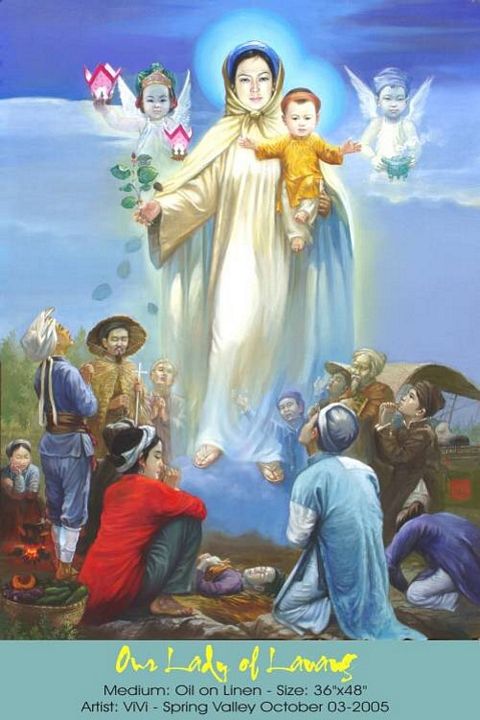
One night in the jungle in 1798, they were unexpectedly visited by an apparition of a beautiful Lady among the branches of the tree. She appeared in a long cape, wearing a traditional Vietnamese long dress (“ao dai”), and holding a child in her arms. There were also two angels –“like bright lights” — at her sides. She comforted and reassured the sick and weary refugees. She told them to boil the leaves from the surrounding trees to use as medicine. She stated that all who would come to this place would have their prayers heard and answered. This all took place on the grassy area near the big ancient banyan tree where the refugees had been praying. All those who were present witnessed the miracle. The sick were healed. By 1802 they could return to their villages.
The Virgin Mary appears in a banyan tree in the jungle of Vietnam in 1798.
They erected a small and desolate chapel in her honor in 1820. Despite its isolated location in the high mountains, groups of people continued to find ways to penetrate the deep and dangerous jungle to pray to the Lady of La Vang. Many prayers have been validated as having been answered. Gradually, the pilgrims that came with axes, spears, canes, and drums to scare away wild animals were replaced by those holding flags, flowers, and rosaries. Despite the ongoing persecution campaign, pilgrimages continued every year.
The Virgin gives directions for boiling ferns and leaves as medicine for the ill.
Another wave of persecutions from 1830-1885 decimated the Christian population and destroyed the chapel. With the persecution ending in 1885, Bishop Gaspar ordered a new church to be built on that location to the Lady of La Vang in 1886. Because of limited funding and its remote and difficult location, it took 15 years to complete. On August 6-8, 1901, Bishop Gaspar inaugurated the new church in a solemn ceremony attended by 12,000 people! By 1928 a much larger church was needed and replaced the old one.
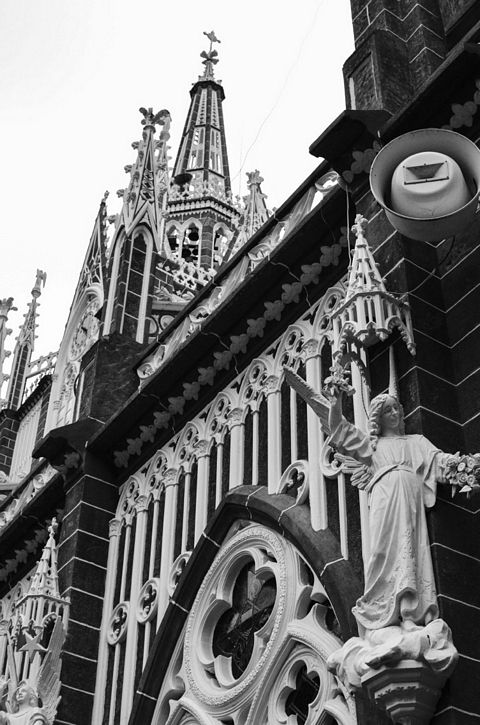
Statue of Our Lady of La Vang, today, as part of the shrine.IF
In August of 1962, Pope John XXIII elevated the church of La Vang to the Basilica of La Vang. On June 19, 1988, Pope John Paul II held a canonizing ceremony for 117 Vietnamese martyrs. He proposed rebuilding the Basilica in August of 1998 to commemorate the 200th anniversary of the first apparition. The Vatican cannot officially recognize this apparition because the country of Viet Nam does not recognize the Vatican State and still opposes the Vatican’s appointments of cardinals, etc. (Politics!)
In 2013, there was a report acquired from a Vietnamese pilgrim that Mary’s statue at the shrine had been weeping tears in recent years.
“Our Lady of Las Lajas”
GUAITARA CANYON, COLOMBIA (1754)
Back in the eighteenth century, María Mueses de Quiñones, a local woman from the village of Potosi, Colombia, often walked the six miles between her village and the neighboring one of Ipiales. One day in 1754 as she was making the journey with her daughter Rosa, they approached the place called Las Lajas (the Rocks), where the trail passes through a deep gorge of the Guaitara River. Maria never liked this part of the trail because there were rumors that a cave in Las Lajas was haunted. Such superstitions remained among the converted Christian Indians.
Unexpectedly, a rainstorm started, and spying a cave ahead, Maria anxiously entered it. While invoking the protection of the Virgin of the Rosary, she suddenly felt someone touching her shoulder – as though to gain her attention. Without looking back to see who it was, Maria fled back into the storm with Rosa protected and sheltered by her mother’s tight embrace.
Maria and daughter Rosa hike through the canyon boulders in 1754 (actors).
Days later, needing to follow this same route again, Maria was carrying her deaf-mute daughter, Rosa, on her back. By the time she had climbed to Las Lajas she was weary and sat on a rock to rest. The child got down from her back to play. The next thing Maria knew Rosa was at the cave shouting:
“Mommy, there is a woman in here with a boy in her arms!”
Maria became very frightened. This was the first time she had ever heard her daughter speak! She didn’t see the figures that the girl was talking about, nor did she want to. She grabbed the child and ran on to Ipiales. When she told people what happened, nobody at first took her seriously. However, as the news spread some asked if maybe it was true. After all, the child was now able to speak!
The miraculous image appears as the natural cave rocks change colors.
A few days later Rosa disappeared from home. After looking everywhere the anguished Maria realized that her daughter must have gone to the cave. Little Rosa often said that the woman was calling her. Maria ran to Las Lajas and found her daughter, kneeling in front of a splendid woman and playing affectionately with a child who had come down from His mother’s arms to let the girl enjoy His divine tenderness. Maria fell to her knees before this beautiful spectacle in reverence and admiration. She knew now that she was seeing the Blessed Virgin and Jesus.
Fearful of ridicule, Maria kept quiet about the event. But, frequently, she and Rosa went to the cave to place wild flowers and candles in the cracks of the rocks. The months went by with María and Rosa keeping their secret. However, one day the girl fell gravely ill — and died. A distraught Maria decided to take her daughter’s body to Las Lajas to ask Our Lady to restore Rosa to life.
Crowns were attached later to this miraculous image in Colombia.
Pressed by the sadness of Maria’s unrelenting supplications, the Blessed Virgin obtained Rosa’s resurrection from Her Divine Son. Young Rosa awoke in perfect health. Overflowing with joy, Maria went home. It didn’t take long for a crowd to gather. Friends and neighbors who had seen the child without life were now overwhelmed with awe at this latest miracle. Early the next morning everyone went to Las Lajas – each one wanting to check the details for themselves.
That was when the marvelous picture of Our Lady on the wall of the grotto was discovered. Maria Muese de Quinones could not recall ever noticing it until then. Her delicate and regal features are those of a Latin American, perhaps an Indian. Her abundant black hair covers her like a mantle (The two-dimensional crown is metal and was added by devotees much later on). Her eyes sparkle with a pure and friendly glow. She looks about fourteen years old. The Indians had no doubt: this was their Queen.
An altar was constructed with the miraculous cave image as the backdrop.
The child Jesus is in Our Lady’s arms. On the right side of Our Lady is Saint Francis; on the left side is Saint Dominic. St. Dominic is receiving a rosary from Our Lady; St. Francis is receiving the Franciscan cord from the Child Jesus. These two orders, the Franciscans and the Dominicans, are the founders of the two Orders that first evangelized Colombia, South America.
The ensemble of colors in the picture gives an undeniable ambience of majesty. The colors behind Our Lady’s head create a splendid background. The burgundy of her dress is a warm, rich red embroidered with a golden flower pattern, giving the impression of the garment of a Queen. Her long hair flows freely in such a way that it appears to be a royal mantle. There is extraordinary good taste in the way the hair is arranged, which reinforces the notion of majesty. Our Lady’s face watches us from on high with a serious probing gaze. She is not smiling. She has the royal countenance of a person who imposes respect with confident strength.
A grand cathedral is built outward from the cave image.
In contrast, the Divine Infant is very amiable and turned toward the supplicant. Thus, instead of having the classic picture of a serious Child and a smiling Mother, here we have the opposite. One could say that He is distributing the gifts while she appears as a Queen. In reality, there is something profound in this contrast. It is the idea that He is merciful because He is seated in Our Lady’s arm. He communicates to the person who prays a little of His happiness to be with her. Our Lady’s image expresses motherhood. She is not looking at Him directly, but she has an enormous intimacy with Him. She extends this maternity to the sinner who kneels before her. She is also his Mother. This image is a masterpiece reflecting both the majesty and the maternity of Our Lady.
As devotion to the image grew, a good road replaced the old trail. In the early 20th century a tasteful gothic church was built over the cave. But who put this magnificent image there? Tests done when the church was built show how stupendous this image actually is. Geologists from Germany bored core samples from several spots in the image. There is no paint, no dye, nor any other pigment on the surface of the rock. No brush strokes are visible despite meticulous inspections. The colors are the colors of the rock itself. Even more incredible, the rock is perfectly colored to a depth of several feet! The picture penetrates the rock miraculously. It is not painted, but mysteriously imprinted in the rock. The colors are not applied in a surface layer of paint or other material, but penetrate deep into the rock. Certainly it has no natural geological cause. There is no known place in the world where nature reproduced human faces with such perfection. These circumstances seem to indicate that it is an akeropita image – akeropita in Greek means not made by human hands, i.e., made by the Angels.
The great Guaitara Canyon church is built on pillars.
The mystery remains unsolved. Historians and scientists cannot explain this mysterious and beautiful work of art. Were the angels instructed to craft it? Was it by the hand of God?
The church is of Gothic revival architecture and was built from January 1, 1916 to August 20, 1949, with donations from local churchgoers, replacing an old nineteenth-century chapel. The name Laja comes from the name of a type of flat sedimentary rock similar to floor tiles found in the Andes Mountains. The miraculous image on the cave wall can still be seen today, found behind the main altar. The church was literally built around the image with most of the church extending out over the gorge and supported by decorative pilings. A bridge from the church touches the adjacent hillside which makes it easier for the approach of pilgrims. Custodians of the church boast that it has more turrets and spires than Notre Dame in Paris.
The minor basilica had to be built out over the canyon on giant pillars.
Pope Pius XII granted a canonical crowning of Our Lady of Las Lajas in 1952 in the presence of the entire Colombian episcopate. The Gothic church was elevated to the dignity of a minor basilica.
It is a marvelous wonder visited by many tourists today.
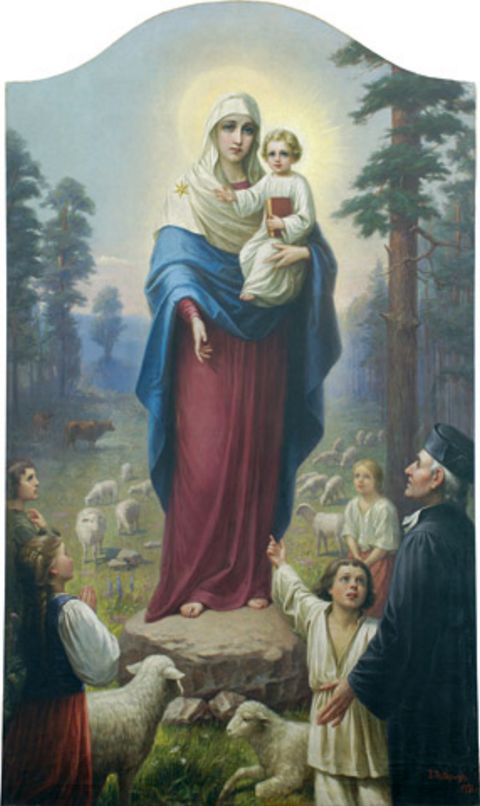
At the foot of the Alps in southern France is the village of Laus. In 1666 the hamlet held twenty households, scattered in little huts. The inhabitants had built a chapel dedicated to Our Lady of the Annunciation. A humble, unschooled shepherdess, Benoite Rencurel, was born into extreme poverty – complicated by the death of her father when she was only seven years old. Benoite was protective of her mother, who trained them well in religious prayers, while Benoite had to take a job as a shepherdess for two different masters to help support the family.
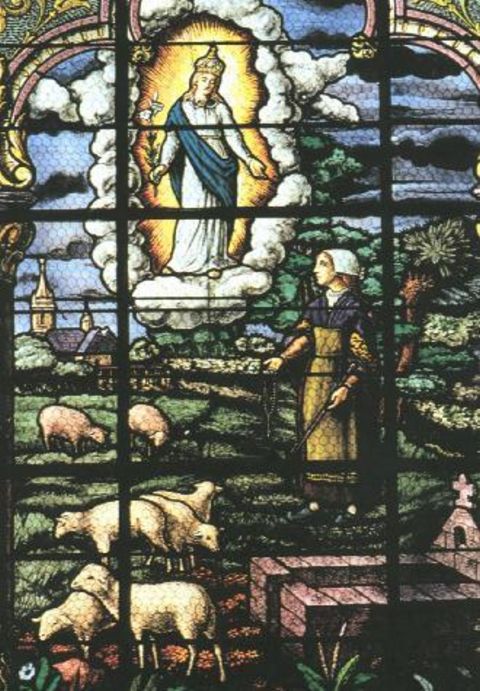
In May of 1664, 17-year old Benoite was watching her flock of sheep while praying the Rosary. Suddenly, an old man, clothed in the vestments of a bishop of the early Church, approached her and asked her what she was doing in this place. She replied that she was tending her sheep, praying, and looking for water. He offered to get her some water and went to a well that she had not seen before.
B: “You’re so beautiful! Are you an Angel, or Jesus?”
M: “I am Maurice, to whom the nearby chapel is dedicated. My daughter, do not come back to this place. It is part of a different territory, and the guards would take your flock if they found it here. Go to the valley above Saint-Etienne. That is where you will see the Mother of God.”
B: “But Sir, She is in Heaven. How can I see Her there?”
M: “Yes, She is in Heaven – and on earth, too, when She wants.”
Benoite Rencurel is entranced by visits from the Virgin Mary.
Very early the next morning, Benoite led her flock quickly to the designated area in the Valley of Kilns. As Benoite arrived in front of a small grotto on that site, a lady of incomparable beauty appeared, holding the hand of an equally beautiful child. Despite St. Maurice’s prediction, the naïve shepherd girl just could not believe that she was actually in the presence of the Mother of God.
“Lovely lady, what are you doing here? Did you come to buy some plaster? (local product) Would you be so kind as to lend us this child? He would delight us all!”
The beautiful lady just smiled without answering. Benoite invited her to eat something with her. She just smiled again. She would go in and out of the cavity in the rock grotto, approaching at times, moving away at other times from Benoite. When evening came, she took the child in her arms, entered the grotto and disappeared.
Every day for the next four months, Benoite would come to this place and enjoy the beautiful lady’s presence. She never dared to ask who she was, but the villagers began to seriously wonder if it could be the Virgin Mary – just from the amazing transformation in the face, mood, and spirit of this young shepherdess. After two months of silence, Mary finally spoke – in order to teach, test, and encourage her. One day, Mary invited Benoite to rest by her side and to peacefully fall asleep on the hem of the Virgin’s mantle.
Portrait of visionary Benoite Rencurel
She taught Benoite the Litany of Loreto, and then asked her to teach it to the girls of Saint-Etienne and go with them to sing it in church every evening. Mary displayed the sweetness and patience of a loving mother in dealing with Benoite’s stubbornness and frequent impatience. She told Benoite that she wanted her role to be that of working for the conversion of sinners through prayer, sacrifice, and exhortation. Mary said that God had granted Benoite the “charism of reading in hearts.” This means that she could discern the good or bad condition of one’s soul. She would work with sinners to help them admit to and confess their issues.
Benoite’s employer, Mrs. Rolland – a woman who had no interest whatsoever in religion, wanted to see for herself what was going on at the site of these apparitions. One day before dawn Mrs. Rolland entered the grotto and hid behind a rock. Shortly afterwards, Benoite arrived and Mary appeared to her.
“Your mistress is over there, hiding behind the rock. Tell her not to curse with the name of Jesus, because if she keeps it up, there will be no paradise for her. Her conscience is in a very bad state; she should do penance.”
Mrs. Rolland heard every word clearly — and tearfully promised to amend her ways – which she did, faithfully, after that day.
Benoite’s doubting employer is shocked by Mary’s words directed at her.
News of these apparitions spread quickly; everybody was talking about them. Many believed in them; others treated Benoite as a “false mystic.” Francois Grimaud, the magistrate of Avancon Valley and a good Catholic and man of integrity, decided to conduct an investigation. After a serious examination, he concluded that Benoite was not deceiving anyone, nor was she an impostor, or was she mentally ill. But, since Benoite had never asked the identity of the beautiful lady, the magistrate requested that Benoite at least ask her who she really is.
“My good Lady, I and all the people in this place are hard put to know who You are. Might You not be the Mother of our good God? Please be so kind as to tell me, and we will build a chapel here to honor You.”
“I am Mary, the mother of Jesus. There is no need to build anything here because I have chosen a more pleasant spot. You will not see me here anymore, nor for some time.”
Benoite did not see Mary for an entire month and became profoundly depressed. But on September 29, 1664, halfway up the hill that leads to Laus, on the other side of a stream, Benoite caught sight of the Virgin. Crossing the stream, she threw herself at Her feet.
“Oh, good Mother! Why did you deprive me of the joy of seeing you for so long?”
“From now on, you will only see me in the chapel that is in Laus.”
The Laus apparitions lasted a record-long 54 years from 1664 through 1718.
The little chapel in Laus was nothing more than a small, thatch-roofed structure just over two meters square. Its plaster altar only had ornaments of two wooden candlesticks and a pewter ciborium. The chapel appeared to look like all the other small houses in the village, so Benoite had a terrible time the next day trying to locate it in a town she had never travelled to. She stopped at the entrance to every poor dwelling, trying to detect that “sweet fragrance” that she associated with the Blessed Virgin. Finally, she detected the fragrance at a doorway where the door had been left ajar. Inside, she found the beautiful Lady standing on the dust-covered altar.
“My daughter, you have searched diligently for Me, and you should not have wept. Even so, you pleased Me by not being impatient.”
“Honorable Lady,” Benoite replied, “would you like me to spread my apron under Your feet? It is very white.”
“No, … soon nothing will be lacking here – neither vestments nor altar linens nor candles. I want a large church built on this spot, along with a building for a few resident priests. The church will be built in honor of my dear Son and Myself. Here, many sinners will be converted. I will appear to you often here.”
Benoite: “Build a church? There’s no money for that here!”
“Do not worry. When the time comes to build, you will find all that you need, and it will not be long. The pennies of the poor will provide for everything. Nothing will be lacking.”
Benoite travelled the four kilometers to Laus every day, even through the entire winter, praying as Mary instructed for the conversion of sinners. In 1665, Mary asked her to stop tending her flocks of sheep in order to devote herself to her mission.
“I asked My Son for Laus for the conversion of sinners, and He granted it to Me.”
As news of the continuing apparitions spread, the number of visitors to Laus increased. Graces and blessings poured down upon souls; people came by the hundreds and then thousands to pray in the poor little chapel. Cures of all kinds abounded, and sinners were converted in great numbers. By March 25, 1665, an immense crowd had come to the once-deserted chapel. On May 3, 1665, thirty-five parishes converged in a ceremonial procession, and then several priests heard many confessions. Although the Catholic authorities had not pronounced any decision regarding these apparitions, they did permit Mass to be held at the chapel.
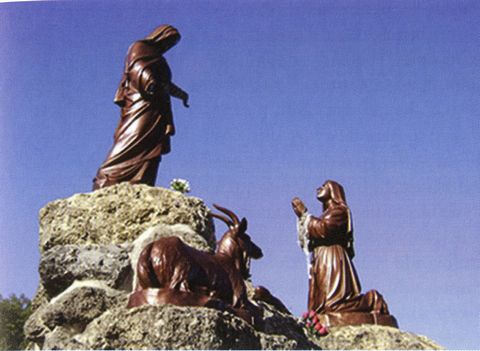
Statues located at the Laus apparition site commemorate the apparitions.
That is when the Vicar General, Rev. Pierre Gaillard, entered the scene. Out of curiosity he arrived in August of 1665 and asked for graces. He obtained such great graces there that he was immediately convinced of the authenticity of the apparitions. But Laus was not in his diocese, so he wrote to the Vicar General of the Diocese of Embrun, Father Antoine Lambert, and suggested he make an official inquiry. Father Lambert was unsympathetic and convinced that Benoite’s apparitions were diabolical. He arrived at Laus on September 14, 1665 to put an end to “this sorcery” by proving Benoite to be a fake and shut down the chapel.
Benoite became frightened and wanted to run away, but Mary intervened:
“No, my daughter, you must not run away. You must remain, for you must do justice to churchmen. They will question you one by one and try to catch you with your own words. But do not be afraid. Tell the Vicar General that he can very well make God come down from Heaven by the power he received when he became a priest, but he has no commands to give the Mother of God.”
Benoite remained unruffled during the tricky interrogation, answering him with simplicity and calm assurance. But Father Lambert already had his mind made up.
“It is my conviction, as it is of everyone with any common sense, that your visions are false. Consequently, I am going to close down this chapel and prohibit the devotion.”
Benoite: “Sire, although you command God each morning and make Him come down to the altar by the power you received when you became a priest, you have no commands to give His holy Mother, who does as She pleases here.”
(Impressed by her words:) “Well, if what people are saying is true, then pray to Her to show me the truth by a sign or miracle, and I will do all that I can to accomplish Her will. But, once again, be careful that these not be illusions and effects of your imagination to delude the people, or I will punish you severely to undeceive those who believe you. I will stamp out abuses with every means in my power.”
Heavy rains prevented the Vicar from leaving too quickly, delaying his departure for two days. A well-known cripple in the area, Catherine Vial, was praying a novena with her mother at the chapel. Her nerve contraction disorder was declared incurable by two eminent surgeons. Around midnight of the last day of her novena, she suddenly felt her legs relax, and she was able to walk. The next morning she entered the chapel under her own power, totally cured, as the Vicar General was saying Mass. Quite a stir was created as many shouted, “Miracle, miracle!” Moved to tears, Father Lambert had a hard time finishing Mass. The Vicar General declared,
“There is something extraordinary occurring in that chapel. Yes, the hand of God is here!”
Although there were no resources at all, construction of a much-needed, larger church was undertaken with great enthusiasm. It was the poor who took up the challenge. Many of the pilgrims as well as the local people would carry one or more stones from the streams to the construction site. Thanks to Father Gaillard’s tenacity, the construction was built according to the indications Our Lady had given to Benoite. On October 7, 1666, Father Gaillard laid the first stone of the building at the Feast of the Holy Rosary. At the same occasion Benoite became a Dominican Tertiary.
Within four years, the church was completed. The hands of the poor had gathered its materials; donations had dug its foundations. The earliest historians of Laus are unanimous in reporting the sweet, heavenly fragrance of the place. A great number of people attested to the strong fragrances coming from the church. It was so intense that it spread from the church all over the valley. Judge Francois Grimaud claimed,
“During the Easter season of 1666, I smelled a very sweet fragrance for around seven minutes. I had never smelled anything like it in my life, and it gave me such deep satisfaction that I was enraptured.”
From March 24th until the end of May, 1690, the Laus church was so pervaded with this fragrance that all the pilgrims attested to it. This phenomenon is still experienced today. To avoid any possibility or claim of deception, flowers are not usually allowed at the shrine. The manuscripts of Laus report:
“Every time the Blessed Virgin honored her with Her visit, people smelled a heavenly fragrance that pervaded the entire church. Sometimes the shepherd girl’s clothing was deeply permeated with the heavenly scent for up to eight days. These supernatural fragrances were so sweet and delightful that they uplifted many souls.”
One day in the winter of 1665, Benoite was advised by the Virgin Mary to invite those with illnesses to take oil from the lamp in the chapel and apply it to themselves, and if they have recourse to Her intercession and have faith, they will be healed. Physical and moral cures were granted in great number by means of the oil applied with faith.
Mary appeared to Benoite at least once a month for 54 years! The Virgin Mary gave Benoite the exceptional privilege of reading onto souls. She could “see consciences the way we see in a mirror, all at once.” She revealed faults, grievous and lesser sins, hidden motives, hypocrisy, and errors often committed unconsciously. She would even take away from the Communion rail those people who were not in the state of grace. She would often have to share her painful observations, but her kindness and compassion generally led to grateful responses.
To priests, she revealed their indiscretion, their lack of prudence in their manner of questioning penitents, their neglectful behavior, and their grudges. She would see priests at the altar either shining with light or tarnished, according to the state of their conscience. She would warn them if they appeared “tarnished.” A young priest claimed, “You cannot be in that chapel without trembling if your conscience is not clear.”
Mary counseled and corrected Benoite closely in her mission:
“Take heart, My daughter! Have patience. Do your duty cheerfully. Bear no hatred towards the enemies of Laus. Do not be troubled and sick over it if people do not profit from your advice. Do not be disturbed by temptations, visible or invisible spirits, or temporal affairs. Strive never to forsake the presence of God, for whoever has any faith will not dare to offend Him.”
On Friday, July 7, 1673, a vision of the bleeding Christ on the cross was the beginning of a weekly “mystical crucifixion” that started on Thursday evening and ended on Saturday morning. This lasted every week for 15 years!
Politics and personalities brought turmoil, controversy, persecution, and threats to close the church over some 20 years. But Benoite always remained faithful until her death on December 28, 1718. (Approved by the Church: May 4, 2008.)
“Our Lady of Eternal Aid”
QUERRIEN, LA PRENESSAYE, FRANCE (1652)
Querrien is a small village in the northwestern part of France known as Brittany. On August 15, 1652, Jeanne Courtel, age 12, was a poor shepherdess tending her father’s flock of sheep. She had been both deaf and mute ever since her birth. She was reciting her prayers when she was surprised by the sudden appearance of the Blessed Virgin. Our Lady was holding the Child Jesus on one arm and holding a stalk of lilies in the other.
Blessed Mary had only spoken a few words when Jeanne suddenly realized that she could actually hear her! The twelve-year old had been miraculously healed. Our Lady spoke in a sweet voice,
“I choose this place to be honored. Build for me a chapel in the middle of this village and many people will come.”
Then a dialogue began between the Holy Virgin and the shepherdess. Mary continued,
“Charming shepherdess, give me one of your lambs.”
Jeanne would have willingly given one to the Lady, but she replied,
“These sheep are not mine; they are my father’s.”
Then Mary replied with these directions,
“Return to your parents and tell them that I require a lamb.”
Jeanne turned to leave, but then turned back and asked Our Lady,
“But who will keep my herd?”
Blessed Mary replied,
“Myself. I will keep your sheep!”
The little girl returned to her parents quickly – and they were astonished to hear her speak! Jeanne excitedly told them,
“A Lady came to see me, and she asked me for one of your lambs.”
The father was overjoyed at his daughter’s miraculous recovery and replied,
“Ah, my daughter. Because this Lady has made you speak, we will give her all the flock.”
Jeanne also related that her father should dig in the nearby pond to find a statue of this Lady that had been buried there for centuries – according to Our Lady. The father asked his daughter if the Lady had stated who she was?
“She said that she was the Virgin Mary, and we need to build a chapel in the village so many pilgrims will go there to honor her.”
The father responded,
“If this is true, we will ask the bishop to allow us to build a shrine to the Virgin Mary.”
Jeanne Courtel is healed so that the Virgin Mary can complete her mission.
In the days that followed, the Virgin appeared again and repeated her request for a chapel. History states that in the year 610 A.D., St. Gall had visited the region to erect a hermitage. He had sculpted a statue of the Virgin Mary. During a disastrous time in the region, the chapel that he had built was destroyed, and the statue was lost.
But, on August 20, having been divinely directed by Our Lady to search the pond for the statue, it was duly found and proved to be in excellent condition – despite having been buried in water for centuries.
During that same year of 1652, Msgr. Denis de La Barde, bishop of that region, made an appearance on September 11 and was informed about all that had taken place. Several days later on September 20, after conducting his investigations, he formally recognized the validity of the apparitions and blessed the first stone of the future chapel. The chapel was begun that year in 1652 and was completed four years later. It was enlarged in 1779 because of the large crowds that visited the shrine. The body of visionary Jeanne Courtel was entombed within the shrine after her death in 1703 at the age of 63.
On August 14, 1950, some 20,000 pilgrims visited Querrien for the coronation of the miraculous statue by the local bishop — who did so in the presence of many ecclesiastics. One of the most splendid ceremonies to take place at the shrine was that in honor of Cardinal Lustiger, Archbishop of Paris, who paid homage to the Madonna and then blessed the new buildings on September 10, 2000. The shrine of Our Lady of Eternal Aid is proud to announce that it is the only one in Brittany that has been authenticated by the Catholic Church.
“Our Lady of the Willow Tree”
VINAY, FRANCE (1649)
The village of Plantees, France, was Catholic in 1649. A farmer in the area, Pierre Port-Combet, had abandoned the Catholic Faith for the heresy known as Calvinism. He refused to allow his devout wife to raise their six children in the Catholic Faith – and instead, drew them into heresy. Pierre delighted in disobeying church directives by working on Sundays and feast days dedicated to Our Lady.
It was on March 25, 1649, the Feast of the Annunciation, when a miraculous event occurred. Pierre decided to flaunt his disdain for the feast day by pretending to prune a willow tree with his knife alongside the road that others would be taking to Mass. He stabbed the trunk of the tree and then drew back in horror. The tree bled – so much so that it splashed on Pierre’s hands and arms. There was so much blood that for a moment he thought that maybe he was wounded. Puzzled, he stabbed the tree again, and it bled even more.
At this moment, his wife was passing by on her way to church – and hurried to see if he had any wounds, but could find no injury. After hearing his story, the wife took the knife and stabbed the tree, but nothing happened. Frustrated, Pierre took the knife from her and stabbed the tree again. Once again, the tree spurted blood.
The altar with a piece of the willow tree preserved within.
A neighbor, Louis Caillet, was passing by and tried to produce the same effect, but nothing happened. Other neighbors passing by tried to make the tree bleed with repeated attempts, but nothing would happen. Only when Pierre struck the tree, would it bleed. The crowd that had gathered all agreed that the miracle only took place at the hand of the heretic, and that the prodigy was a stern warning for Pierre to convert and observe the laws of the Church. The bishop ordered an inquiry, and a tribunal of churchmen finally declared that Pierre had indeed received a severe warning from Heaven.
Pierre began profound prayers at the willow tree, but disapproving Calvinists threatened him with bodily harm. His actual conversion was thereby stalled for the next seven years.
On the Feast of the Annunciation in March of 1656, Pierre was working in his field when he saw a woman in the distance. She was clothed in white, wearing a blue mantle. Over her head was a black veil that partially hid her face. As she came toward him, he thought she was lost and about to ask for directions. Displaying amazing speed, she was suddenly standing next to him! In a sweet voice, the Lady greeted Pierre,
“A Dieu-sois-tu, mon ami!” (“God be with you, my friend!”)
Pierre hesitated — hearing the sweet sound of the voice and seeing the incredible beauty of the woman. Again, she spoke,
“What is being said about this devotion? Do many people come?”
Pierre nervously answered, “Yes, many people come.” Our Lady continued,
“Where does that heretic live who cut the willow tree? Does he not want to be converted?”
Embarrassed by her question, he could only mumble a response. After a moment, the Lady asked Pierre,
“Do you think I do not know that you are the heretic? … Realize that your end is at hand. If you do not return to the True Faith, you will be cast into Hell. But, if you change your beliefs, I shall protect you before God. Tell people to pray to advantage, not to neglect the source of graces which God in His mercy has made available to them.”
Overwhelmed with remorse, Pierre ran after Our Lady as she began moving away. But then he saw her suspended several feet in the air and slowly fading from sight. He realized that he had been granted a vision of the Blessed Virgin and fell to his knees, sobbing uncontrollably, and pledged a complete reform.
One month later, on the eve of the Assumption, Pierre contracted a serious illness. A priest of Vinay heard his confession and welcomed him back into the Church. He completed his conversion by receiving the Holy Eucharist the next day on the Feast of the Assumption. His conversion inspired many others to also convert – including his son and five daughters, as well as many Protestants and Calvinists. Our Lady’s words, “Realize that your end is at hand,” were confirmed with his death just weeks later. In accordance with his final wish, he was buried at the bottom of the willow tree.
The Propagation of the Faith in Grenoble gave its approval for the purchase of the field of the apparition and to build a chapel there. Unfortunately, during the French Revolution, terrorists pillaged and desecrated the sanctuary and hacked to pieces a statue of Our Lady that had been sculpted according to Pierre’s description. Luckily, a valiant woman hid the pieces until peace was restored. Following the Revolution, devotion to Our Lady of the Willow was restored by the Oblates of Mary Immaculate.
In 1856, Pope Pius IX decreed a solemn jubilee and a papal crowning of the restored statue. Another crowning was ordered by the same pope in 1873. The church was raised to the dignity of a small basilica by Pope Pius XI on March 17, 1924. The once-mutilated statue of Our Lady is found here. Beneath her altar is a decorative box containing the piece of the willow tree. Pierre’s tomb is at the foot of this altar.
Prayers said before this altar have led to more than one hundred miraculous cures. These miraculous healings are said to be “undoubtedly genuine” due to the sworn testimonies of reliable witnesses.
“Our Lady, Comforter of the Afflicted”
KEVELAER, GERMANY (1641-1642)
Around 1640 the small village of Kevelaer had suffered greatly from a tragic fire and the ravages of the Thirty Years war. It was considered a vast moorland and a place where few ventured.
Hendrik Busman, a pious traveling salesman, was on his journey from Weeze to Geldern when he stopped at a cross on the heath of Kevelaer to pray for a few minutes.
“At Christmas in 1641, I was making my way when I came to the region around Kevelaer. There was a cross by the roadside, and I heard a voice coming from that direction say to me,
‘Here thou shalt build me a chapel.’
I looked around me — but saw no one. I resolved to press on and put all thoughts of the phenomenon out of my head. About a week later, I passed the place again and there heard the same voice speaking the same words as before. Then I heard it again a third time. I was sad because I was poor, and I had no means by which I might build a shrine. Nevertheless, I saved regularly from my petty cash in the distant hope that one day I should have a fund to fit the purpose.
Our Lady, Comforter of the Afflicted, with baby Jesus
Then, four weeks before Whitsunday, my wife, Mechel Schouse, received a vision by night. She saw a great light, and in the midst of it a shrine. And in that shrine was a picture of Our Lady of Luxembourg – like one she had been shown some time earlier by two soldiers passing through our village. The soldiers had offered to sell Mechel the picture, but, upon asking the price, she realized that she could not afford it. (A night watchman, making his usual rounds, saw a strange light in the home of the Busmans, confirming their supernatural visitation that night.)
When Mechel told me of her vision, I connected it with my own experience near Kevelaer. I urged her to find the soldiers and the picture. She discovered that the picture was now in the possession of a lieutenant presently in prison in Kemen. Mechel obtained the picture from him.”
Convinced that the vision experienced by his wife was a confirmation of his Heavenly assignment, Hendrick used the little money that he had saved and began to construct a shrine according to Mechel’s description. This was supported by the parish priest of Kevelaer, Rev. Johannes Schink.
The portrait was a copper-printed picture measuring only twelve centimeters tall and eight centimeters wide. “Our Lady of Luxemburg” was known as the “Comforter of the Sad and Depressed” whom everyone had worshipped during the Pest Epidemic of 1623. The text on the picture said, “A faithful portrayal of the Mother of Jesus, The Comforter of the Sad and Depressed renowned for miracles and worshipped by many people.” At first, Carmelite nuns of Geldern offered to keep it safe during the construction. After that, during a temporary period of caring for the image in his own home, Hendrick appealed to the Capuchin priests to house it safely in their chapel because so many pilgrims were already traveling to venerate the image. The crowds became so great that monks soon asked for him to please take it back as soon as he could for placement in the shrine.
On June 1, 1642, Rev. Schink officially brought the image in great ceremony to the new shrine where large crowds awaited. Miracles were soon reported. On September 8th, feast day for the birth of Our Lady, Reinier and Margaretha van Volbroek traveled with their invalid son, Peter, who had been paralyzed for five years – unable to walk or stand. Although his case had been declared hopeless by physicians, just two days after their visit to Our Lady of Luxembourg, Peter was totally cured and able to walk again without any difficulty.
A woman suffering open wounds on her legs that no treatments had helped for years was healed miraculously after just two visits. Her healing was so dramatic and profound that it was reported by the Mayor of Huissen, Holland for official documentation on August 13, 1643. Many other miraculous cures were documented at the shrine.
Five years after Hendrick’s death, the old chapel was replaced by a new one in 1654. A basilica was built between 1858 and 1864. Today it is a huge and beautiful complex with multiple buildings, bubbling fountains, and an outdoor Stations of the Cross. The little picture of Our Lady, Comforter of the Afflicted, has been decorated through the years with golden angels, golden roses, golden medals, and jeweled ornaments – donated by grateful pilgrims.
In 1892, the 250th anniversary of the shrine’s inauguration was celebrated with a papal coronation – a crown studded with diamonds and jewels, placed above the picture.
On May 2, 1987, Pope John Paul II visited and worshipped the miraculous image.
“Our Lady of Manaoag”
MANAOAG, PANGASINAN, PHILIPPINES (1610)
In 1610, a man was walking home along a lonely road in the Pangasinan region when he happened to hear a lady’s mysterious voice. Turning around, he was greatly surprised to see a radiant lady holding a small child on one arm while a rosary was suspended from her right hand. The vision appeared to be standing on a bright cloud over a small bush. Saying nothing, the Virgin looked sweetly at the man – who was now on his knees in profound reverence.
When the villagers heard of the vision, they hastily journeyed there and soon built a small church over the place of the apparition. A town soon flourished near it and was named “Manaoag” — which means “to call.”
The Blessed Virgin seems to have protected this region ever since then from numerous threats. There was a time in which mountain tribes were accustomed to burning Christian villages. One day, when Manaoag was destined to be torched, flaming arrows were shot into the little church. Not a single flame set it on fire.
On an even greater scale, during World War II, four bombs were dropped. Three landed on the patio and only damaged the facade of the church. One bomb crashed through the roof of the church, but it failed to explode inside. The church was miraculously saved.
Our Lady of Manaoag, Philippines with baby Jesus
In 1698, huge swarms of locusts began to ravage the rice fields. They came in swarms so vast that the sky was darkened. An image of the Blessed Virgin (that had been brought to the Philippines by Padre Juan de San Jacinto of Spain in the early 17th century) was taken out to the fields. Desperate for help, they placed the small image on the ground and then watched in amazement as the locusts began to destroy each other in a totally unexpected manner that had never been witnessed before. The carnage continued until not a single locust could be found alive.
Another miracle took place during the drought of 1706. The fields had been scorched by the drought, and the seedlings were shriveled from the heat. As days passed with more sun, heat, and no rainclouds, the people began praying to Our Lady for help and took her image once more out to the fields. During the first day of a novena, and after a procession with the miraculous statue, Our Lady showed her compassion again for this region by gathering rain clouds as soon as her image was returned to the church. The sky dimmed and a downpour of much-needed rain soon fell. This rainfall continued for many days until the ground was refreshed and the crops were saved.
Another spectacular miracle was documented in 1698. It was on Easter Sunday when a fire of unknown origin devoured the whole town and crept steadily toward the church. The parish priest was notified of the danger and rushed to the scene. He grabbed the statue of Our Lady from inside the church and took it out to protect it from harm. He prayed and pleaded with Blessed Mary, saying,
“Dear Lady, if you do not spare the church from fire, I will hurl myself into the flames with you so that the two of us may be consumed by it.”
After he pleaded with Our Lady of Manaoag, the flames immediately died down and were extinguished. Once again , the church was miraculously saved.
Many pilgrims visit the shrine of Our Lady of Manaoag every year – but, especially during the months of April and May when annual, worldwide pilgrimages occur. Many other miracles attributed to Our Lady are depicted in giant wall paintings in the church. The crowds were huge on April 21, 1926, when the Papal Nuncio canonically crowned the image of Our Lady of Manaoag.
Allegedly, Our Lady visits all the barrios of Manaoag and all the towns in the district of Pangasinan every twenty-five years.
The exact date of the discovery of the Madrid image is unknown, although it is known that it began when Spanish friars were traveling through the village of Traigueras on their way to Rome to gain approval for the Order of Minims, founded by St. Francis of Paola (1416-1507). When a furious storm descended upon them, they prayed for God’s guidance and help. Looking for shelter, they saw a mysterious light coming from a cave. They hurried to it and found the beautiful statue of the Virgin Mary holding the Child Jesus. Surrounding it was a shimmering light and a heavenly fragrance of flowers.
When nobody in Traigueras knew anything about the statue and did not claim it, the friars carried it with them to Rome. On arriving there, they met with Pope Paul V (1605-1621), who heard the story of the discovery – and not only venerated and blessed the statue, but also gratified the friars by granting full approval of their new Order of Minims.
Mother Mariana de Jesus Torres, visionary
The image was first placed in the Royal Hospital of Madrid where many miracles were granted. In fact, there were so many miracles that King Philip III ordered the construction of the Sanctuary of the Puerto del Sol where the image is found today, beautifully adorned and sumptuously enthroned.
The image of “Our Lady of Good Success” in Madrid was dear to the hearts of countless souls, including Sister Mariana of Jesus Torres, who, even as a child, received visits from the Blessed Mother. After joining the Order of the Immaculate Conception, Sister Mariana was sent from Spain to Quito, Ecuador to found another house of the Order — of which she became the Abbess. Her great devotion to Our Lady under this title was continued when she arrived in Quito, Ecuador.
It was there in Quito, on February 2, 1610, while she was praying to the Blessed Mother, that she was granted another heavenly visitation. Identifying herself as “Mary of Good Success,” the Virgin Mary asked that a statue be made to her likeness for the consolation and preservation of the convent – and for those faithful souls who would pray to her.
The Virgin asks to be measured for a statue that will be crafted by angels.
“It is now necessary that you have my holy statue made promptly, just as you see me, and that you make haste to place it in the place which I indicated to you. With this statue I will favor not only my convent, but also the people of Quito and all the people throughout the centuries.”
Mother Mariana responded with great humility:
“Beloved Mother of my soul, the tiny ant that thou hast before you will be unable to relate any of thy beautiful features … or thy height. It will be necessary that the three Archangels who accompany thee … would come to sculpt thy statue which thou askest me to have made, so that the work may be as thou wilt …”
Blessed Mary replied, in a calming manner,
“Do not be worried about any of this, dear daughter. The perfection of the work is my concern. Gabriel, Michael, and Raphael, with the whole Heavenly Court, will secretly take care of the making of the statue … Regarding my height, bring the cord here that you wear, and measure me without fear, since to a Mother like me, the confidence, respect, and humility of her daughters pleases her. Beloved daughter, put into my hands one of the ends of your cord, and I will place it upon my forehead, and you will apply the other end to my right foot.”
The painted wooden statue of Mary and Jesus, completed by the archangels.
The three Archangels lifted the crown of the Queen of Heaven while she was placing the end of the cord on her head. But the cord was too short to reach to the ground. But the Child Jesus reached out from his Mother’s arms and miraculously stretched it to reach. Then Mother Mariana came out of her ecstasy and now had the exact measurements for the statue.
On February 5, 1610, she contacted a Spanish sculptor, Francisco del Castillo, and honored him with this special project that would be due for consecration on February 2, 1611. The bishop routinely inspected the work going on in the choir loft. On January 10, 1611, he noted that the statue only needed a final coat of paint before completion. The sculptor indicated that he must travel far to Pasto, Colombia to get the fine paints required, and so he left town.
At midnight, the first hour of January 16 (the day the sculptor was to return), Mother Mariana witnessed the choir loft and entire church illuminated with a supernatural light. The tabernacle opened by itself, and the three archangels, Michael, Gabriel, and Raphael, placed themselves before the throne of God — and something was given to them. Choirs of angels united their voices in singing, “Blessed Mary, temple and tabernacle of the Blessed Trinity.” In the next instant, Mother Mariana saw the three archangels in the choir loft, illuminating the statue with their divine light. St. Francis of Assisi appeared and joined the three archangels as they approached the unfinished statue. The statue was transformed so rapidly that Mother Mariana could not perceive how it happened. St. Francis took the cord from around his waist and placed it around the statue’s waist. Then he and the archangels disappeared as the Blessed Virgin appeared and entered the statue herself while angels continued to sing the Latin hymn, Salva Sancta Parens.
At 3:30 a.m. Mother Mariana came out of her ecstasy and saw the statue still illuminated by Divine Light. When all of the convent sisters came to see the miraculous completion of the statue, they heard the angels still singing and saw the supernatural light still present. Later that day, when the sculptor returned, the nuns watched quietly as he approached the choir loft. As he approached the statue, he dropped to his knees and cried out, “This exquisite statue is not my work!” He wept as he realized that a miracle had been performed. He immediately composed a written statement testifying to the beautiful changes in the sculpting and painting that “were not of my hands.” The bishop was notified, and he, too, knelt and wept before the beautiful masterpiece, verifying the miraculous changes performed by angels that had completed the wooden statue in the sculptor’s absence.
The large statue high above the church in Quito, Ecuador.
During other apparitions to Sister Mariana, the Blessed Mother confided several prophecies, some of which have already taken place, thus validating her words. Many predictions are pertinent to the troubled times of the present. Some of these prophecies include a warning that Masons and other secret sects would have an influence – even within the Church. She warned:
“A worldwide campaign against the virtues of chastity and purity will succeed in corrupting the youth … evil will invade childhood innocence. The clergy will leave much to be desired because priests will become careless in their sacred duties … Faithful priests upholding, the Faith will suffer greatly and will be overwhelmed with vexations in order to stop them from fulfilling their ministry. The precious light of Faith will be extinguished in souls by the almost total corruption of customs.”
Then Our Lady of Good Success continues to complain that:
“Those who have the financial means to help the Church will do nothing. Their miserly attitude toward God and His Church will allow evil to seemingly triumph.”
Many other prophecies were given which depict the future as being very troublesome for the Church.
The Pope’s “infallibility will be declared a dogma of Faith by the same Pope chosen to proclaim the dogma of the mystery of my Immaculate Conception. He will be persecuted and imprisoned in the Vatican through the usurpation of the Pontifical States and through the malice, envy, and avarice of an earthly monarch.”
“Unbridled passions will give way to a total corruption of customs because Satan will reign through the Masonic sects, targeting the children in particular to insure general corruption.
“Unhappy, the children of those times! Seldom will they receive the sacraments of Baptism and Confirmation. As for the sacrament of Penance, they will confess only while attending Catholic schools, which the devil will do his utmost to destroy by means of persons in authority.
“The same will occur with Holy Communion. Oh, how it hurts me to tell you that there will be many and enormous public and hidden sacrileges!
“In those times, the sacrament of Extreme Unction will be largely ignored.… Many will die without receiving it, being thereby deprived of innumerable graces, consolation, and strength in the great leap from time to eternity.
“The sacrament of Matrimony, which symbolizes the union of Christ with the Church, will be thoroughly attacked and profaned. Masonry, then reigning, will implement iniquitous laws aimed at extinguishing this sacrament. They will make it easy for all to live in sin, thus multiplying the birth of illegitimate children without the Church’s blessing….
“Secular education will contribute to a scarcity of priestly and religious vocations.”
“The holy sacrament of Holy Orders will be ridiculed, oppressed, and despised, for in this both the Church and God Himself are oppressed and reviled, since He is represented by His priests.
“The devil will work to persecute the ministers of the Lord in every way, working with baneful cunning to destroy the spirit of their vocation and corrupting many. Those who will thus scandalize the Christian flock will bring upon all priests the hatred of bad Christians and the enemies of the One, Holy, Roman Catholic, and Apostolic Church. This apparent triumph of Satan will cause enormous suffering to the good pastors of the Church…and to the Supreme Pastor and Vicar of Christ on earth who, a prisoner in the Vatican, will shed secret and bitter tears in the presence of God Our Lord, asking for light, sanctity, and perfection for all the clergy of the world, to whom he is King and Father.”
“Unhappy times will come wherein those who should fearlessly defend the rights of the Church will instead, blinded despite the light, give their hand to the Church’s enemies and do their bidding. But when [evil] seems triumphant and when authority abuses its power, committing all manner of injustice and oppressing the weak, their ruin shall be near. They will fall and crash to the ground.
“Then will the Church, joyful and triumphant like a young girl, reawaken and be comfortably cradled in the arms of my most dear and elect son of those times. If he lends an ear to the inspirations of grace–one of which will be the reading of these great mercies that my Son and I have had toward you–we shall fill him with graces and very special gifts and will make him great on earth and much greater in Heaven. There we have reserved a precious seat for him because, heedless of men, he will have fought for truth and ceaselessly defended the rights of the Church, deserving to be called ‘martyr.’”
“At the end of the nineteenth century and throughout a great part of the twentieth, many heresies will be propagated in these lands.…
“The small number of souls who will secretly safeguard the treasure of Faith and virtues will suffer a cruel, unspeakable, and long martyrdom. Many will descend to their graves through the violence of suffering and will be counted among the martyrs who sacrificed themselves for the country and the Church.
“To be delivered from the slavery of these heresies, those whom the merciful love of my Son has destined for this restoration will need great will-power, perseverance, courage, and confidence in God. To try the faith and trust of these just ones, there will be times when all will seem lost and paralyzed. It will then be the happy beginning of the complete restoration….
“In those times the atmosphere will be saturated with the spirit of impurity which, like a filthy sea, will engulf the streets and public places with incredible license.… Innocence will scarcely be found in children, or modesty in women.
“He who should speak seasonably will remain silent.
“There shall be scarcely any virgin souls in the world. The delicate flower of virginity will seek refuge in the cloisters.…Without virginity, fire from heaven will be needed to purify these lands.…
“Sects, having permeated all social classes, will find ways of introducing themselves into the very heart of homes to corrupt the innocence of children. The children’s hearts will be dainty morsels to regale the devil.…
“Religious communities will remain to sustain the Church and work with courage for the salvation of souls.… The secular clergy will fall far short of what is expected of them because they will not pursue their sacred duty. Losing the divine compass, they will stray from the way of priestly ministry mapped out for them by God and will become devoted to money, seeking it too earnestly.
“Pray constantly, implore tirelessly, and weep bitter tears in the seclusion of your heart, beseeching the Eucharistic Heart of my most holy Son to take pity on His ministers and to end as soon as possible these unhappy times by sending to His Church the Prelate who shall restore the spirit of her priests.”
The incorrupt, non-decaying body of Mother Mariana after almost 400 years.
Mother Mariana of Jesus Torres died on January 16, 1635, after receiving the Holy Eucharist and the Sacraments of the Church. After three hundred years, in 1906, when the church was being remodeled, her tomb was opened. They were stunned to find her body perfectly intact with no decay after three hundred years! This divinely incorrupt body is now kept in a small chapel in the lower level of the cloistered convent. Her Cause for beatification was opened on the diocesan level by the local bishop. At the conclusion of the investigation of her heroic virtues, she was given the title, Servant of God.
At the request of Blessed Mary, her statue was placed above the Abbess’ chair in the upper choir of the convent because she desired to be Abbess of the convent “until the end of time.” Unlike the statue in Madrid which depicts the Baby Jesus on the left arm, while the right hand of the Virgin holds a queenly scepter. The statue in Quito also has the Baby Jesus on the left arm, while the right hand holds a crosier and the keys of the convent – not a royal scepter. The crosier denotes her authority as Abbess.
When the Protestant Reformation swept over Europe, the little town of Siluva in Lithuania saw their Catholic lands seized and the Lutheran faith dominated in 1532. By 1551 that gave way to Calvinism, and the Catholic following died out over the following decades. So, when Mary appeared in 1608, it was in a completely un-Catholic atmosphere. One summer day in 1608, a number of children were tending their sheep in a field on the outskirts of the village of Siluva. They were playing near a large rock, close to a wooded section of the field, shouting merrily to one another in carefree fun. Suddenly, one after another stood transfixed, staring in the direction of the rock. In the silence there could be heard the sound of loud sobbing. Then the children beheld a beautiful young woman standing on the rock holding a baby in her arms and weeping bitterly. Her overwhelming grief was only too evident. She did not speak, but looked at them sadly as she stood there, weeping as though her heart was breaking. So profuse were her tears that they ran down her cheeks, and some of them splashed on the rock. The woman was dressed in flowing blue and white robes, unlike any costume with which the children were familiar. Her long, light brown hair fell softly over her shoulders. A strange light surrounded both the woman and child. When the children went home that evening, they told their parents and neighbors about the weeping woman.
A group of curious people are stunned by the appearance of the Virgin Mary.
Word spread rapidly, and the next day, a large number of people went to the place where she had appeared, impressed by the children’s tearful insistence that they were telling the truth. When the children were questioned, either separately or together, each told the same identical story, even to the smallest detail. The Calvinist catechist was also present, along with the rector of the Calvinist seminary. The Catechist dismissed the events as nothing but the work of the devil. But, as he was speaking, the woman again appeared on the rock, very sorrowful with tears in her eyes, holding a child in her arms. The assembled people became very frightened and did not dare to say a word. The Catechist finally got enough courage to ask, “Why are you crying?” Mary replied,
“Formerly in this place, my Son was honored and adored, but now, all that the people do is seed and cultivate the land.”
The basilica in Siluva, Lithuania.
Then she disappeared in front of everyone present. They were confused, dumbfounded, and stunned. They did not really believe that it was the work of the devil as the Calvinists had insisted. A blind man, more than a hundred years old, heard about the apparitions from a nearby village. He recalled a night, eighty years ago, that he helped Father Holubka bury an ironclad chest, filled with church treasures, next to a large rock. The villagers led the blind man to the field where Mary had appeared to see if he might be able to locate the place where the treasures had been buried. No sooner had he reached the spot, when his sight was miraculously restored. Falling to his knees with joy and gratitude, he pointed to the exact spot where the chest had been buried. The ironclad chest was dug out of the ground, and when it was opened, there – perfectly preserved – was the large painting of the Madonna and Child, several gold chalices, vestments, church deeds, and other documents. The painting was enshrined in the Basilica of the Birth of the Blessed Virgin Mary. Many miracles have been recorded over the years. The apparition was authenticated by a Papal Decree by Pope Pius VI on August 17, 1775.
First Apparition: Vailankanni was a small fishing village on the coast of India with only a few dozen residents around 1580. While the men went fishing every day, the women and children tended the fields and animals. Along the main road was a favorite rest stop for many travelers – a fresh water pond with a large shady banyan tree to rest under. Every day, a poor milk delivery boy would take his pot full of milk door to door, making deliveries. At one point he grew weary and decided to rest under the favorite banyan tree by the pond. Suddenly he was bathed in a brilliant light – out of which appeared a beautiful woman holding an infant in her arms. She asked him if he would spare some milk for her child. Without hesitation he handed the pot to the lady. She fed her baby, thanked him, and handed the pot back. Then she quickly vanished before his eyes. But when he looked at his pot, it was completely empty – and he knew his master would be angry.
The boy offers his pot of buttermilk to the Virgin Mary and Jesus.
Despite his fears, he chose to be truthful with his master. The master was indeed angry, but then they both noticed that the empty pot was now overflowing with milk! Recognizing it as miraculous, the master was certain that the boy must have met a divine being – and asked the boy to take him to the spot of the apparition. They both went to the banyan tree and knelt in prayer. The Lady appeared again and, this time, identified herself as Mary, Mother of Jesus. Residents of the local Catholic community were ecstatic and renamed the pond, Matha Kulam – Our Lady’s Pond. Miraculous cures were attributed to the water from this pond. Later, a building was constructed over it, and it became known as “Our Lady’s Tank”.
Blessed Mary gives Jesus a drink of the boy’s buttermilk.
Second Apparition: A lame boy had been helping his mother in Vailankanni by selling her daily pot of buttermilk to travelers along the main road. Buttermilk was a real treat, and he had no problem selling all of it by the end of each day. One day, as he sat along the side of the road, a strange and brilliant light surrounded him. A beautiful lady appeared in the light, holding an infant in her arms. She asked if she could have some buttermilk for her child. Without hesitation he poured her a cup, and she gave it to her child. Then she asked the lame boy if he would deliver a message for her to a certain Catholic gentleman in nearby Nagapattinam. The boy replied that he wanted to do her the favor but could not because of being so lame. She smiled and told him to stand up. Immediately, he was surprised that he could walk, jump, and run – for the first time in his life! She again commanded the boy to contact the Catholic gentleman in the nearby town of Nagapattinam to build a church in her honor. He was so excited that he ran down the road, thrilling the villagers who knew he had been unable to walk. The gentleman had no trouble believing the young boy because he had had a dream in which Blessed Mary had told him to do the same thing. He asked the boy to take him to the spot of this apparition. The first thatched church was built on that very spot by this Catholic gentleman.
The boy’s empty pot magically refills with buttermilk on its own.
Third Apparition: Sailing from Macau, China to Colombo, Sri Lanka, a Portuguese merchant vessel got caught in a tempest in the Bay of Bengal. When the sailors reached the point of absolute despair, they began praying to the Virgin Mary. They promised that if they would live, they would build a chapel in her name wherever they could find safety and land. The stormy sea soon became quiet, the clouds parted, and land was spotted nearby. Their ship reached the shore of Vailankanni safely on the 8th of September, Blessed Mary’s birthday. Holding to their promise, the Portuguese sailors returned two weeks later and built a church right there on the beach where they had landed.
The three apparition stories of Vailankanni, India.
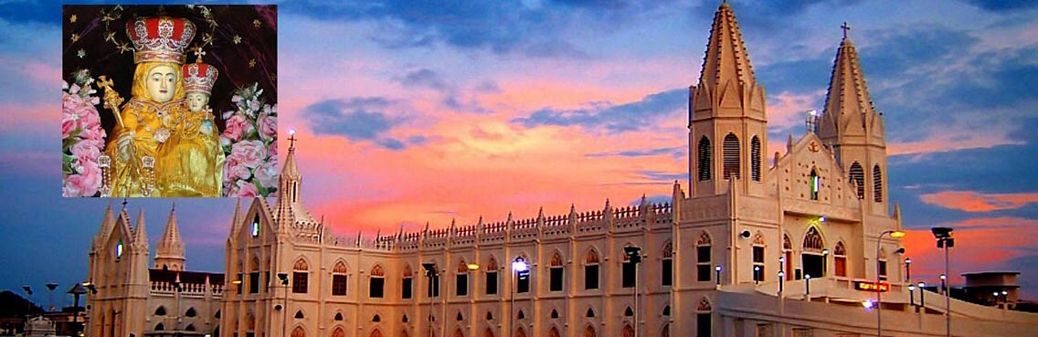
September 8th is now the feast day for Our Lady of Good Health. Every year a procession begins on August 30, and people come from all over India – some walking as much as 200 miles on foot, because of their devotion and sacrifice to Mary. As many as 500,000 pilgrims visit every day during this week long celebration. Ironically, very few are Christians – most are Hindu, Muslim, Parsee, Egyptian, etc. The little church on the beach is now a magnificent basilica with at least eight million visitors every year.
The beautiful Catholic basilica in Vailankanni, India.
After Vatican II, Pope John XXIII officially recognized this pilgrimage site as the “Lourdes of the East” due to the healing waters of the pond. Adjacent to this basilica is a museum of “offerings” left behind by hundreds of pilgrims – often with their personal stories of miraculous healings. There are many shrines around India now, dedicated to Our Lady of Good Health.
The festive lights of the Vailankanni grand church.