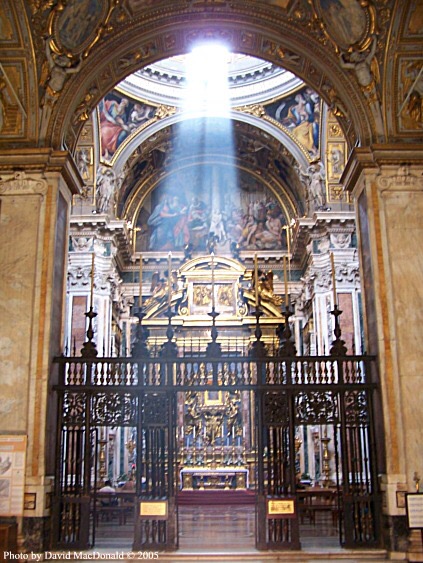
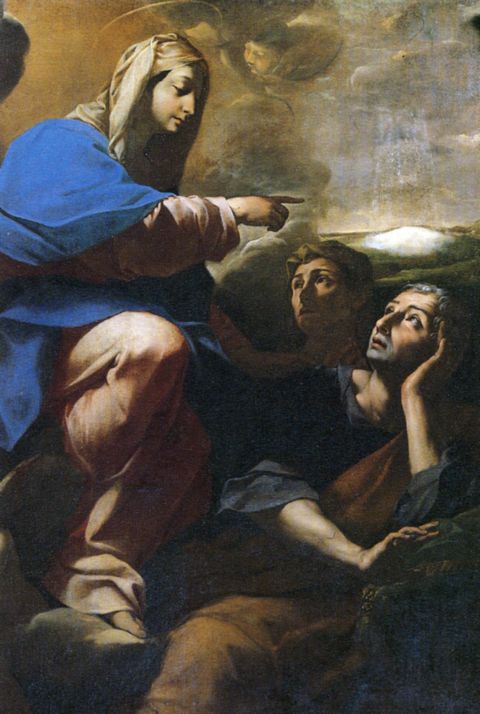
Thierry Schoere was a blacksmith who lived in the village of Orbey. On May 3, 1491, he was on his way to market when he stopped by an oak tree. A fatal accident had occurred at that location, and the family had placed a crucifix on the tree where he had fallen. Getting off his horse, Thierry knelt down to pray for the repose of the victim’s soul.
Suddenly, he was dazzled by a bright light. In the brilliant light he could distinguish the figure of the Blessed Mother dressed in a long white veil. She was holding three ears of corn in her right hand while the other hand held a clump of ice. Without identifying herself, she began to speak,
“Arise, brave man. See these ears? These are the symbols of fine harvests that will reward virtuous and generous people and bring peace and contentment in the homes of faithful Christians. As to the ice, it means hail, frost, flood, famine and all its attendant misery and desolation that will punish disbelievers with the gravity of their sins which tire the Divine Mercy. Go down to the village and announce to all the people the meaning of these prophecies.”
Statue of Our Lady of Three Ears
When the vision disappeared, the blacksmith became terribly frightened, and, upon reaching the village, he said nothing – in disobedience of Our Lady’s wishes. He went inside the market, purchased a sack of wheat, and started to prepare it for placement on his horse.
But the sack of wheat became uncommonly heavy and could not be lifted. Even with the help of others, the sack could not be moved. The villagers wondered if witchcraft was involved! It was then that he remembered the words of the Virgin, and realizing the weight of the sack was a signal to him, he loudly shared the message that had been entrusted to him by Our Lady. Many people heard the message spoken with sincerity and took it to heart, resolving to do better in the future. When he had finished telling of his experience and the message given to him, he easily lifted the sack of wheat and secured it onto his horse, and left for home.
During the summer of that same year, a wooden chapel was built on the site of the apparition. Pilgrims made their way there, and miracles were reported. Eventually, this little church was enlarged with the addition of other buildings. For many years, various religious Orders conducted services for the many pilgrims who came from all parts of the country, especially on May 3, the anniversary of the apparition.
For the 519th anniversary in 2010, special services were held, during which many ears of corn were blessed by several priests. These priests, the Redemptorists, have cared for the shrine since 1911. Four years after the original apparition, in 1495, after careful investigations were conducted, the bishop of Basel authorized worship at the shrine and all demonstrations of faith.
VICENZA, ITALY (1426, 1428) “Madonna of Mount Berico”
There was so much pestilence and sickness between 1404 and 1428 in the region of Vicenza, Italy, that the population declined drastically from death or fleeing the area. In those difficult years, Vincenza Passini (age 70) went up the hill each morning to bring food to her husband who worked in his small vineyard. She led a simple, honest life with a heartfelt devotion to Blessed Mary. She attended church regularly and was mindful of the poor.
Vincenza is stunned by Virgin Mary’s appearance
On March 7, 1426, at 9:00 a.m., Vincenza encountered a beautiful woman on her path up the hill. She had “the likeness of a most beautiful queen with garments more resplendent than the sun, wreathed in a fragrance of a thousand scents.” Overcome by the beauty of the woman, she fell to the ground. The beautiful woman spoke:
“I am the Virgin Mary, the Mother of Christ who died on the Cross for the salvation of men. I beg you to go and say in my name to the people of Vicenza that they must build in this place a church in my honor if they want to recover their health. Otherwise, the plague will not cease.”
Vincenza wept with joy, kneeling in front of the Madonna. But then she asked her,
“But the people will not believe me. And where, O glorious Mother, will we find the money to do these things?”
The Virgin Mary replied,
“You will insist so that my people do my will, otherwise they will never be rid of the plague – and, until they obey, they will see My Son angry with them. As proof of what I say, let them dig here, and from the rock, living water will spring. As soon as the building begins, money will not lack.”
After saying this, Blessed Mary took a twig, and with a graceful movement, traced the Sign of the Cross on the ground. Then she also drew the shape of the church to be built. Finally, she planted the twig in the ground where the high altar of the shrine stands today.
“All those who visit this church with devotion on My feast days and on every first Sunday of the month, will be given an abundance of grace and the Mercy of God and the blessing of My Motherly hands.”
Vincenza immediately obeyed the beautiful woman and began telling everyone that she met. But, she soon realized that nobody believed her! The plague was foremost on everybody’s minds. Even Bishop Pietro Emiliani gave little credence to her story. So, as Mary predicted, the plague raged on. Vincenza resumed her work, performed deeds of charity, and climbed the hill on feast days to pray on the spot where Madonna had appeared.
Our Lady of Mt. Berico
On August 1, 1428, the Virgin Mary appeared again to Vincenza. She repeated her previous warning and recommendation for the health of the people. Because of the horrific conditions of the ongoing plague, the people chose to believe her this time. The Hall of Government decided to build a church on Mount Berico, beginning construction just 24 hours after this last apparition! As soon as the church was completed, the plague disappeared, and the region no longer suffered from it.
The Lady had spoken of water that would spring from a rock at the place where the shrine was to be built. While digging in the ground, “a wonderful and incredible quantity of water welled out like a spring … overflowing like an abundant river that ran down the hill with great noise.”
Virgin’s statue behind altar in church
A beautiful statue of the Madonna of Mount Berico is enthroned in the shrine. It is “an imperious image in marble, painted with skill in various and precious colors.” It depicts the Madonna with an open smile. Her head is framed by curls, and she wears a gold-decorated veil, a gold-colored dress with a greenish, gold-edged mantle. Figures of children, women, and men are huddled beneath the mantle that drapes over the Virgin’s extended arms. She also wears necklaces and a golden crown that was placed there by Cardinal Giuseppe Sarto, the Patriarch of Venice – who later became Pope Pius X.
During the First World War, the city of Vicenza was behind enemy lines. Thoroughly frightened, the people made a solemn vow to the Madonna of Mount Berico, promising that if they and their lands remained safe, they would observe the birthday of the Madonna every year in a special way. She granted their prayers, so every year on September 8, great crowds visit the sanctuary to offer their gratitude. People also honored her wish for devotion on First Sundays of every month, so two large chapels were added to this grand basilica in 1972 along with thirty additional confessionals. The Servants of Mary took possession of the shrine in 1435 and are still ministering to pilgrims today, almost 600 years later.
On his visit on January 11, 1978, Pope Paul VI announced:
“We decree that the Most Blessed Virgin Mary be honored with the name of Madonna of Mount Berico, and that from now on truly be the principal patron, next to God, of the city and diocese of Vicenza.”
On August 22, 2000, Pope John Paul II sent a message to the Patriarch of Venice, recounting his own visit to the Madonna of Mount Berico:
“I, too, had the joy of making a pilgrimage to the Shrine of Mount Berico on 7-8 September, 1991, to ask the Blessed Virgin to bless the people of the area and to show herself to be the tender and provident Mother of those who suffer and those who long for justice and peace.”
MEXICO CITY, MEXICO (1531) “Our Lady of Guadalupe”
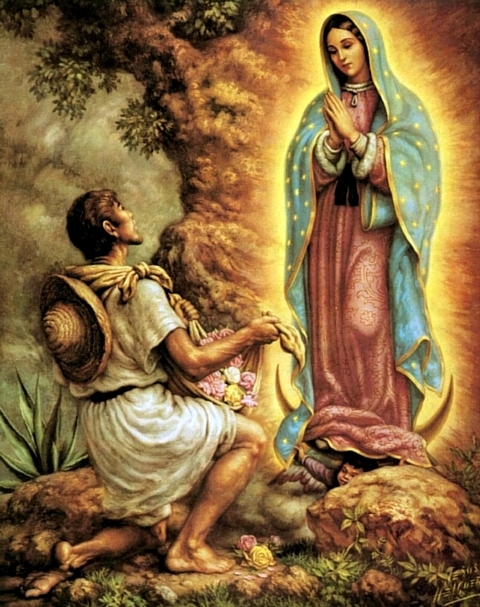
Juan Diego (57) was a farm worker and mat maker who had lost his beloved wife and had only one surviving relative, an uncle, Juan Bernardino. He was one of 15 million Aztec Indians who had new freedoms after the Spanish conquistadors had overrun the ruthless Aztec chieftains. On December 9, 1531, he was traveling his daily route past the hill of Tepeyac when he saw a cloud encircled with a rainbow of colors and heard strange music. A woman’s voice was calling above the music. Ascending the crest of the hill he encountered a strikingly beautiful woman standing there, beckoning to him. She radiated such light and joy that he dropped to his knees and smiled at her in wonderment. The leaves of plants were aglow; the bushes and trees shone like polished gold. She spoke seriously yet lovingly with him:
“You must know and be very certain in your heart, my son, that I am truly the perpetual and perfect Virgin Mary, holy Mother of the true God through whom everything lives,the Creator and Master of Heaven and Earth. I wish and intensely desire that in this place my sanctuary be erected so that in it I may show and make known and give all my love, my compassion, my help, and my protection to the people. I am your merciful Mother, the Mother of all of you who live united in this land, and of all mankind, of all those who love me, of those who cry to me, of those who seek me, of those who have confidence in me. Here I will hear their weeping, their sorrow, and will remedy and alleviate their suffering, necessities, and misfortunes. And so that my intention may be made known, you must go to the house of the bishop of Mexico and tell him that I sent you, and that it is my desire to have a sanctuary built here.”
Virgin Mary appears to Juan Diego
He immediately went at that early hour of dawn to the bishop’s house and was reluctantly received. The bishop, Don Zumarraga, listened respectfully but did not really believe him and told him to return in a few days after he thought about it. Juan Diego could sense his disbelief and became disillusioned when he left. But on the road home, the Lady appeared a second time. He was ashamed and suggested that she get somebody more influential for this job. But she smiled and reassured him that he would be successful. Holding his trembling hands in hers, she said,
“My little son, there are many that I could send to the Bishop. But you are the one whom I have chosen for this assignment. One day all will know my love for you and all my little children. Tomorrow morning you must return to the Bishop and express again my great desire for a church in this place.”
On the next day after Mass, he returned to the bishop’s house but was told to now provide proof that this was indeed the Virgin Mary and that she really wanted a church built on Tepeyac Hill. The bishop sent two servants to secretly follow him but they said he disappeared into thin air before their eyes. Juan Diego had actually entered the mystical realm of Mary as she appeared to him a third time and agreed to give him that desired “proof” on the next day.
“My little son, am I not your Mother? Do not fear. The Bishop shall have his sign. Come back to this place tomorrow. Only peace, my little son.”
He was overjoyed — but that was short-lived as he found his uncle — his only living relative — gravely ill upon returning home. As he could not leave his uncle’s side the next day, he was forced to not show up for Mary to receive the sign of proof she had promised. He felt horrible, but when he did manage to get out on the following day, he took a different route, hoping to not run into her. However, he suddenly ran into her, face-to-face. He begged her forgiveness and told her about his sick uncle. She reassured him with these words:
“Listen and be sure, my dear son, that I will protect you. Do not be frightened or grieved or let your heart be dismayed however great the illness may be that you speak of. Am I not here, I who am your Mother, and is not my help a refuge? Am I not of your kind? Are you not under my shadow and protection? Do not be concerned about your uncle’s illness, for he is not going to die. Be assured, he is already well. Is there anything else you need?”
Miraculous roses growing in Winter
She directed him to climb to the top of the barren Tepeyac Hill where he would find roses growing miraculously among the thistles and thornbush in the winter. There was a lush abundance of every color of rose. He picked them and carried them to the Blessed Mother, and she arranged them in his cloak, which he then folded shut for his journey to the bishop’s house.
“My little son, this is the sign I am sending to the Bishop. Tell him that with this sign I request his greatest efforts to complete the church I desire in this place. Show these flowers to no one else but the Bishop. You are my trusted Ambassador. This time the Bishop will believe all that you tell him.”
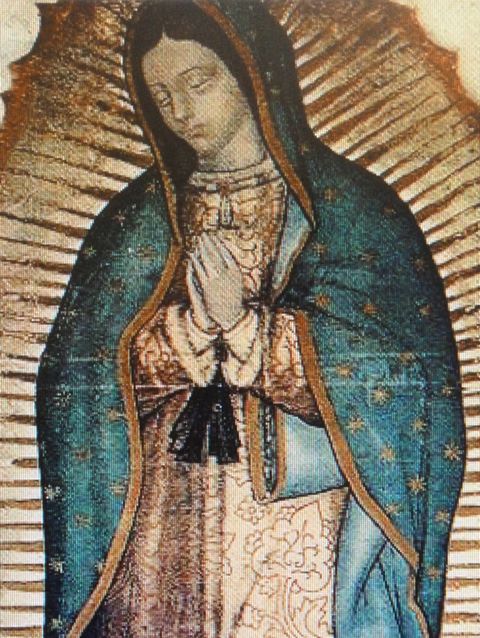
This was the fourth and last time he would see her. The bishop was actually eager to see what miracle had been brought to him, but not even Juan Diego was prepared for what was about to happen. As he unfolded his cloak to dump the multi-colored winter roses before the bishop, they were all stunned to see a beautiful image of the Virgin Mary imprinted on the rough cactus fiber of his cloak! The bishop fell to his knees in reverence and from that moment forth, all worshipped and adored this treasure.
When Juan Diego returned home, he found his uncle completely healed and telling of a visit that he had had with the Virgin Mary. She told of a temple that would be built on Tepeyac Hill and that her image should be called “Our Lady of Guadalupe” — although the uncle did not know yet what image she was talking about.
Ordinarily, the cloth of Juan Diego’s tilma or cloak should have deteriorated in twenty to thirty years. It is made from the maguey cactus plant and is something like burlap, rough and lattice-like. The material is called ayate and is ill-suited for use as a canvas for painting. It is actually made up of two pieces sewn together lengthwise and held together by a single cotton thread. An effort to make a replica of the cloth and image to test its true durability failed miserably — as it deteriorated badly within 15 years. The original cloth and image will be nearly 500 years old soon! And the image is as fresh as ever.
Cloak reveals miraculous image
The Indians in Mexico saw something in the image of Our Lady that the Spaniards did not comprehend. In that period, the Indians did their writing in hieroglyphics, so to them the image was a “hieroglyphic letter.” The fact that the natives “read” the picture is most important in understanding the purpose of Our Lady’s apparition. To the Indians, the image depicted a beautiful Lady standing in front of the sun – a sign to them that she was greater than the sun god (Huitzilopochtli), whom they worshipped. The crescent beneath her feet showed that their moon god (Tezcatlipoca) was less than nothing since she was standing on it. The Indians noted that the Lady was not of this world, for a young child with wings was holding her aloft with his two arms. At her throat was a brooch with a small black cross in the center, reminding them that this was the emblem of the Spanish Friars – and there was One greater than she. The “reading” of this sacred image brought whole tribes from all over Mexico, led by their chiefs and rulers, to be received into the Faith. The significance of her words, the meaning of her garments, and her whole appearance on Juan Diego’s tilma were perfectly clear to the Indians. And so it happened that the worship of pagan idols was overcome.
The Spaniards were quick to notice that Our Lady was the woman of the Apocalypse – “clothed in the sun and the moon under her feet.” The Spanish word “Guadalupe” is similar in sound to Aztec words meaning “she who will crush the serpent.” “Coatl” means snake; “llope” means tread on – or “Who treads on the snake.”
Miguel Cabrera, a famous Mexican artist, was commissioned along with six other artists to examine it in 1750. After a very careful examination in great detail, they concluded that it had been created in a “miraculous” fashion – not by any human artist!
Original 1531 image on cloak today
In 1754, Pope Benedict XIV wrote,
“In it everything is miraculous: an Image emanating from flowers gathered on completely barren soil on which only prickly shrubs can grow; an Image entrusted to a fabric so thin that through it the nave and the people can be seen as easily as through a trellis; an Image in no matter deteriorated, neither in her supreme loveliness, nor in its sparkling colors, by the niter or the neighboring lake, which however, corrodes silver, gold, and brass … God has not done likewise to any other nation.”
For the first 116 years, it was unprotected by glass. People freely kissed it, rubbed it, and touched objects to it. In 1753 it was removed from its glass protection for just two hours. But at least 500 people filed by and touched the frail cloth with many objects like sharp-edged crosses, medals, swords, and rosaries – yet no harm came to it.
In November of 1921, a bomb was secretly planted in a bouquet of flowers that was placed on the altar – just beneath the divine image hanging above it. The bomb exploded with such force that it blew out windows in the old Basilica, shattered the marble altar, and twisted a large bronze crucifix. Yet, the image of Our Lady and the glass enclosing this sacred treasure were completely unharmed and safe – despite its location right above the bomb.
Father James Meehan and Dr. Charles Wahlig examined the sacred image in 1975. They reported that the image does not impregnate the threads of the cloth, but lies on top – something like the emulsion of a photographic print. They state, “The picture defies human explanation. Its artistic source is outside human capabilities. It is a miracle.”
In 1979 — 448 years later — Dr. Philip Callahan, an infrared specialist and biophysicist, scientifically analyzed the Guadalupe image. He found the pigments to be authentic for that period in time but amazingly well preserved, whereas later added embellishments were fading, cracking, and deteriorating while the original image appears to have never aged at all. There were no preliminary sketched lines underneath the painting as could be expected in a hoax. Careful examination with a magnifying glass revealed NO brush marks and no deterioration or cracks in the coloring material.
His greatest discovery came with the enlarged photos of her eyes, revealing the reflection of a man’s image — that resembling the image of Juan Diego! An esteemed opthalmologist, Dr. Javier Torella-Bueno, noted that this image is located and distorted in the precise position that such a real reflection would have occurred on the curvature of an eyeball. Dr. Rafael Torija-Lavoignet adds,
“It is impossible to attribute to chance, to a textile accident or the pictorial matter this extraordinary coincidence between the localization of the reflections in the Virgin’s eyes and the most elaborate and up-to-date laws of optical physiology…”
Over the years, many healing miracles have been documented regarding those who came before her image. The image has also been observed to have been weeping tears.
Pope John Paul II beatified Juan Diego in 1990 and raised him to sainthood in 2002. The great Basilica of Mexico City was built on Tepeyac Hill and houses the divine image today. Our Lady of Guadalupe inspired over nine million conversions in Mexico!
Just north of Genoa, Italy, is a tall mountain named Mount Figogna. Numerous church buildings exist on top of this mountain whose history involves a peasant named Benedict Pareto. On August 29, 1490, Benedict was grazing his flock on the mountain when his attention was drawn to a brilliant movement of light. Within this heavenly glow was the image of a woman holding a child on her arm. Although he did not know who she was, he felt compelled to kneel as she approached him. Standing before him, the “beautiful lady” assured him with these words:
“Do not be afraid. I am the Queen of Heaven and have come to you with My Divine Son for this reason: You are to arrange for a church to be built on this spot, to be dedicated in My name.”
Poor Benedict protested that he had no money with which to build a church. But the Lady calmed his confusion with these words:
“Trust me, Benedict. The money will not be lacking. Only your good will is needed. With My aid, all will be easy.”
Then Benedict watched as the apparition slowly faded. After he recovered from the sweetness and beauty of the apparition, he felt a great urgency to tell others. He ran back down the hill toward his home and met his wife on the way. But she mocked him, disbelieving, and said that he must be suffering from sunstroke. He continued running, excitedly, down the mountain path to tell the parish priest. The priest and Benedict’s neighbors were all skeptical upon hearing his story.
The following day, Benedict climbed a fig tree to pick fruit, but the branch to which he was clinging snapped off, and he fell. Friends carried him home where it was learned that he had broken a number of bones and suffered severe internal injuries. Due to his serious condition, he was given the Last Sacraments or Last Rites by the priest. Now he feared that he would be unable to spread Our Lady’s request to the proper individuals. Grieving these circumstances, he promised that if the Blessed Virgin would help save his life, he would make certain that the church would be built.
Notre Dame De La Garde Statue
Blessed Mary appeared to him again and repeated her request for a church to be built at the place of her first appearance on the mountain. She scolded him for his lack of faith and indicated that his fall from the tree was punishment for allowing his wife to persuade him that his vision had only been an illusion. Our Lady stretched out her hand towards him and then vanished. When she left, he was instantly cured!
When his neighbors, who knew the severity of his injuries, observed his immediate cure, they replaced their doubts and skepticism with wholehearted belief. With approval from the priest, they began collecting money for the building of a small chapel on Mount Figogna. The church became popular so quickly that it had to be extended — and by 1530 it needed to be completely replaced by a bigger church.
In 1582 the shrine was visited by the Bishop of Novarra, who gave his approval for the apparitions, commended the people for their piety – and especially praised the high altar and the image of the Blessed Virgin carved on it. In 1604 a commission of inquiry into the apparitions was opened by the Archbishop of Genoa. The shrine was again authenticated and given the name Madonna della Guardia – Our Lady of the Guard-post. The Confraternity of Our Lady of the Rosary was established there in 1598. In 1614 a Company of the Glorious Virgin of Carmel was founded.
Of all the miracles attributed to Our Lady of the Guard, the most famous is that which took place in 1625. Charles Emmanuel, Duke of Savoy, marched on Genoa with an army of 14,000 men. Knowing that they were outnumbered, a saintly Capuchin lay brother, Fra Tomaso da Trebbiano, urged the people to pray to Our Lady of the Guard for protection. The next day, when Charles’s huge army marched confidently towards the city, it was repulsed by a few hundred, poorly-armed, local peasants who had been sent into battle with religious fervor and the blessing of their priest. It was seen as a miracle!
In gratitude, the people erected a bell tower at the shrine. On the Feast of the Assumption in 1632, a marble statue of the Blessed Virgin was set up over the high altar in the chapel that marked the location of the first apparition. In 1654 this became the first Marian shrine to institute the ritual of the Solemn Coronation of Our Lady – a joyful celebration in which thousands of pilgrims climbed to the top of the hill, sang and prayed as the crown was placed on the head of the marble statue.
Madonna della Guardia
Many miraculous cures associated with Our Lady della Guardia have been officially authenticated. In 1727, for example, Father Giuseppe Maria Sabelli was dying of tuberculosis. He was half paralyzed and highly feverish when he heard Our Lady call out to him with these words,
“Come to me at della Guardia and I will restore you.”
On July 26, 1727, the Feast of St. Anne, his friends carried him up the mountain and laid him in the church to receive the Blessed Sacrament. As he lay there, he heard a melodious voice call to him,
“Stand up! I am the physician who has healed you. Let everyone know you are well again.”
Father Giuseppe stood up, and everyone saw that he was completely cured!
A second statue is found on the wayside chapel of St. Pantaleon on the mountainside. A third and wooden statue is found in the church on Mount Figogna. In 1894, Pope Leo XIII commanded that a formal coronation of that statue take place. The basilica of della Guardia was built in 1923; the greatest day in its calendar is August 29 when there are colorful celebrations and torch-lit processions at night to commemorate Benedict Pareto’s original encounter. The walls of the church are inlaid with marble with the perpetually-lit, crowned, marble statue of Mary in its niche near the high altar. Six popes from Clement XVI to Benedict XVI have honored the shrine in various ways.
AYLESFORD, ENGLAND (1251, 1322) “Our Lady of Mt. Carmel”
For the noble task of giving us Her Scapular, Mary selected the great Carmelite Order of contemplative religious, whose sacred tradition of devotion to Her goes back to the Old Testament Prophet Elias – and to the holy Mount Carmel on which he and his followers dwelt, by the sea, not far from Mary’s home in Nazareth. In the Bible, the third book of Kings describes a terrible drought afflicting Palestine. On Mount Carmel, Elias prayed seven times for rain, and finally “a little cloud arose out of the seas the heavens grew dark with clouds and wind, and there fell a great rain and the hand of the Lord was upon Elias.” Elias was also shown a mystical vision – a prophetic vision of the Virgin who was destined to give to the world the Messiah, who would save men from the drought of sin. Elias therefore instructed his disciples to pray for the coming of this Virgin Mother. During her life, Mary did visit this holy mountain. Our Lord has called the Carmelites “The Order of My Mother.”
Even as a child, Simon Stock had an unusually intense devotion to Mary. While still in his teens, he became a hermit and lived in the hollow trunk of a great tree. A small dog used to bring him crusts of bread. Simon would compose poems to Mary and carve her name on trees. He would make pilgrimages to shrines of Our Lady. Often she appeared to him in visions, guiding and advising him. On one occasion, the Blessed Virgin revealed to him that some holy hermits would come from Mt. Carmel in a few years, and that he should join their Order, which was especially dedicated to Her service.
Our Lady of Mt. Carmel
St. Simon Stock became ordained as a priest at age forty. Having met some of the Brothers of Carmel, he lived their strict penitential lifestyle for several years. He left his homeland of England for the Holy Land, but he returned when Muslims invaded. Upon his return, he joined the Carmelite Order and was eventually elected Prior General. He found the task of organizing a group of contemplative hermits into an order of friars in Europe almost beyond his capacities. When disruption and ruin threatened his beloved Order in the summer of 1251, the aged St. Simon withdrew to his monastic cell. He appealed to the patroness of the Order, Our Lady of Mount Carmel, on July 16, 1251, with this prayer that is still recited frequently by members of the Order:
“Flower of Carmel, Blossom-laden Vine, Splendor of Heaven, Mother Divine, none like to thee, peerless and fair, to Thy Children of Carmel, grant favors, O Star of the Sea.”
Suddenly, a great flood of supernatural light filled his cell. In the company of many bright angels, the Blessed Virgin appeared with the Child Jesus on her arm, living and moving in dazzling splendor. She presented the Brown Scapular to him with this promise:
“Receive, my beloved son, this habit of thy Order. This shall be the privilege for you and for all Carmelites — that whoever dies piously wearing this scapular, shall not suffer eternal flames.”
As Blessed Mary and the Child Jesus vanished, the Saint was filled with joy and gratitude on seeing himself clothed in the Scapular which Our Lady had just given him. He thanked her profusely for this garment of grace and her marvelous promise. He hastened to assemble his brethren and tell them what had happened. The scapular consisted of two lengths of fabric, joined at the shoulders, with a hole in the center for the head, so that the scapular lies front and back. With this recognition given by the Queen of Heaven, this Scapular or monastic apron became a permanent and much respected addition to the Carmelite habit. A smaller form of this exists today and is more familiar to Catholics as two small panels of cloth joined by string and worn over the shoulders. The Church considers the Scapular a miniature religious habit and a highly indulgenced sacramental.
After this apparition, and after numerous appeals for protection against the Order’s antagonists, Pope Innocent IV sent a letter of protection that secured the Order from the problems they encountered. The King of England also issued letters of protection and favor for the Carmelite Order. The Scapular was also officially adopted as the regular habit of the White Friars.
Some years later, when St. Peter Thomas was engaged with important missions of the papal court, Our Lady of Mount Carmel again favored Her Order. Concerned about the Order, he heard these words:
“Have confidence, Peter, for the Carmelite Order will last until the end of the world. Elijah, its founder, obtained it a long time ago from My Son.”
Many were attracted to this Order during the fourteenth century and became members by way of confraternities. They then participated in the graces, benefits, and observances of the Order, and were properly enrolled in the Third Order.
On March 3, 1322, another apparition occurred – this time to Pope John XXII. Now known as the Sabbatine Privilege, Our Lady revealed,
“I, the Mother of Grace, shall descend into Purgatory on the Saturday after their death and whomsoever I shall find in Purgatory, I shall free.”
St. Robert Bellarmine explains the promise to mean “that anyone dying in Mary’s family will receive from Her, at the hour of death, either grace of perseverance in the state of grace or the grace of final contrition.” On learning of this vision, Pope Benedict XV encouraged all to wear this “common armor which enjoys the singular privilege of protection – even after death.”
Sixteen popes have given their approval to this Privilege, including Pope Paul V, who issued a decree on its behalf. Many saints have also added their approval.
Six hundred years after the apparition with Pope John XXII in which the Sabbatine Privilege was revealed, Pope Pius XI observed the occasion by writing in 1922:
“It surely ought to be sufficient to merely exhort all the members of the confraternities and third orders to persevere in the holy exercises which have been prescribed for the gaining of indulgences to which they are entitled and particularly for the gaining of the indulgence which is the principal and the greatest of them all, namely, that called the Sabbatine.”
Many saints have spoken highly of the Scapular, including St. Alphonsus Liguori and St. Claude de la Colombiere, who announced:
“I aver without a moment’s hesitation that the Scapular is the most favored of all.”
It is regarded as the most indulgenced of all sacramentals. It is of interest to realize that the scapulars of St. Alphonsus and St. John Bosco were found intact during their exhumations and are still preserved in reliquaries today. Pope Saint John Paul II joined the Third Order of Mount Carmel as a young man and always wore the scapular – even when in the hospital after the attempt on his life. Pope John Paul II said,
“Through the Scapular, those devoted to Our Lady of Mount Carmel express their desire to mold their existence on the example of our Mother, Patroness, Sister, Most Pure Virgin, to accept God’s word with a purified heart and devote themselves to the zealous service of others.”
We wear Our Lady’s Scapular as a loving “yes” to her desire that we keep Jesus as the center of our lives and bring Him to others. At the First Communion, we usually add a “new cloak” – that of Our Lady’s Brown Scapular. The beautiful custom of enrolling children in the Scapular puts them, in their innocence, under the tender care of their Heavenly Mother. Mary wants to draw all of humanity under her protecting and sanctifying mantle by means of her Brown Scapular. She has solemnly promised us that if we sincerely fulfill the conditions of this beautiful devotion, we shall not only be saved, but she will see to it that we do not remain long in Purgatory before joining her in Heaven!
Pope Pius X concluded, “Can anyone fail to see that there is no more direct or surer way than Mary to unite all mankind in Christ?” And the Catholic Encyclopedia states, “Like the Rosary, this Scapular has become the badge of the devout Catholic and the true servant of Blessed Mary.”
SPAIN / SOUTHERN FRANCE 1214 “The Birth of the Rosary”
Found in the very well-known book, De Dignitate Psalterii, by Blessed Alan de la Roche, is the account of how Saint Dominic acquired the Rosary in the year 1214. St. Dominic, seeing that the gravity of people’s sins was hindering the conversion of the Albigensians, withdrew into a forest near Toulouse, where he prayed continuously for three days and three nights. During this time he did nothing but weep and do harsh penances in order to appease the anger of God. He used his discipline so much that his body became lacerated, and, finally, he fell into a coma. Our Lady appeared to him, accompanied by three angels, and said,
“Dear Dominic, do you know which weapon the Blessed Trinity wants to use to reform the world?”
“Oh, My Lady,” answered Saint Dominic, “you know far better than I do, because next to your Son Jesus Christ you have always been the chief instrument of our salvation.”
Our Lady replied, “I want you to know that, in this kind of warfare, the principal weapon has always been the Angelic Psalter, which is the foundation-stone of the New Testament. Therefore, if you want to reach these hardened souls and win them over to God, preach my Psalter.”
So he arose, comforted, and burning with zeal for the conversion of the people in that district, he made straight for the cathedral. At once, unseen angels rang the bells to gather the people together, and Saint Dominic began to preach. At the very beginning of his sermon, an appalling storm broke out, the earth shook, the sun was darkened, and there was so much thunder and lightning that all were very much afraid. Even greater was their fear when, looking at a picture of our Lady positioned in a prominent place, they saw her raise her arms to heaven three times to call down God’s vengeance upon them if they failed to be converted, to amend their lives, and seek the protection of the Holy Mother of God. God wished, by means of these supernatural phenomena, to spread the new devotion of the holy Rosary and to make it more widely known.
Saint Dominic and the Rosary
At last, at the prayer of Saint Dominic, the storm came to an end, and he went on preaching. So fervently and compellingly did he explain the importance and value of the Rosary that almost all the people of Toulouse embraced it and renounced their false beliefs. In a very short time a great improvement was seen in the town; people began leading Christian lives and gave up their former bad habits.
Inspired by the Holy Spirit, instructed by the Blessed Virgin — as well as by his own experience, Saint Dominic preached the Rosary for the rest of his life. He preached it by his example as well as by his sermons, in cities and in rural places, to people of high station and low, before scholars and the uneducated, to Catholics and to heretics. The Rosary, which he said every day, was his preparation for every sermon and his little tryst with our Lady immediately after preaching.
One day he had to preach at Notre Dame in Paris on the Feast of St. John the Evangelist. He was in a little chapel behind the high altar, prayerfully preparing his sermon by saying the Rosary as he always did, when Our Lady appeared to him and said,
“Dominic, even though what you have planned to say may be very good, I am bringing you a much better sermon.”
Saint Dominic took in his hands the book Our Lady offered, read the sermon carefully and, when he had understood it and meditated on it, he gave thanks to Her. When the time came, he went up into the pulpit and, in spite of the feast day, made no mention of Saint John other than to say that he had been found worthy to be the guardian of the Queen of Heaven. The congregation was made up of theologians and other eminent people, who were used to hearing unusual and polished discourses; but Saint Dominic told them that it was not his desire to give them a learned discourse, wise in the eyes of the world, but that he would speak in the simplicity of the Holy Spirit and with his forcefulness. So he began preaching the Rosary and explained the Hail Mary word by word as he would to a group of children, and used the very simple illustrations which were in the book given him by Our Lady.
St. Dominic and the Virgin
Blessed Alan, according to Carthagena, mentioned several other occasions when Our Lord and Our Lady appeared to Saint Dominic to urge him and inspire him to preach the Rosary more and more in order to wipe out sin and convert sinners and heretics. In another passage, Our Lady revealed that after she had appeared to Saint Dominic, Her blessed Son appeared to him also and said,
“Dominic, I rejoice to see that you are not relying on your own wisdom and that, rather than seek the empty praise of men, you are working with great humility for the salvation of souls. But many priests want to preach thunderously against the worst kinds of sin at the very outset, failing to realize that before a sick person is given bitter medicine, he needs to be prepared by being put into the right frame of mind to really benefit by it. That is why, before doing anything else, priests should try to kindle a love of prayer in people’s hearts and especially a love of my Angelic Psalter. If only they would all start saying it and would really persevere, God in his mercy could hardly refuse to give them his grace. So I want you to preach My Rosary.”
All things, even the holiest, are subject to change, especially when they are dependent on man’s free will. It is hardly to be wondered at, then, that the Confraternity of the Holy Rosary only retained its first fervour for a century after it was instituted by Saint Dominic. After this it was like a thing buried and forgotten. Doubtless, too, the wicked scheming and jealousy of the devil were largely responsible for getting people to neglect the Rosary, and thus block the flow of God’s grace which it had drawn upon the world.
Carlow Cathedral, St. Dominic
Thus, in 1349, God punished the whole of Europe with the most terrible plague that had ever been known. Starting in the east, it spread throughout Italy, Germany, France, Poland and Hungary, bringing desolation wherever it went, for out of a hundred men hardly one lived to tell the tale. Big cities, towns, villages and monasteries were almost completely deserted during the three years that the epidemic lasted. This scourge of God was quickly followed by two others: the heresy of the Flagellants and a tragic schism in 1376.
Later, when these trials were over, thanks to the Mercy of God, Our Lady told Blessed Alan to revive the former Confraternity of the Holy Rosary. Blessed Alan was one of the Dominican Fathers at the monastery at Dinan, in Brittany. He was an eminent theologian and a famous preacher. Our Lady chose him because, since the Confraternity had originally been started in that province, it was fitting that a Dominican from the same province should have the honor of re-establishing it.
Blessed Alan began this great work in 1460, after a special warning from our Lord. This is how he received that urgent message, as he himself tells it. One day, when he was offering Mass, Our Lord, who wished to spur him on to preach the Holy Rosary, spoke to him in the Sacred Host:
“How can you crucify Me again so soon?”
“What did you say, Lord?” (Alan was horrified)
“You crucified Me once before by your sins, and I would willingly be crucified again rather than have My Father offended by the sins you used to commit. You are crucifying Me again now because you have all the learning and understanding that you need to preach My Mother’s Rosary, and you are not doing it. If you only did that, you could teach many souls the right path and lead them away from sin. But you are not doing it, and so you, yourself, are guilty of the sins that they commit.”
This terrible reproach made Blessed Alan solemnly resolve to preach the Rosary unceasingly. To inspire him to preach the Rosary more, Our Lady said to him one day,
“You were a great sinner in your youth, but I obtained the grace of your conversion from My Son. Had such a thing been possible, I would have liked to have gone through all kinds of suffering to save you, because converted sinners are a glory to me. And I would have done that also to make you worthy of preaching my Rosary far and wide.”
Ever since Blessed Alan de la Roche re-established this devotion in 1460, the voice of the people, which is the voice of God, gave it the name of the Rosary, which means “crown of roses.” That is to say that every time people say the Rosary devoutly they place on the heads of Jesus and Mary 153 white roses and sixteen red roses. Being heavenly flowers, these roses will never fade or lose their beauty.
St. Dominic
Our Lady has approved and confirmed this name of the Rosary; she has revealed to several people that each time they say a Hail Mary they are giving her a beautiful rose, and that each complete Rosary makes her a crown of roses. So the complete Rosary is a large crown of roses and each chaplet of five decades is a little wreath of flowers or a little crown of heavenly roses which we place on the heads of Jesus and Mary. The rose is the queen of flowers; the Rosary is the rose or “queen” of devotions, thus becoming the most important one.
In a small village in North Norfolk, England, in 1061, lived a devout young widow, Richeldis de Faverches, Lady of the Manor of Walsingham. Our Lady appeared to her three times in a vision, and each time showed her the house in which the Holy Family had dwelt in Nazareth. Mary led Richeldis “in spirit” to Nazareth to show her the place where the Archangel Gabriel had greeted her, and directed the widow to take measurements of the house so that she could build one like it at Walsingham. In this spot, the Virgin Mary explained, the people would celebrate the Annunciation, “the root of mankind’s gracious redemption.”
“Do all this unto my special praise and honor. And all who are in any way distressed or in need, let them seek me here in that little house you have made at Walsingham. To all that seek me there shall be given succor. And there at Walsingham in this little house shall be held in remembrance the great joy of my salutation when Saint Gabriel told me I should through humility become the Mother of God’s Son.”
Three times Richeldis experienced this vision and request. This confirmed her desire to have the replica constructed, but the directions about the exact location were unclear to her and the carpenters. Richeldis gave instructions for the building to commence but nothing seemed to go right.
When the carpenters could make no progress in building, Richeldis found it difficult to go to sleep. She spent the night in prayer, asking for guidance. There was an energy in the air that “made the night seem almost alive.” She heard singing that seemed “not of this world” and went out into her garden to investigate. She noted that the “heavenly singing” was coming from the direction of the unfinished construction. As she approached the site she was amazed to see that the little house had been completed – but had been moved about two hundred yards from the site of the original construction! She then saw what appeared to be angels leaving the now completed house. When the carpenters returned to the site, they, too, reported hearing strange sounds and were amazed to see that the house had been moved and completed. They pronounced the craftsmanship of the completed construction to be far superior to their own.
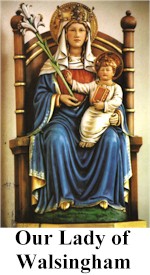
Our Lady of Walsingham
The Holy House had been miraculously built, and very soon pilgrims began to arrive.
During the Middle Ages, Walsingham became one of the greatest pilgrimage sites in all of Europe. It became widely known as “England’s Nazareth.” A church was constructed around the house to protect it from the elements. All walks of life came there – peasant, king, rich and poor. At the Holy House, all were equal. From the time of Henry III in 1226 almost every king and queen of England as well as Queen Isabella of France and King Robert Bruce of Scotland visited the shrine. For almost 500 years, Walsingham continued to draw thousands. Many miracles were attributed to Our Lady of Walsingham, including one in which King Edward I was saved from a piece of falling masonry.
In the early 1500’s, Henry VIII visited the Holy House of Walsingham more than once as a pilgrim. On one such occasion he walked barefoot twice the usual distance traversed by penitents. But Henry’s ways changed as the years passed. In an effort to be rid of one of his wives, Queen Catherine, and marry another, the king broke with the Pope and had himself declared by his parliament to be head of the English Church. Then, in 1538, in order to move against all religious orders in his domain, Henry confiscated and burned to the ground the Holy House of Our Lady of Walsingham. Only a portion of the massive east wall is visible today.
A wealthy Anglican woman, Charlotte Boyd, bought and restored it in 1863. In 1864, Pope Leo XIII re-founded the ancient shrine of Our Lady of Walsingham, and pilgrimages were permitted to resume. In 1954, the image of Our Lady of Walsingham was solemnly crowned at the direction of Pope Pius XII.
A chapel devoted to Saint Catherine of Alexandria, about a mile before the shrine, became nicknamed the “Slipper Chapel” because visitors would leave their footwear there, out of respect, and walk the last mile barefoot or in slippers.
The Slipper Chapel
Our Lady of Walsingham is also known as “The Virgin by the Sea.” The medieval ballad told that she helps mariners in distress. The Anglican pilgrim hostel displays the name “Stella Maris” or “Star of the Sea,” one of Mary’s more ancient titles. Just a few miles from the Norfolk coast, Walsingham is a sanctuary of prayer and healing, a metaphor of salvation from storm and shipwreck, offering calm waters and safe harbor for all in trouble.
A wealthy aristocrat and devout Christian known by tradition as John lived in Rome with his wife in the fourth century. They had no children and feared that lack of an heir would end their family’s long prominence in the government of the city. They had often prayed for a child but without success. One day John’s wife said, “Let’s pray to the Blessed Virgin to nominate an heir.”
In August of that year, John had a dream that the Virgin Mary wanted a church built in her honor in Rome. He was told that they would know where to build it because snow would fall on that spot. Amazingly, Pope Liberius had the same dream on the same night. Despite it being a very hot summer in Rome, snow fell the next day on Mount Esquiline, one of the famous Seven Hills. However, it fell into a precise rectangular pattern – as if outlining the boundaries of the church Mary desired to have built.
When Pope Liberius showed up on Mount Esquiline to witness the miraculous snowfall, he found John and his wife already there, kneeling in prayer to the Virgin. People crowded to see the rectangular patch of snow, which would not melt despite the hot summer heat of August. John was convinced that its shape and size indicated that a church should be built on that precise spot. As soon as the plot for the building had been staked out, the snow melted.
Basilica of St. Mary Major
John met the costs of building this church, which was completed in 354 A.D. It was dedicated as the Basilica Liberiana after Pope Liberius. Seventy years later, it was rebuilt on a grander scale by Pope Sixtus III, who added decorations and ornaments of silver. It was renamed the Basilica Sixti at that time. Today, it is called the Church of Santa Maria Maggiore (St. Mary Major) and is one of the largest basilicas in the world. They celebrate the Miracle of the Snow every year on August 5th.
Pope Liberius provided a special painting of Madonna and Child from St. Helen, mother of Emperor Constantine, to be housed in this new basilica. Many miracles are attributed to this wonderful painting. When Gregory I was Pope (590-604 A.D.), Rome was ravaged by a plague. Pope Gregory carried the image of the Holy Mother in a procession from the basilica as far as Hadrian’s Mausoleum. When the procession arrived, they heard an invisible heavenly choir singing Regina Coeli. When the Pope asked the Virgin to pray for the city, he saw an apparition of St. Michael replacing the sword of vengeance into its scabbard. And the plague ended.
Basilica of St. Mary Major, side altar
The magnificent Basilica of St. Mary Major, still stands today as the seat of devotion to Our Lady of the Snows. Father Paul Schulte, of the Missionary Oblates of Mary Immaculate, introduced a shrine in her honor in the Midwest in 1941, which stands today in Belleville, Illinois.
Close-up analysis of Zeitoun photo of Virgin Mary on top of church in Egypt, 1968. Note tips of her crown.
Rare photo of Communion Host miraculously appearing on Garabandal visionary Conchita’s tongue with large crowd watching closely in Spain, 1960’s.
Saint Bernadette Soubirous of Lourdes, France — today after her death in 1879. Her body is not preserved by any man-made effort; it will not decay naturally.
Saint Vincent de Paul, another body that will not decay naturally ever since 1660.
Saint Padre Pio of Italy — another incorrupt body that will not decay since his death in 1968.
Shroud of Turin — another inexplicable and miraculous image, allegedly of Jesus Christ and validated by many scientific tests.
Our Lady of Guadalupe miraculous image formed on cactus cloth (1531) like a photo lying on top of the threads!
Our Lady of Las Lajas: cave wall image miraculously formed in 1754 from the natural color of the rock changing to this image in Guaitara Canyon, Colombia, South America.
Close-up of miraculous image in Guaitara Canyon, Colombia. Colors of cave wall rock changed after appearance of Virgin Mary.
Beautiful church built out from miraculous cave wall image in Guaitara Canyon, Colombia.
Pillar of jasper left behind by Virgin Mary with St. James in 40 A.D., Zaragoza, Spain.
Our Lady of Ocotlan, Mexico 1541: statue of Mary miraculously discovered inside an Ocote tree near Tlaxcala.