“Our Lady of St. Bauzille-de-la-Sylve”
HERAULT, FRANCE (1873)
Auguste Arnaud, age 30, was a regular participant in Holy Mass on Sundays. He was a father of two, having been married for six years, and a respected member in his community. And he worked on Sundays.
On Sunday, June 8, 1873, the Feast of the Holy Trinity, he attended Holy Mass and then went to work in his vineyard to tend the vines. After working for two hours, Auguste sat down to rest, eat his packed lunch, and smoke his pipe. Suddenly, he saw before him a beautiful young woman dressed in white. She wore a white veil that reached to her feet. She had a fringed belt and a tall crown. He jumped to his feet and asked, “Who are you?”
“I am the Blessed Virgin. Do not be afraid.”
Auguste was reassured by her words and listened with great emotion as she continued,
“You have the disease of the vine. You left St. Bauzille. We must celebrate his feast on the day it falls. Next Thursday you must go in procession to St. Anthony and hear Mass. In a fortnight you must go in procession to Notre Dame, to the Canton of Gignac, Montpellier, and the city of Lodeve. You must place a cross here, changing it later to another. Come in procession each year. Go tell your father and your pastor all of this. In a month I will come to thank you.”
At that, Blessed Mary rose vertically into the air and gradually disappeared. Auguste left the vineyard immediately for home, where he excitedly told his father what he had seen. When they went together to tell the village priest, the priest met their remarks with coldness and skepticism. He found it hard to believe that the Virgin Mary would make that effort just to tell one man not to work on Sundays.
But Auguste remained inspired to perform his mission given to him by the beautiful Lady. He had a carpenter build a wooden cross which he then placed in the vineyard where Mary had indicated. It was just a temporary one as the Virgin had asked for a wrought iron version with her image in the middle in his next effort.
On June 12, he and his family visited the chapel of St. Anthony. On June 22, he made it to Our Lady of Grace in Gignac. He made it to all the places that she had requested. On July 4, he finally replaced the wooden cross with the wrought iron one and set it on a stone pedestal.
Believers, skeptics, and the curious all gathered on July 8, 1873, in his vineyard for the predicted second appearance of Mary. Auguste’s wife worried about what might happen if the Virgin failed to appear and this crowd of five hundred would become disappointed and perhaps angry. But Auguste had plenty of faith and no fear at all.
After a few minutes, Auguste removed his hat and raised both arms high in the air. He seemed transfixed by what he was able to see, while everybody else saw nothing. With his arms still raised, he was suddenly carried with uncommon speed by some invisible force to the cross about forty yards away. He prayed silently while gazing at the Blessed Virgin, dressed now in gold and holding a rosary in her right hand. In a sweet voice:
“Do not work on Sundays. Blessed is he who believes and unhappy the man who does not believe. You must go to Our Lady of Gignac in procession with your whole family.”
She slipped the rosary to her left hand and, raising her right hand high, she blessed Auguste and the whole crowd. Before disappearing, she spoke one more time:
“Let us sing hymns.”
Auguste turned to the crowd and, in a low voice, told them to sing. The crowd began singing the Magnificat. After this day, many visitors frequented the area, leaving many flowers, candles, rosaries, and ex-votos. The activity interested the local bishop to the point of appointing a Commission of Inquiry. After witnesses were questioned and the committee filed its conclusions, the bishop recognized the authenticity of these appearances by Mary with a proclamation in 1876.
A chapel was built near the site and cared for by nuns. Auguste Arnaud died on
February 8, 1936, at the age of 92. He was buried in this chapel where his tomb reads:
“At the feet of the Virgin he so loved and so faithfully served, here lies in wait for the blessed resurrection the body of Augustus Arnaud, piously asleep in the Lord’s peace.”
On January 17, 1871, Eugene Barbadette (12) and brother, Joseph (10) heard the priest pray through Blessed Mary at Mass for mercy to come to the area. Paris was already besieged by Prussian forces, and war-torn France was in complete disarray. The little town of Laval nearby would be the next to fall to the invading Prussians.
That wintry night, looking outside the family’s barn at 6:00 p.m., Eugene noticed in the cold starry night that a section of the sky was without stars. Suddenly, in that very area, a young woman of 18 years old appeared to be hovering in the sky and smiling down at him. She was strikingly beautiful and wearing a dark blue dress covered with stars and a black veil with a golden crown on top. He gasped a yell of surprise, and brother, Joseph came to him and stared up at the apparition as well. Their parents then came to see what was going on but could not see what the boys continued to marvel at. The mother boxed their ears, scolded them, and then forced them to come in and eat dinner.
The visionary children who were able to witness the spectacle in the sky.
They ate hastily, rushed back outside, and again saw the beautiful lady in the sky. Joseph records the details later in his writings as follows:
“In the air above Augustin Guidecoq’s house, I saw a woman of extraordinary beauty. She appeared to be young, about 18-20 years of age and tall of stature. She was clad in a garment of deep blue. When we were told to describe exactly the shade of blue, we could only do so by comparing it to balls of indigo such as laundresses use for rinsing linen. Her dress was covered with golden stars, pentagonal in form, all of the same size and brilliant, but without emitting rays. They were not very numerous and seemed scattered over the blue without regard to method. The blue garment was ample, showing certain strongly marked folds, and without girdle or compression of any kind from the neck to the feet. The sleeves were ample and long, falling over the hands.
On the feet, which the dress left uncovered, were chaussons (shoes), the same blue as the dress, and ornamented with golden bows. On the head was a black veil, half covering the forehead, concealing the hair and ears, and falling over the shoulders. Above this was a golden crown resembling a diadem, higher in front than elsewhere and widening out at the sides. A red line encircled the crown at about the middle. The hands were small and extended toward us as in the ‘miraculous medal’ but without emitting rays.
The face was slightly oval. To the freshness of youth was added exquisite delicacy of feature and of tint, the complexion being pale rather than otherwise. Smiles of ineffable sweetness played about the mouth. The eyes, of unutterable tenderness, were fixed on us. I give up further attempting to describe the beautiful figure of her who looked down upon us and smiled. Like a true mother, she seemed happier in looking at us than we in contemplating her.”
The vision in the sky of the Virgin Mary in Pontmain, France, 1871.
But when a local nun heard the startled mother’s story, she reminded her that Mary often comes to young children. Going on the theory that maybe only children could see Mary, she brought two young girls, Francoise Richer and Jeanne-Marie Lebosse (ages 9 and 11) from the convent school to the family’s farm. The nun made certain to not tell the young girls anything. Although not having heard what the two brothers had seen, the two young girls immediately began describing, excitedly, the exact same image of the Virgin Mary down to the last precise detail.
Clusters of people began to gather — within 20 minutes after this vision had begun — yet, none of the adults could see anything. Three more small children began pointing at the sky and describing the same apparition of Mary. Even a two-year old in her mother’s arms started clapping with joy, looking up into the sky, and holding out her arms as if wanting Our Blessed Mother to come pick her up. A total of about 60 villagers gathered before the barn and knelt in the snow to begin praying. Sister Mary Edward began leading the Rosary. The children reported that Our Lady smiled throughout the Rosary, appearing very much alive and showing the dazzling whiteness of her teeth.
Many people gather to observe the children in awe of the image.
Afterward, Father Guerin led in singing hymns and reciting other prayers. The children reported that the Lady became more beautiful and her garments more intense in illumination in proportion to the devotion of the people. “Oh, there are so many stars (on her dress) that the Blessed Virgin will soon be gilt (golden) all over.”
The four young children who could describe what was happening said that three bright stars formed a triangle around Mary. A darker blue oval backdrop appeared and formed around her. Two candles appeared inside the oval on either side of her shoulders. Two more candles appeared inside the oval on either side of her knees. A small red heart appeared on her left side. About forty stars only visible to the children gathered beneath her feet. The villagers were all able to witness the formation of the three stars in a triangle.
As Sister Mary Edward began the Magnificat, the children cried out that the image was changing again. A white band about a yard wide unrolled itself under her feet and extended across the roof of Guidecoq’s house. These words appeared on the banner:
“Mais priez, mes enfants.” (But pray, my children.)
As the Magnificat continued, the dreadful news arrived that the Prussians were now at nearby Laval and heading soon toward Pontmain. More letters appeared on the banner:
“Dieu vous exaucera en peu de temps.” (God will hear you in a little while)
“Mon fils se laisse toucher.” (My Son permits Himself to be moved)
So she was telling them that God had heard their prayers and fears about the invasion of soldiers, and that he would answer their needs shortly. He would answer because he is a God who allows himself to be touched by pleading and prayers. The crowd sang hymns, but when “My Sweet Jesus” was sung, the children reported that she looked sad. A blue band, the same color as the sky, began passing over the words and erasing them. As the white banner rolled away, the Virgin lifted her hand to the level of her shoulders. She seemed to be moving her fingers and speaking, but nothing was heard.
The small crowd prays and sings to honor the Blessed Virgin in the sky.
Her hands were then joined over her heart and a large red cross with a darker red image of Jesus appeared in her hands. A star seemed to move and light four candles about her. When the crowd sang Ave Maris Stella, the red crucifix disappeared and a small white cross about eight inches high appeared on each of her shoulders. Mary looked upward. Prayers continued and Mary smiled as the crosses disappeared. She opened her arms outward and downward. A white veil appeared at her feet and rose slowly upward until Our Lady was completely concealed by it.
It was now about 9:00 p.m.; the experience had lasted a total of three hours!
Our Lady of Hope tells them that God hears their prayers.
By the next morning the town learned that the Prussian soldiers had witnessed a vision of the Virgin Mary on the outskirts of their town. The startled and frightened soldiers had told their Prussian superiors,
“Madonna is guarding the country and forbidding us to advance! We can go no further – an invisible Madonna is barring the way.”
Within eleven days the Prussian soldiers had mysteriously retreated and abandoned the country they had planned to invade and occupy. A truce was signed and the war ended.
The next morning, the Prussian army is halted by the Virgin Mary.
After a thorough investigation, the ecclesiastical authority fully approved in February of 1875 the appearances of the Virgin Mary in Pontmain. The Barbadette barn first became a chapel, and then a large basilica, years later in 1900, for “Our Lady of Hope.”
Today this grand basilica honors the apparition of Pontmain, France.
Joseph Barbadette became a priest and a member of the Congregation of the Oblates of Mary Immaculate. Brother Eugene became a priest of the archdiocese. Francoise Richer became a housekeeper for a priest, and Jeanne-Marie Lebosse became a nun.
On May 12, 1874, two young shepherds, Angela Berruti (12) and Vincent Scossiera (13), were leading their flock up the hill Pra` when, suddenly, to the east, appeared a lady high in the air. But she was supported by the cloud that she stood on. She wore a coffee-colored outfit, and her head was covered by a veil. She stood with a child in her arms. Frightened, Angela ran to her boss and reported what she had seen, but she was disbelieved and derided for “acting stupid.”
Vincent managed his feelings better and calmly viewed the scene. Something white like a sheet was behind the figure of the beautiful lady. Two others were with her — one on each side – but were not identified at this time. Her hands were at her sides. On her head she wore a gold crown. Her dress was a blue and white color. There was a brightness about her, and she stared at the young boy. It caused him to cry out in awe and shock. A very loud cry startled him, and he ran all the way home, crying.
A man, Olivieri Magdalene, was praying in the little wooded valley when he encountered the same appearance of the Virgin Mary that Angela had. On May 16, Teresa Burnengo (36) was praying at the site of the first apparition. She saw the Madonna at a short height above the ground and almost in a niche. She described the same coffee-colored outfit, veil covering her head, and baby Jesus in her arms.
On October 25, a thirteen year old and her friend, Maria Valley Pegollo visited the site of the apparitions and saw the Virgin Mary dressed in black. They lowered their eyes and prayed. After a while, they saw angels surrounding the Blessed Mother, who now wore a blue cape, fastened on her chest with a shining star. Her hands were folded on a cross upon her breast. Two people were at her sides, benign and friendly. The girls began asking questions. The Virgin stated that she was “the Immaculate Conception.” The two people with her were Saint Clare and Saint Elizabeth. The angels were reported as having come to assess the innocence of the girls. Mary explained that the star on her chest which served as a clasp for her cape was given by Her Son, Jesus, to recognize his mother as the “Queen of Heaven and Earth.”
After this encounter, the parents of a blind boy and a girl with a paralyzed left arm asked the two girls to help present their two suffering children to the Virgin Mary for hopeful healing. The two visionary girls took a hand of each of the suffering youths and led them to the apparition site. As they approached the youthful image of Mary all decorated in white, who had reappeared at the door of a large chapel, Maria Pegollo held back and allowed her friend to approach Mary.
A pardon was requested for the two. Our Lady said that the blind person must first receive Holy Communion and learn well the truth of the faith. The girl with paralysis only needed to come to this place and her hand would heal. Then Our Lady requested that a church be built in this place. Despite the opposition of the authorities of Feglino, the church was finally built.
“Our Lady of Good Help”
CHAMPION, WISCONSIN, USA (1859)
The Brice family emigrated from Belgium to the United States on July 23, 1855. On August 7, 1855, Lambert and Marie Brice purchased 240 acres of land in the Red River, Wisconsin region to establish their family farm. Daughter Adele would walk the 11 miles by herself to the nearest church every Sunday.
In early October of 1859, Adele Brice, age 28, was taking some wheat to a grist mill along a four-mile Indian pathway. Just as Adele came to a clearing between a maple tree and a hemlock tree, she saw someone standing between the two trees. As she approached, her heart filled with fright, and she froze as she looked at the woman. The woman was all white with a yellow sash at her waist. Around her head was a crown of twelve stars. She was standing on a small cloud. She had yellow hair, blue eyes, and was surrounded by a bright light. Adele watched until the woman disappeared, and then she saw the cloud disappear as well. When she arrived at the mill, the miller could tell that she was very upset. She was also very nervous on her return trip home, but nobody was between the trees this time. When she arrived home, she told her parents what had happened. Her father suggested that it might be a poor soul that needed prayers, “so pray for her if you see her again.”
Adele Brice encounters a ghost-like, glowing lady in the woods in 1859.
On October 9, 1859, Adele, her sister Isabelle (age 24), and their good friend, Mrs. Theresa Vander Niessen, were walking the eleven miles together to the Sunday Mass at the nearest church in Bay Settlement. As the three women approached the spot where the two trees stood, Adele again saw the lady in white. She got excited and told her sister what she was seeing. Adele froze, staring at the woman, but the other two could see nothing. But they could see that Adele was indeed staring at something, and they could see fear in her eyes. Then the lady disappeared, and they all agreed to pray for the “poor soul.” Adele confessed to the priest what she had seen, and he spoke to her about the matter, suggesting that she ask the lady who she is and what she wants. Adele felt comforted and believed by Father Verhoeff. On the way home the three women were joined by a man who was clearing the land for the Holy Cross Fathers.
When they came to the place with the two trees, Adele stopped because she saw the lady again. She could clearly see that she was dressed in a white gown which fell to her feet in graceful folds. There was a yellow sash around her waist. Long wavy golden hair fell loosely over her shoulders. On her head was a crown of twelve stars. The bright light surrounding her made it difficult for Adele to look at her for very long. Adele saw that the lady had a very sweet, gentle face. Surprisingly, she felt no fear this time. Instead, she was completely filled with joy and peace. She walked closer and fell to her knees before her.
Promising to teach children about religion, Adele keeps her vow to the Virgin.
A: “In God’s name, who are you, and what do you desire of me?”
VM: “I am the Queen of Heaven, who prays for the conversion of sinners, and I wish you to do the same.” (She spoke in a soft, sweet voice – “the sound was heavenly.”) “You were at Holy Communion this morning.”
A: “Yes, dear lady.”
VM: “You have done well, but I wish you to do more. Pray for nine days. Go and make a general confession and offer your Holy Communion for the conversion of sinners. If they do not convert themselves and do penance, my Son will be obliged to punish them.”
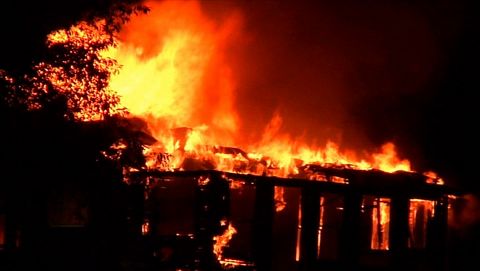
A horrible fire breaks out in 1871, enhanced by tornado-like winds.
Meanwhile, the others could tell that Adele was seeing someone and talking with her. They kept asking her, “Who is she? What is she saying? Is she the poor soul from Belgium? Who is it?” Adele heard her friends and told them to kneel because “she said she was the Queen of Heaven.” When Theresa complained about not being able to see her, Adele saw the Virgin Mary look kindly at Theresa and say,
VM: “Blessed are they that believe and do not see. (then back to Adele:) What are you doing here in idleness, while your companions are working in the vineyard of My Son?”
A: (crying) “What more can I do, dear Lady?”
VM: “Teach the children.”
A: “How can I teach them when I know so little, myself?”
VM: “I do not mean the science of the world. Teach them their catechism, how to sign themselves with the sign of the cross, and how to approach the sacraments, that they may know and love My Son; otherwise, the people here will lose their faith.”
A: “With God’s grace, and the help of your intercession, I promise, dear Lady, to be faithful to what you bid me.”
VM: “Go and fear nothing. I will help you.”
Nobody can escape the horrible blaze as it heads toward “Mary’s Five Acres.”
With that said, the Blessed Mary raised her eyes and hands toward heaven and slowly rose upward. She was surrounded by a light smoke-like incense. She looked like she was asking for a blessing for all of those kneeling before her. Adele, overwhelmed with emotion, collapsed to the ground in exhaustion. The man brought a cloth, soaked from a nearby stream, to help revive her from unconsciousness. Then the four walked home, and Adele told everyone about her encounter. Because of her character, most people believed her words. Her father had always believed her because she had always been a truthful girl. To show his support for his daughter and his love for the Virgin Mary, he decided to honor the location of the apparitions with the building of a very small chapel (10 feet x 12 feet) on that very spot. Father Verhoeff gave Adele a picture of Mary to hang there.
Adele offered to work hard for the busy pioneer families if they would let her teach their children the catechism and the rosary in spare moments. She did so for seven years, bringing each child that was ready to Father Daems in Bay Settlement to test their knowledge before each one’s First Communion. In 1861, the community built a larger chapel (24 feet x 24 feet) that could hold a hundred people – and often did. Mrs. Isabella Boyer donated the five acres that contained the holy site.
Sister Adele Brice leads a night-long praying of the Rosary, pleading for heavenly help.
When doubters began to give Adele a hard time, miracle healings began occurring in the chapel when Adele asked for divine assistance. Blind visitors regained their sight, deaf people regained their hearing, the desperately sick were healed, and cripples would walk again, leaving their canes and crutches behind as evidence. Word spread across the Midwest of these divine healings near Robinsonville (later called Champion). Adele acquired a beautiful, hand-carved statue of Mary from Belgium, and there was a glorious procession from the boat to its final resting spot in the chapel. However, some time later, the statue was severely damaged when it caught fire from candles placed too close to it. But farmers and other settlers took up a collection to replace it with a new statue.
In 1864 Adele and the other religious women helping her became the Sisters of Good Health – and were accepted by the Bishop of Green Bay. In 1867, Adele opened a school next to the chapel and a boarding school, the St. Mary’s Academy, in 1869.
Devastation is everywhere the next day (actual photo).
On Sunday, October 8, 1871, a most deadly fire was created by a gale force wind that turned the prairies and forests of Wisconsin into a raging inferno. Fire tornadoes ripped through the area causing death and destruction everywhere. Flames jumped rivers, embers rained down, and small fires were whipped up into a giant fireball that destroyed homes, buildings, farms, factories, and entire towns. It was described as “a wall of flame a mile high, five miles wide, traveling 90-100 m.p.h., hotter than a crematorium, turning sand into glass.” The heat was so strong that it killed people before the fire ever got to them. Approximately 2,500 people died, 12 towns destroyed, and 1.2 million acres devastated – the deadliest fire in American history. The ground was burned to a depth of two feet deep in some places. Hiding in brick homes or underground basements did not help. Only those hiding in rivers had the best chance of survival.
Father Pernin of a local church made every effort to save the tabernacle from his church, but at the river his cart dumped, and it floated away as he watched helplessly. Many people lined the river banks, but the only ones who survived were those who jumped in the water with Father Pernin. Three days later, among the blackened terrain and black ashes of everything destroyed, a pristine white tabernacle was discovered sitting upright on a log in the river. Its contents were unharmed from water or heat, and the people saw it as a miracle and a sign of hope.
Only Mary’s five acres remains green and untouched by the disaster; all there lived.
Sister Adele decided it was impossible to flee the fire, so the sisters, the school children, and frantic neighbors gathered in the chapel on the five-acre grounds and prayed to Mary for help. Then Adele led a procession around the perimeter of the chapel grounds, carrying a statue of Mary. The procession continued all night, praying the Rosary, all around the grounds. Everyone believed a miracle had occurred: the wind cooled, a heavy downpour drenched the fires, but this was longafter the fires had stopped right at the fence line surrounding the five acres. The outer side of the fence posts were charred while the inside was untouched. Everything surrounding their five acres, including the lush green forest, farm buildings, and homes were blackened, obliterated, and gone. Only the people and animals that had come to these grounds survived. The five-acre grounds that had been dedicated to Mary were green and untouched – “a glorious sight.” Exhausted from their fears and night-long processions of prayers, the people praised God and retired to sleep. Twelve years ago, on this exact day, Mary had warned of a potential punishment.
he Bishop of Green Bay approves these apparitions in 2010.
Another miracle on the chapel grounds had to do with the chapel well. The weather had been extremely dry all summer with the deepest of wells in the region barely containing any water left. The chapel well was only a few feet deep, and yet it was always providing plenty of water. All the neighbors, their surviving livestock which they had brought to the grounds, and everyone else living on Mary’s five acres had plenty of water from this shallow well. There was no explanation or logic for this small well to serve so many for so long under the dry conditions. People started taking some of the well water home as it was believed to have led to some healing miracles.
Many other miracles were documented. A seventeen year-old boy developed pleurisy from double-pneumonia. Despite his lungs becoming extremely weak, he said a novena at the chapel, and he was completely healed. Another boy, Michael Fonde, age nine, fell from a barn and was crippled. Four years later, a group of women prayed a novena with him at the chapel, and he walked out healed, leaving his crutches behind. A little girl with bleeding sores, who had been treated by doctors for years, was completely healed after she and her Mom made the pilgrimage to this chapel. Another small girl had become blind from a severe case of measles. When her mother brought her to this chapel to pray, she was instantaneously healed. And a deaf boy brought by his Mom to the chapel completely regained his hearing.
A statue of Mary gazes at pilgrims on the site; many healings occur.
On December 8, 2010, a historic event took place in this Shrine of Our Lady of Good Help near Champion, Wisconsin. Bishop David Ricken of Green Bay formally announced the approval of these apparitions:
“I declare with moral certainty and in accord with the norms of the Catholic Church that the events, apparitions, and locutions given to Adele Brice in October of 1859 do exhibit the substance of supernatural character, and I hereby approve these apparitions as worthy of belief by the Christian faithful.”
This becomes the first approved Marian apparition in the United States of America.
“Our Lady of La Salette”
LA SALETTE, FRANCE (1846)
Maximin Giraud (11) and Melanie Mathieu (14), young cow herders, were headed for high pastures in the Alps on Saturday, September 19, 1846. They came from non-practicing Catholic families, disregarded church bells, and were not serious about their religion. Suddenly, around 3:00 p.m., they became stunned and mesmerized by a large, glowing circle of light —“like the sun” — shimmering like a diamond. Then it began to open, revealing a weeping woman inside, bent forward with her face buried in her hands, and her elbows resting on her knees, sitting on a large rock. The glowing globe faded away and the woman stood up, revealing her exquisite beauty in a long white dress that seemed to glitter with small pearls of light. She wore a translucent white headdress with a tall crown underneath. Across her shoulders was a shawl trimmed with roses. A large yellow apron was tied around her waist. A cross hung on a chain around her neck. The following details were extracted from the exact text written in 1878 by Melanie:
The visionaries: Maximin Giraud and Melanie Calvat
“The sight of the Holy Virgin was itself a perfect paradise. She was all beauty and love. The sight of her overwhelmed me. Everything radiated the majesty, the splendor, the magnificence of a Queen beyond compare. The word LOVE seemed to slip from her pure and silvery lips. She appeared to me like a good Mother, full of kindness, amiability, of love for us, of compassion and mercy. She had a beautiful crucifix hanging from her neck (the brightness in which she was enveloped seemed to come from the crucifix). At times the Christ on her cross appeared to be dead. At other times, He appeared to be alive – His head erect, His eyes open … He appeared to speak … showing that He was on the Cross for our sake.”
“The Holy Virgin was crying nearly the whole time she was speaking to me. Her tears flowed gently, one by one, down to her knees. Then – like sparks of light – they disappeared. They were glittering and full of love. … The eyes of our Mother cannot be described in human language. … They appeared thousands of times more beautiful than the rarest diamonds and precious stones. In her eyes, you could see paradise. They drew you to her.”
A weeping Virgin Mary draws their attention high in the Alps.
Then the Blessed Virgin spoke these words:
“Come to me, my children. Do not be afraid. I am here to tell you something of the greatest importance.” As they approached, the globe of shimmering light enveloped all of them. “If my people will not obey, I shall be compelled to loose my Son’s arm. It is so heavy, so pressing, that I can no longer restrain it. How long have I suffered for you! God is being dishonored with swearing. The price for such abuse would be costly. If the harvest is spoiled, it is your fault. A great famine is coming. Many young children will die from a serious disease.”
“Woe to the inhabitants of the earth! God will exhaust His wrath upon them. The leaders of the people of God have neglected prayer and penance, and the devil has bedimmed their intelligence. They have become wandering stars which the serpent will drag along with his tail to make them perish. … There will be bloody wars and famines, plagues and infectious diseases. There will be thunderstorms which will shake cities, earthquakes which will swallow countries. Voices will be heard in the air. The fire of heaven will fall and consume three cities.”
“In the year 1864, Lucifer, together with a large number of demons, will be unloosed from hell. They will put an end to faith, little by little, even in those dedicated to God. Several religious institutions will lose all faith and will lose many souls. Evil books will be abundant on earth, and the spirit of darkness will spread everywhere a universal slackening in all that concerns the service of God.”
“The true faith of the Lord having been forgotten, they will abolish civil rights as well as ecclesiastical. All order and all justice will be trampled underfoot, and only homicides, hate, jealousy, lies, and dissension would be seen without love for country and family. All the civil governments will have one and the same plan – which will be to abolish and do away with every religious principle, to make way for materialism, atheism, spiritualism, and vice of all kinds.”
“The earth will be struck with calamities of all kinds. There will be a series of wars until the last war, which will then be fought by the ten kings of the anti-Christ, all of whom will have one and the same plan. Before this comes to pass, there will be a time of false peace in the world. People will think of nothing but amusement. The wicked will give themselves to all kinds of sins. And so, my children, make this known to all my people.”
Coming from a ball of light, the Virgin greets the startled children.
Then she turned and spoke to each child individually without the other being able to hear her. When asked if they prayed, they admitted “hardly ever.” She encouraged them to do so every night and morning with at least an Our Father or Hail Mary during the day if rushed. She impressed Maximin with recounting an incident with him and his father, word for word, when he thought they had been alone. Then she turned and left, gliding over the ground and rising into the air in the globe of light again.
The Blessed Mother is dressed in their native clothing.
Upon returning to their families, their story seemed fantastic, yet, their details matched perfectly, and their manner was so sincere. Despite pressures, bribes, and threats from townspeople, they stuck to their story. About a week later, a spring gushed forth out beside the rock upon which the Virgin had sat. This place had only collected water previously whenever snows melted or after heavy rains. But now, the spring flowed steadily, incessantly, and fully — even in dry weather conditions. And it has never stopped since that time. Numerous miraculous cures have been attributed to the water.
The Virgin tells of many future events for mankind.
On the anniversary of the sighting, 50-60,000 people gathered and held Mass at the site. Twenty-three people reported miraculous cures. The Vatican approved this apparition in 1851. A Basilica was eventually built on the original site, high in the Alps, in 1879 where their visitation took place.
A basilica is built on the apparition site high in the French Alps.
Mary had correctly prophesized the great famine in Europe and the decline of religion and morals in the world. She also accurately predicted the American Civil War and the “great war” (World War I) that would follow.
Bernadette Soubirous (14) was the oldest daughter of a desperately poor, miller’s family — who had to take a foul-smelling room in the old abandoned prison to survive. Lourdes was a village of about 4,000 people, tucked in the foothills of the French Pyrenees.
On February 11, 1858, Bernadette was sent with her sister, Toinette (11) and their friend, Jeanne to search for firewood that could be sold to the ragpicker for a few pennies that could buy a pound of bread for their dinner. Bernadette was lagging behind the other two because of her asthma. She suggested they cut across some fields to reach a point where the River Gave de Pau meets the canal. She paused in front of the hollowed-out rock Grotto of Massabielle at the base of a small mountain to take off her shoes and socks so that she could wade through an icy cold stream. She remembered her mother warning her to stay warm due to her asthma.
Bernadette Soubirous, 14-year old visionary of Lourdes, France.
Toinette and Jeanne had already removed their wooden shoes and waded through the icy millstream to the other side when Bernadette heard “a gush of wind” come from the grotto — yet, no trees were moving. She continued to remove her socks, when she heard the rush of wind again. She saw some wild rose brambles stir in the niche above the grotto. A soft light brightened the recess in the cliff. Then, it became a brilliant light — “like a glaring reflection of the sun off water.” In the light she began to see a young woman about her same age, dressed in white with a blue sash. A yellow rose adorned each bare foot. The mysterious young girl in the light smiled at Bernadette.
“When I saw that, I rubbed my eyes. I thought I was mistaken.” But Bernadette could not rub away the image of the girl in the light. The Lady made the sign of the cross with a Rosary in her hand, and Bernadette knelt and said a Rosary in front of her. As Bernadette said her rosary, the young girl in white fingered her own rosary beads but did not move her lips during the Aves. After that, the beautiful Lady motioned for her to come closer, but Bernadette was too timid. Glowing, as if standing in a sunburst, the Lady vanished. Wondering what she had just encountered, she finished removing her stockings and crossed the millstream – which was surprisingly warm now.
The other two girls had not seen or heard anything. Her sister scoffed at her story, and their mother spanked both girls when she heard such nonsense. However, this would be the first of 18 visitations! Despite being forbidden to return to the grotto, friends and others put pressure on the family to let her go, escorted. Just three days later, she felt compelled to return (with father’s permission) and took a bottle of holy water and a group of her curious classmates with her down the path to the Grotto of Massabielle.
Bernadette falls into a trance before the Blessed Virgin Mary in 1858.
She fell into a mesmerizing trance in front of the grotto as she saw the Lady again. Others could not see or hear anything but were impressed by her gaze that could not be broken with distractions. When Bernadette was done praying and the Lady had vanished, friends could not move her physically from her spot. They ran to the sawmill, and the operator of the nearby mill struggled to move the girl as she suddenly seemed incredibly heavy and hard to move. He was able to finally drag her back up the footpath. Later, she was again punished and warned.
Madame Jeanne-Marie Milhet thought that this apparition might be the spirit of her deceased relative, Elisa Latapie. Because Madame Milhet often paid Bernadette’s mother for odd jobs, Bernadette’s mother, Louise, gave in and allowed her to return to the grotto with Madame Milhet and her dressmaker, Antoinette Peyret. On February 18, these two, well-to-do women decided that they would accompany Bernadette to the grotto after Mass. Bernadette saw the Lady for a third time, but the two women, who could not see anything, asked for the Lady to write on a piece of paper so that they, too, could believe. Bernadette held the pen and paper up to the lady in the niche, asking her to write her name down. Mary smiled and then spoke for the first time,
“It is not necessary,” said Mary in a soft, musical voice to Bernadette only. “Would you have the graciousness to come here for 15 days? I do not promise to make you happy in this world but in the next.”
On the way ome, one of the women offered to let Bernadette stay with her for those 15 days. But, because her mother and aunt now insisted they should have this role, Bernadette only stayed with the nice woman for a couple of days.
A rare view of the actual apparition site at that time in 1858.
The Lady appeared to Bernadette silently, only smiling during each visit. Bernadette would always hold a blessed candle in one hand and a rosary in the other. Despite crowds gathering and following, nobody else could see anything. They could see that Bernadette was clearly in a trance or ecstasy as she gazed intently at the grotto, moving her lips at times, listening at other moments to someone they couldn’t see.
After the sixth apparition on February 21, Police Commissioner Dominique Jacomet pulled Bernadette in for an intense interrogation, trying to twist the facts and confuse her, adding occasional threats. But Bernadette remained calm, sincere, and consistent — never even making the claim that this was the Virgin Mary. And, despite his threats to jail her if she returned to the grotto, she calmly announced that she would return because she had pledged that she would.
On February 23, the Blessed Virgin told Bernadette three secrets that were for her alone. And she never did reveal what those three secrets were.
Bernadette continues to meet with Blessed Mary for 15 days in a row.
Finally, on February 24, Blessed Mary spoke to her again:
“Penitence is what I wish of everyone. Pray to God for the conversion of sinners.
Kiss the ground as a gesture of penance for others. Penance, penance, penance!”
Then, on February 25, with hundreds of curious people watching her silent interactions with Mary, she performed some very strange actions.
“She told me to go drink at the spring and to wash in it. Not seeing any spring, I headed toward the river to drink, but she beckoned with her finger for me to go under the rock. I went and found a little muddy water, almost too little for me to hold in the hollow of my hand. Three times I threw it away – it was so dirty. The fourth time I succeeded to drink some and then spit it out.”
Onlookers feared that she had gone mad, digging in the mud, drinking it, and smearing some on her face. Then she ate from a plant called dorine. The crowd gasped at each odd behavior, but they were later told that she had been instructed to do so “for sinners.” Nevertheless, the crowd left confused and dismissing her; her embarrassed aunts took her home. But later that same day, clear water started flowing from that muddy place.
On February 26, despite being ordered not to go there by the police commissioner, she found 600 people waiting there for her. Where she had dug into the mud was now a clear pool of fresh water. As many as 1,200 crowded into the area on February 28, leading authorities to grab the girl, interrogate, and threaten her again. But she calmly refused their demands, stating that she would not break her promise to go there for 15 days as promised (until March 4th).
The original home of Bernadette Soubirous in Lourdes.
At the golden dawn of March 1st, others saw the apparition as well, including Catherine Latapie and her two toddlers. She had broken her arm, paralyzing two fingers the year before, but when she placed her arm into that clear pool of running spring water, her hand was perfectly healed.
On March 2nd Bernadette turned and announced to the on-looking crowd of 2,000 people, “Go and tell the priests that people must come here in procession, and that a chapel must be built here.” Accompanied by her Aunt Bernarde and Aunt Basile, Bernadette approached Father Peyramale, the authoritative priest of St. Peter’s Church, and presented the Blessed Virgin’s request. Doubtful and disgusted, the priest needed to know that this was truly the Virgin Mary. He also demanded that this so-called “Virgin Mary” make the wild rosebush bloom in the winter grotto — as added proof.
Despite thousands of people showing up the last day, March 4, it was the same as the others — without any grand finale or miracle as was greatly hoped. Life returned to normal — now that the 15 visits were over.
But on the night before the Feast of the Annunciation, Bernadette received an “inner call” to return to the grotto one more time. Before the sun rose on March 25, she and her parents made their way to the Grotto of Massabielle. They were surprised to find a crowd already there, hopeful that this feast day might bring some special blessings or favors. The Virgin did appear again to Bernadette! Bernadette decided to meet the priest’s request, so she dared to ask Mary four times,
“Mademoiselle, would you be good enough to tell me who you are?”
The Blessed Mother slipped the rosary over her right arm, unfolded her arms, extended her hands toward the ground, and then folded them at her breast. She then raised her eyes toward heaven and finally answered,
“I am the Immaculate Conception.”
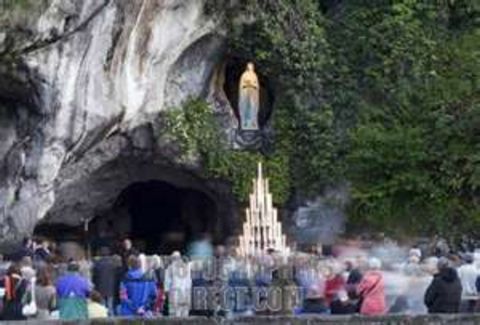
The apparition site is a popular place for prayer and pilgrimages today.
Bernadette had absolutely no idea what that meant, but she kept repeating the strange words to herself all the way to Father Peyramale’s residence so that she would not forget this precious response that they had all been waiting for. After she reported to him what Mary had told her, he was simply astonished. How could this uneducated girl, whose catechist had described her as “a blank slate,” know that the Virgin Mary had been born without sin? Pope Pius IX had proclaimed the dogma of the Immaculate Conception only four years earlier. When she left, Father Peyramale was now a believer and broke down and wept.
On April 7, the Tuesday after Easter, Bernadette prayed at the grotto in the early morning. Several hundred watched — including Dr. Dozous, who was there to examine her during her visionary experience — as Bernadette took a large candle and encircled the flames with her hands and fingers. This should have severely burned anyone else but she had no reaction or burns as the stunned doctor examined her closely. Bernadette reported, “Our Lady still wants her chapel.”
By the end of June at least 50 others reported visions of Mary there. On July 16 was Bernadette’s last vision, after again receiving an “irresistible invitation” on the Feast of Our Lady of Mount Carmel. Disguised with a cloak and not crossing the river, she admired Mary’s presence from farther away – yet felt like she was at the same distance as previous visits. “I had never seen her so beautiful.” This was her last visit from Mary.
On January 18, 1862, Bishop Bertrand Laurence declared,
“We judge that Mary Immaculate, the Mother of God, really did appear to Bernadette Soubirous, on eighteen occasions from 11th February, 1858, at the Grotto of Massabielle near the town of Lourdes; that these apparitions bear the characteristics of truth; that the faithful can believe them as true.”
The first of several chapels was built, and Bernadette was invited to march in the procession that Blessed Mary had requested, fulfilling both requests before she left her family and friends at age 22 on July 4, 1866, to join the Sisters of Charity in Nevers.
During Holy Week of 1879, Bernadette’s pains and ailments worsened. “I wouldn’t have thought it took so much suffering to die.” On Easter Wednesday, April 16, she stretched out her arms like a cross and said, “My God! … Holy Mary, Mother of God, pray for me, a poor sinner.” Then she died at the age of 35 due to her poor health. Yet, her body lies under glass without any decompositionover 135 years later in the chapel of the Convent of the Sisters of Charity in Nevers! She was beatified on June 14, 1925, and canonized on December 8, 1933 in Rome – on the Feast of the Immaculate Conception!
Sister Bernadette is incorrupt after death in 1879 (her body does not decay).
Today, as much as 14,500 gallons of water are generated daily from the spring that started as a mud hole she dug with her fingers. The latest chapel built there is underground but can hold 20,000 people! During the first 150 years after this, 7,000 authenticated medical cures were documented by the International Medical Bureau of Lourdes. Of those miracles, the Catholic Church has conservatively accepted 67 of them as clearly from the hand of God with no other possible explanation. Here is a sampling of the miraculous healings from the waters of Lourdes:
Louis Bouriette (54), a quarryman, had lost complete vision in his right eye during a mine explosion. He bathed his eye several times with water from the spring, and his sight was totally restored.
Henri Busquet (16) begged his parents to take him to Lourdes as his suffering from tuberculosis was unbearable. A neighbor brought him water from Lourdes and within two days his tuberculin ulcers had healed and infections gone.
Justin Bouhort (2) had never walked and was so sick from various illnesses that he was close to death. His mother plunged her baby into the cold waters of the spring, ignoring the fears of bystanders. The next day, young Justin walked for the first time – and lived to attend the canonization ceremonies for Bernadette in 1933 at the age of 77.
Bedridden for over 20 years, Madeleine Rizan (58) was paralyzed on her left side. Her daughter gave her a few sips of the Lourdes water and applied some to her face and body. She was instantly healed!
Marie Moreau (17) had a bad infection that had nearly robbed her of most of her eyesight. A compress soaked in Lourdes water was placed over her eyes. The next morning, after removing the compress, her vision was completely restored!
A fallen tree had crushed the left leg of Pierre de Rudder (52). Infection had prevented the compound fracture from healing. Hobbling on crutches for eight years, he faced amputation soon. He prayed to the Blessed Virgin in front of a replica of the Lourdes grotto in Belgium. Within minutes, his bones fused back together, and he was able to walk away without any crutches. He was quite active until he died at the age of 75.
In 1963, Vittorio Micheli of Italy (23) was suffering from a cancerous tumor on his hip bone. Lowered into the Lourdes bath waters on a stretcher, his tumor vanished as well as all of his pain. He resumed an active, healthy life again.
Serge Perrin (41) suffered from a blocked carotid artery which caused paralysis, blackouts, and vision issues. In 1970 he visited Lourdes and was completely cured.
Delizia Cirolli (12) suffered from a potentially fatal tumor in her knee and faced amputation soon. After a trip to Lourdes and praying to Our Lady, she was 100% healed.
Jean-Pierre Bely, a nurse, was diagnosed with Multiple Sclerosis in 1972. By 1987 he was bedridden and 100% disabled. After the Anointing of the Sick at Lourdes, he felt a great sense of peace; he regained his mobility and sense of touch again.
Anna Santaniello (41) suffered from severe heart disease, labored breathing, and low oxygen levels. Carried to the Lourdes baths on a stretcher, she walked out on her own. Doctors confirmed her good health, regular heart rhythm, and breathing without restrictions.
An Austrian Jew named Alphonse Ratisbonne was the youngest son of an important banking family in Strasbourg. Alphonse was a Jew by race and religion and was very well off in material possessions. He harbored a great hatred for Catholics and anything to do with the Catholic Church – largely due to his brother George converting and becoming a priest. He blamed the Catholic Church for “bewitching” his brother. A series of mishaps brought him to Rome, a city he had vowed to never visit. He became acquainted there with Baron Theodore de Bussieres, a very fervent Catholic.
Alphonse Ratisbonne
One afternoon, during a raging argument with Bussieres in which Ratisbonne was ridiculing the superstitions of the Catholic religion, the Baron challenged him to submit to a simple test and wear the Miraculous Medal. Ratisbonne consented so that he could prove the ineffectiveness of such religious baubles. The Baron also added that Ratisbonne must recite the Memorare once a day. He promised that he would, saying, “If it does me no good, at least it can do me no harm.”
The Baron and a close circle of aristocratic friends increased their prayers for the skeptical Jew. One of them, Comte de la Ferronays, was a devout, but seriously ill, Catholic, who offered his life for the conversion of this young Jew. On that same day Comte entered the church and prayed 20 Memorares, then suffered a heart attack and died. Although Ratisbonne was ready to return the medal and leave Rome, the Baron asked Ratisbonne to accompany him the next day to the church while he was making funeral arrangements. Ratisbonne felt obligated – due to the dead man’s prayers.
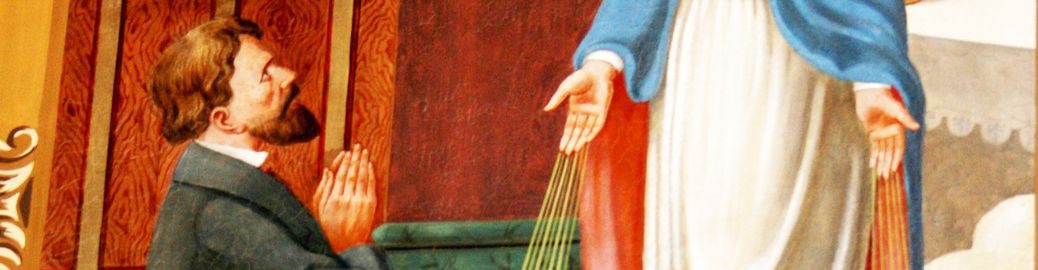
Alphonse is stunned by the unexpected appearance of the Virgin Mary in 1842.
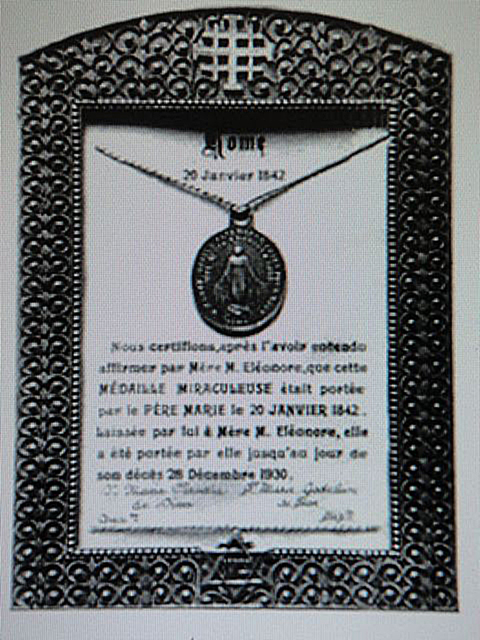
While waiting for Bussieres, he wandered through the church, admiring the beautiful artwork, but then decided to turn to leave out the front door. A huge black dog suddenly appeared and blocked his path. The animal was vicious, baring his fangs. As Ratisbonne froze in his place, unable to move, the dog vanished and a brilliant light began glowing from a side chapel directly in front of him. As he stood before the altar dedicated to St. Michael the Archangel, Our Lady suddenly appeared to him (January 20, 1842). She was wearing a crown and a simple long white tunic with a jeweled belt around her waist and blue-green mantle draped over her left shoulder. Her peaceful gaze reached deeply into his soul. Her hands were open, spreading rays of graces. The light coming from her was so brilliant that he had to look away from her enchanting face and captivating eyes. Her height and elegance gave the impression of a great lady, fully conscious of her own dignity. She transmitted both grandeur and mercy in an atmosphere of great peace. He said that her hands “expressed all the secrets of the Divine Pity.” Ratisbonne understood that he was in the presence of the Mother of God. Although Mary never said a word to him, he felt that he “understood all.” He fell to his knees, sobbing, and converted.
Official documentation of the miraculous conversion.
The Baron was surprised to find him praying fervently on his knees. Ratisbonne immediately asked to go to a confessor so that he could receive Baptism. Eleven days later he received Baptism, Confirmation, and his first Communion. The entire Catholic world became aware of this amazing conversion. Ratisbonne became a Jesuit priest and founded a religious group, the Daughters of Zion – to help with the conversion of Jews!
On August 2, a bright summer morning, four shepherdesses push their herd of cows at daybreak out onto the road that climbs the mountain. Maria Pittavino (12), Margherita Pittavino (12), Maria Chiotti (12), and Maria Boschero (10) were out of breath when they came to a beautiful basin at an altitude of 1,378 meters. Some testify that Margherita’s younger brother Chiaffredo (8) may have been with them that day, also. In the middle of the green valley of Chiotti, there is a large rough stone where they like to stop and rest.
Suddenly, they were astonished to see before them, standing on the stone slab, a beautiful lady of majestic appearance. She was a young woman of ordinary stature about twenty years old. She wore a long dress with a reddish belt tied to the sides. From the head draped a long, celestial blue veil, held to her neck with a bright yellow button. It covered her head, hair, forehead, and sides of her head, only leaving her face and neck uncovered. Under the mantle is a dark red color all over with a beautiful yellow belt encircling her hips. Her feet fit into simple sandals. On her head is a crown of beautiful high-gloss gems adorned in dazzling beauty.
She does not speak, but her eyes are rich with expression, shedding tears that flow down her cheeks and fall to the ground. She alternates her tearful gaze from one shepherdess to the next. Her arms were outstretched with open hands, a traditional pose of the Virgin Mary. But they were not sure who she was – maybe Saint Anna, perhaps the Madonna. The only words they recall hearing were a request for a chapel to be built on this site.
The four young girls fell into an ecstasy, partly from fear, and remained silent. The Lady disappeared as quickly as she had appeared. The girls returned home – too upset to talk about what they had seen. Despite their reluctance to return to that area, their parents urged them to fulfill their duties with the herd.
Our Lady of Mercy statue in Valmala, Italy in 1834.
The girls admitted that they too fearful to return to that area “because every now and then the same great Lady – who always cries – appears before the four of us.” Mary Pittavino’s father, Joseph, knowing the innocence and honesty of his daughter, decided to accompany the girls to see about this matter, personally.
On August 6 at 10:00 a.m., the four girls, the father, and other people from the village climb the mountain to the Chiotti basin or valley. As they approach the rock boulder, the four milkmaids cry out together, full of wonder,
“There she is, standing on the stone – the beautiful lady. She keeps crying, wears the same clothes and has the same features as all the other times.”
But the people all around them see nothing. One of the girls approaches the boulder, takes one hand and raises the hem of the coat of Blessed Mary. The spectators see the girl’s hand with fingers closed as if she is grasping something – but see nothing else. Joseph Pittavino invites all to kneel and pray. He vows that if he could learn the apparition’s identity, he would build a chapel in that place.
However, one of the villagers present, Bartholomew Valmala Chiotti, turns with confidence toward the invisible Madonna and offers a promise. If she will heal him from his two-year ailment of acute kidney pain, he promises Mary a “gift.” The pain had caused him to walk with great difficulty, hunched over, and with his forehead toward the ground. Instantly, he receives that grace and is able to walk upright with no pain and no further ailment! Everyone observes this miracle! (And he kept his promise to Mary …)
On August 15, the Feast of the Assumption of Mary, Joseph Pittavino feels inwardly compelled to return to the site of the apparition. He joined other people who had the similar desire to possibly see her and confirm her identity as the Blessed Virgin. As the party of people arrive at the stone in Chiotti, the four shepherdesses all exclaim,
“Here, here she is – the Lady! She is more beautiful than ever! The same crown!”
Although still invisible to the others, they are more certain from the girls’ description that this is most likely the Blessed Virgin Mary. Without speaking, they all kneel. Joseph lights a blessed candle, makes the sign of the Holy Cross, and prays the Holy Rosary. During the fervent recitation of the Rosary, the four shepherdesses are enraptured in ecstasy, holding their gaze upon the boulder and just above it (where she stands). Bystanders witness the illuminating joy and happiness upon their faces, transfigured by their heavenly experience.
After the recitation of the Rosary, Joseph asks the shepherd girls if they still see the Lady. They are amazed that others cannot see her. They respond that the Lady is still there, standing where she always does, her eyes dripping with tears that glisten on her face. Then the girls add some new details,
“We hear voices singing religious songs … what beautiful voices! … I sing pretty … a song that resembles that of the Solemn Mass of the Dead …”
They describe seeing “people moving in the blue sky, passing across the sun” which casts such large shadows that the whole cowherd is in darkness. Then they state that the “beautiful Lady” has gone from the rock.
Appearances of the Blessed Virgin continued for fifty days. Our Lady would appear either standing on the rock, sitting on the rock, or walking on the ground surrounding the rock. But she would always have tears in her eyes. She would make “amorous glances” toward the girls as she walked to and fro over the surface of the rock. Then she actually spoke to Mary Pittavino in the dialect of Occitan during one appearance:
“When returning home tonight, tell your father (Joseph) that I want him to erect a mast in this place where I am. Tell him that under these clods where you and your classmates have seen me walking, he will find sand and stones in abundance, a quantity not only to erect the mast, but enough for still other factories.”
Joseph Pittavino began construction at once – but he still wants to be certain to whom he is dedicating this structure. The girls reply that the Lady is “just an extraordinary beauty” who becomes more beautiful with each appearance and each recitation of the Rosary. Others still argue that this is St. Anna. However, the most common opinion is that this is really the Blessed Virgin.
To solve this mystery, Joseph Pittavino leads the four girls to explore many pictures and depictions of the saints and Madonna that are located in the district of Valmala. None of these images looks familiar to the girls. Finally, one day, in the marketplace of Venasca, there were many paintings on display from a stranger. All eyes of the four girls fixated upon one painting with wonder and joy, exclaiming,
“Here it is! Here is the image that resembles in all respects the Lady whom we have seen so many times on the rock of Chiotti.”
It is the Madonna as she appeared to Anthony Botta on March 18, 1536. This image hangs in the great shrine of Savona with the title, “Blessed Virgin Mary, Mother of Mercy.” Joseph Pittavino immediately buys that image so that the painter Giuseppe Gauteri of Saluzzo can add it to the constructed pylon or mast.
From that day, the apparitions ceased entirely – as if to signify that Mary wanted to make sure that the right image and title, “Mother of Mercy” would be assigned before she departed. Buildings were added around the pylon “marker” – with a Sanctuary eventually added.
On the first Sunday of August in 1946, Our Lady Queen of Valmala was solemnly crowned by Archbishop Luigi Lanzo Gile, Bishop of Saluzzo in the Diocese. From March 19 to July 30, 1949, the statue of the Mother of Mercy, worshipped at the shrine, was chosen for the Pilgrimage of Mary, and brought into all the parishes of the diocese. In August of 1949, in memory of Pilgrimage, and artistic marble statue of the Heavenly Queen was placed in the forecourt of the Shrine.
“Our Lady of the Miraculous Medal”
PARIS, FRANCE (1830)
When Catherine Laboure, an unsophisticated country girl, was barely 19 years old, she had a dream that she was in her Parish Church at Fain-Les-Moutiers. An old priest, whom she had never seen before, was celebrating Mass. After it was over, he beckoned Catherine to come to him. She panicked, although she didn’t know why. In her dream she ran away from the Church and the old priest. Next, in her dream, she found herself in a room beside the bed of a sick person. The old priest was standing next to her, saying,
“My child, it is good to care for the sick. You run away from me now, but one day you will be glad to come to me. God has His designs on you! Do not forget it.”
Catherine yearned to become a nun, but her father was opposed for the longest time. Finally, she made her way to Paris because her father thought that life in the big city would change her mind. As she was visiting her aunt in nearby Chatillon, she stopped in at the convent of the Sisters of Charity. As she was ushered into the parlor, she froze in her tracks. There on the wall was a painting of an old priest – the very same old priest from her unforgettable dream! She was told that it was Saint Vincent de Paul.
Catherine Laboure at Rue du Bac convent in Paris, France.
On April 21, 1830, she entered the convent of the Sisters of Charity at 140 Rue du Bac in Paris. On the eve of the Feast of St. Vincent de Paul, Catherine worked hard to prepare the chapel and convent for the next day’s events. Exhausted, she fell into a deep sleep on this night of July 18, 1830.
“At 11:30 in the evening I heard someone calling me, ‘Sister, Sister, Sister.’ I awoke and looked in the direction that I heard the voice coming from. I saw a little child dressed in white who appeared to be about 4 or 5 years old. The child said to me, ‘Let us go to the Chapel. Get up quickly and go to the chapel. The Blessed Virgin is waiting for you.’ The thought came to me ‘but someone will hear me.’ The child told me, ‘Do not worry, it is 11:30 in the evening and everyone is asleep. Come, I am waiting for you.”
“I arose and dressed quickly while the child waited for me at the foot of the bed. I followed him; he was always on my left. He shone brightly and illuminated the path we were taking. This astonished me greatly. But I was even more surprised as I entered the chapel and found that the door opened at the child’s touch. My amazement was made complete when I saw that all the candles and lights in the chapel were illuminated as if for midnight mass. I did not yet see the Blessed Virgin. The child led me into the sanctuary to the chair where the sisters’ director always sat.”
“I fell to my knees, and the child remained with me. I thought a long time had passed, and looked to see if the sisters on the night watch passed by. Finally the time had come. The child sensed this and told me, ‘Here is the Blessed Virgin, She is here.’ I heard a rustling like the sound of a silk dress. This sound was coming from the Gospel side of the altar … I doubted at first that this was the Blessed Virgin.”
“Meanwhile, the child said to me, ‘Here is the Blessed Virgin.’ After this, it was impossible for me to describe what I was feeling or what was going on around me. It seemed that I still could not recognize the Blessed Virgin … Now the child no longer spoke to me in a child’s voice but in a man’s strong voice.”
Catherine is led by a “glowing child-angel” to meet the Virgin Mary in 1830.
Catherine’s heart pounded furiously. From out of nowhere, the most beautiful lady she had ever seen, appeared before her. Mary appeared so young and exuberant. The Blessed Virgin sat in the priest’s chair. A wave of emotion swept through Catherine. She paused, then rushed forward, kneeling and placing her hands on Mary’s knees.
“Then I recognized the Blessed Virgin. I quickly knelt before her on the steps of the altar and put my hand on her knees. Then, I spent the greatest moments of my life. It would be impossible for me to describe how I felt. She told me how I must conduct myself during the struggles that would come to me in the future. She pointed to the foot of the altar with her left hand and said that it was there I was to open my heart, there I would receive all the consolation that I needed … There I should ask for the explanation of all things that I had seen. Oh! She explained everything to me!”
Catherine is stunned by the appearance and words of the Blessed Virgin.
Mary sat with her for what seemed like an eternity. She instructed Catherine in the proper behavior of a nun. She also gave her private secrets, many of which were revealed towards the end of Catherine’s life. Other secrets were never revealed.
“My child, rely on prayer when your heart is troubled. God wishes to entrust a mission to you. It will be the cause of great suffering to you, but you will surmount it with the thought that it will work to God’s glory. You will be contradicted, but do not fear. Grace will be given to help you. In your prayers inspiration will be given to you. The times are very evil. Great misfortune will come to France. Her throne will be over thrown. There will also be victims among the clergy. The archbishop himself will die.
The cross will be insulted; blood will flow in the streets. But come to the foot of this altar. Here, great graces will be poured upon all those who ask for them with confidence and fervor. Graces will be bestowed upon the great and the small.”
The glowing angel stands by while Mary instructs Catherine for two hours.
Mary finally broke down in tears after revealing all the misfortunes and outrages that France would suffer.
“I do not know how long I stayed there. All I know is that when she left she suddenly was gone in the same way that she arrived. I found myself on the steps of the altar and I saw that the child was where I had last seen him. He told me, ‘She is gone.’ We returned the same way we had come with the path illuminated before us. The child was always on my left. I believe that this child was my guardian angel who had become visible to guide me to the Blessed Virgin. Because I had prayed so hard he obtained this grace for me. He was dressed in white and was miraculously illuminated. I returned to my bed. I heard the clock sound the time; it was 2:00 a.m. I could not get back to sleep.”
Catherine pondered all that had been said, wondering what her mission was to be. The angel boy faded away as she got back into bed. She was so excited that she could not fall back asleep.
The first image that the Virgin Mary wanted Catherine to remember.
Within one week, Mary’s predictions began to happen as riots broke out on the streets. Paris became a “bloodbath for three days” and then the king was deposed and fled the country. The revolutionary forces slaughtered priests and religious. But, as Mary had promised, no harm came to the sisters of the Rue du Bac convent.
In the chapel, on November 27, 1830, she heard the rustling of the silk dress again. Standing right by the altar in a white robe of silk was Mary with her eyes raised upward. Her hair was covered under a white veil. “Her face was quite beautiful.” She was holding a golden ball at arm’s length while standing on a green snake, coiled upon the white globe beneath her. Her fingers had three rings on each one, which emitted brilliant rays of light downward. The Virgin Mary explained the images:
“The ball which you see (in my hands) represents the whole world, especially France and each person in particular. These rays symbolize the graces I shed upon those who ask for them. The gems from which rays do not fall are the graces for which souls forget to ask.”
Rays of light stream from Mary’s hands as graces are dispensed.
Mary emphasized how many graces lie unclaimed because nobody asks for them. Then the golden ball vanished from Her hands, and her arms dropped downward — hands held outward as if to welcome. The rays of light focused downward on the globe beneath Her.
An oval frame appeared around her with these words: “O Mary, conceived without sin, pray for us who have recourse to thee.” Mary said to have a medal made in this image with these words, and all who wear it around their neck with confidence will be blessed with abundant graces and enjoy the special protection of the Mother.
The Virgin Mary gives Catherine the images for the medal she wants struck.
The image turned and Our Lady disappeared. The back side of the medal was to contain these images: a large M with a bar through it and a cross extending from it, two hearts below the M – one surrounded by thorns (Sacred Heart of Jesus), one pierced by a knife with droplets of blood dripping from it (Immaculate Heart of Mary), and twelve stars surrounding these images on an oval border. Then, it all faded away slowly.
Catherine felt a great urgency to have this medal created. But her confessor, Father Aladel, did not share the same urgency and had many other important matters to attend.
The actual Miraculous Medal as designed precisely by the Virgin Mary.
The Blessed Mother appeared again on five more occasions at key times to keep Catherine inspired to keep pushing the priest to take action. But the refusals disheartened Catherine to the point that she asked Mary to get someone else for this job. But one last conversation, when repeated to the priest, may have made all the difference:
Cath: “But, my good Mother, you see that he (the priest) doesn’t believe me.”
Mary: “Never mind. He is My servant, and HE WOULD FEAR TO DISPLEASE ME.”
Mary knew that this would greatly disturb the priest – who actually trembled at the thought of displeasing the Mother of God. He used as his justification for the medal that the reported predictions by Mary HAD COME TRUE. The medal struck in 1832 was originally called the “Medal of the Immaculate Conception.” But what was to follow led to the popular change in its name to the “Miraculous Medal.” Reports started pouring in from those who wore the new medal: physical cures, conversions, and miracles of every sort. Even the Archbishop of Paris, who had finally authorized the medal’s production, was one of the first to wear it and experience a miracle.
The incorrupt (non-decaying) body of Catherine Laboure in Paris, France.
Two million were distributed worldwide by 1836. Reports came in of miraculous healings of those who had been hopelessly incurable. Some of the worst enemies of the Church experienced unlikely and amazing conversions. By the 21st century more than a billion medals had been reproduced and spread worldwide.
Catherine downplayed her own importance, wanting others to focus on Mary, not her. She went to work for the next 45 years at a hospital for old people on the outskirts of Paris, taking care of the sick – as St. Vincent de Paul had predicted in Catherine’s dream at age 19.
Catherine Laboure quietly died on December 31, 1876. On May 28, 1933, she was beatified in St. Peter’s Basilica in Rome. As part of the Canonization process, the body of the saint had to be identified. In a solemn procession, her coffin was removed from the vault under the convent’s chapel and brought to the Mother house at Rue du Bac. In the presence of the Archbishop of Paris, civil officials, and various doctors, the coffin was opened. They were stunned at what they witnessed. The body of Catherine Laboure had been in this coffin for 57 years – and yet, she had not decayed in the slightest. It was as if she were still alive and simply sleeping peacefully. She was canonized in 1947.
Today, some 139 years later, she is still perfectly preserved by supernatural means as a “totally incorrupt” body – and can be viewed, enclosed by glass, in the little chapel at 140 Rue du Bac in Paris, France.
The first apparition appeared to Tomasz Klossowski in 1813 while he was away at war, fighting with the Polish soldiers under Napoleon in Leipzig, Germany. He became gravely injured and feared dying in a foreign country, so he prayed and asked the Holy Virgin to allow him to come back to Poland to die in his own homeland. The Holy Mother appeared to him in the light of the crimson setting sun. She was wearing the crown, an amaranth dress and a gold mantle. She was hugging a white eagle – the symbol of Poland. She comforted him and informed him that he would be healed and would return safely to Poland. But, she had a request. He was to find a picture of Mary, place it in a public area and worship it. When he returned to Poland, he searched for a picture of Mary – and finally found one in 1836 on the way back from a pilgrimage to Czestochowa. He took the picture and hung it on an old pine tree in the Grablin forest near his house. Soon after, he died.
Tomasz Klossowski is saved by the Virgin Mary in wartime of 1813.
Our Lady appeared in 1850 to Mikolaj Sikatka, who was pasturing his cattle near the area where the picture was hanging in the forest. She called for people to come to conversion, penance, and prayer. She informed about the punishment which would come – predicting wars and an epidemic of cholera. But she gave hope and promised:
Mikolaj Sikatka is given directions by the Virgin Mary in 1850.IF
“When hard days will come, those people who will come in front of this picture and will pray and do penance, will not die. Whenever this nation will come to Me and ask for help, I will never leave this nation, and I will protect this nation, and I clasp this nation to My heart like I did with this White Eagle. The picture should be placed in a better, more proper place and should be publicly worshipped. The pilgrims from all of Poland will come to this picture, and they will find consolation in their distresses. I reign for My nation forever. On this place will be built a magnificent church for My veneration. If people will not build this church, the angels will build it.”
The tiny little picture of Our Lady of Lichen, framed and hung.
The Holy Virgin predicted the formation of the sanctuary and the monastery in Lichen from which her glory would flow. The shepherd Mikolaj started to expound Our Lady’s message, but he was persecuted and imprisoned by Russian authorities.
But, just as the Virgin had predicted, two years later in 1852, the epidemic of cholera began. That
The miraculous healings occurred in front of Our Lady of Lichen.
same year, the picture was placed in the parish church in Lichen. People remembered the Virgin’s prophecy and thronged to her portrait to kneel and pray. Whoever prayed in front of this picture received graces and did not become ill or die. Those who were already ill or dying recuperated.
The sanctuary in Poland that houses the miraculous healing image.
A special Episcopal committee of the Roman Catholic Church investigated these claims and by 1939 had documented around 3,000 recorded acts of grace, including many miraculous recoveries and cures.
The old part of the sanctuary in Lichen, Poland.
The miraculous painting survived many incidents over the years. Thanks to the generosity of visiting pilgrims, a new Sanctuary of Our Lady of Lichen was built, modeled after St. Peter’s Basilica at the Vatican. Pope John Paul II consecrated this church – Poland’s largest – on June 7, 1999. It is the 7th largest church in Europe.