Some time after 988 A.D., when Grand Prince Vladimir I married a Byzantine princess and consequently became a Christian, the painting of Our Lady of Kazan was treasured and revered by the Russian people. The icon’s origins are rooted in the early founding days of the church of the apostles. It was brought from Constantinople, across the Black Sea, up the Volga River to a monastery in Kazan, deep in the interior of the former Mongolian Empire. By 1101, pilgrims were traveling vast distances on foot to pray before this icon. In 1209, the city of Kazan was overrun and conquered. Angry mobs destroyed the city and the monastery – the icon being lost in the rubble, apparently lost forever.
Three hundred and seventy years later, on July 8, 1579, a small, nine-year old girl named Matrona was suddenly startled by an immense flash of light. She fell to her knees in amazement at the beauty, holiness, and eternal kindness of the Mother of God – who was standing on a cloud and clothed in the brilliance of God’s love. The “beautiful lady” asked the child to rescue the ancient and holy icon of Our Lady of Kazan from the burned-out ruins of the old monastery near Matrona’s home. She was to give certain directions and specific instructions to the people so that they could locate it.
The painting of Our Lady of Kazan 1579
Word spread quickly, and many people gathered at the ruins. Matrona quietly repeated the instructions that she had heard from Mary. The others sang folk songs with joy and great anticipation. In no time at all, digging right where Mary said to look, they uncovered the miraculous icon. Suddenly, there was total silence. People had fallen to their knees in astonishment and awe as they experienced the sacred Presence in the icon. People spoke of a divine light that radiated forth from the painting of Our Lady of Kazan.
Thousands upon thousands gathered at the site of the apparition. Even high-ranking clergy and aristocrats wept with amazement. Almost immediately, miracles and healings occurred in the lives of those who gazed with reverence upon the holy icon.
The church in Kazan, Russia
It was safely housed in a convent especially constructed for it – and known throughout the Russian Empire as the Liberatrix and Protectress of Holy Mother Russia. Peter the Great proudly carried it as his banner as he marched into battle against Russia’s enemies. During the reign of Alexander II, a magnificent basilica was constructed in Moscow (at Red Square) which housed the sacred icon. Miracles and healings proliferated from its presence there. But the Bolsheviks saw it as a threat to their philosophy and revolution, so on October 13, 1917 (the day of the Fatima Miracle!), they destroyed the Basilica of Our Lady of Kazan. That same day at Fatima, Mary was telling the visionaries,
“If humanity does not turn back to God, Russia will spread errors and terrors worldwide.”
Somehow, the sacred icon had been saved and mysteriously removed from Russia — and discovered years later in a castle in England! Seventy-five years after its destruction, the great basilica was reconstructed at Red Square. The sacred icon has been housed at Fatima in a beautiful Byzantine-style Shrine, constructed especially for its time in exile. On October 13, 1992, His Holiness Aleksey II announced that Russia looks forward to the “peace and abundance” that its anticipated return shall bring eventually.
An elderly farmer named Antonio Botta was surprised to receive a visit from the Queen of Heaven on March 18, 1536. The farmer described the Virgin Mary as being dressed in white and surrounded by a dazzling light. The Blessed Virgin stood on a large rock overlooking a stream near the river Letimbro. As he knelt reverently before Our Lady, Blessed Mary directed Antonio to go to his priest with the request that three Saturdays of fasting be observed, and that three processions be organized in honor of God and the Mother of Jesus. Then Mary asked the farmer to return to this same place on the fourth Saturday to receive another message meant for the Curia and the people of Savona. When she vanished from his sight, a sweet fragrance of flowers lingered for some time.
Obeying the words of the Virgin Mary, Antonio went immediately to inform his local priest, Monsignor Bartholomew Zabreri, who then shared the message with the bishop of the diocese. Although they were receptive to the requests of the Blessed Virgin based on the sincerity and humility of the elderly farmer, the mayor of the area, Genoese Doria, was not convinced. He promptly summoned the farmer to the castle for questioning about the circumstances of Mary’s visit. Legend states that during the interrogation of Antonio, some fishermen just off the coast of Savona saw three flames that rose high into the sky above the cathedral and the castle.
Antonio Botta stunned by Virgin Mary in 1536
The second visit by the Blessed Virgin Mary happened as predicted on April 8, 1536, the fourth Saturday after the first appearance of Our Lady. She appeared with the same brilliant illumination on the exact same location as in the first visit. The elderly farmer, Antonio, recalled that she stood with outstretched hands extended downward in a gesture of mercy. Once again, Our Lady asked him for the three Saturdays of fasting and the processions. She praised the local fraternities and brotherhoods for their dissemination of the Word of God. She urged Antonio and his countrymen to follow the Creed and disappeared after saying these words,
“Mercy, my son, not justice.”
News of this apparition spread quickly. There was such an influx of pilgrims that a committee was formed to handle the increase in numbers. Large sums of money donated by pilgrims resulted in plans being developed for the building of a place of worship. Soon, a chapel at the site of the apparitions was authorized by Bishop Bartholomew Chiabrers on April 21, 1536. Plans for the new church were also approved by the city council of Savona and Cardinal Spinola Horace on July 24 of that same year. By August 11, 1536, the construction of the church was begun.
Four years later in 1540, Savona decreed that March 18 would be observed as an annual festival with a candle votive procession to the shrine. Pope Pius VII was exiled to Savona by Napoleon from 1809-1812. During those years he vowed that if he were released, he would crown the statue of Our Lady of Mercy. The pope kept his promise, placing a royal diadem on the statue on May 10, 1815. Pope Benedict XVI honored Savona and the church with a papal visit on May 17, 2008.
VICENZA, ITALY (1426, 1428) “Madonna of Mount Berico”
There was so much pestilence and sickness between 1404 and 1428 in the region of Vicenza, Italy, that the population declined drastically from death or fleeing the area. In those difficult years, Vincenza Passini (age 70) went up the hill each morning to bring food to her husband who worked in his small vineyard. She led a simple, honest life with a heartfelt devotion to Blessed Mary. She attended church regularly and was mindful of the poor.
Vincenza is stunned by Virgin Mary’s appearance
On March 7, 1426, at 9:00 a.m., Vincenza encountered a beautiful woman on her path up the hill. She had “the likeness of a most beautiful queen with garments more resplendent than the sun, wreathed in a fragrance of a thousand scents.” Overcome by the beauty of the woman, she fell to the ground. The beautiful woman spoke:
“I am the Virgin Mary, the Mother of Christ who died on the Cross for the salvation of men. I beg you to go and say in my name to the people of Vicenza that they must build in this place a church in my honor if they want to recover their health. Otherwise, the plague will not cease.”
Vincenza wept with joy, kneeling in front of the Madonna. But then she asked her,
“But the people will not believe me. And where, O glorious Mother, will we find the money to do these things?”
The Virgin Mary replied,
“You will insist so that my people do my will, otherwise they will never be rid of the plague – and, until they obey, they will see My Son angry with them. As proof of what I say, let them dig here, and from the rock, living water will spring. As soon as the building begins, money will not lack.”
After saying this, Blessed Mary took a twig, and with a graceful movement, traced the Sign of the Cross on the ground. Then she also drew the shape of the church to be built. Finally, she planted the twig in the ground where the high altar of the shrine stands today.
“All those who visit this church with devotion on My feast days and on every first Sunday of the month, will be given an abundance of grace and the Mercy of God and the blessing of My Motherly hands.”
Vincenza immediately obeyed the beautiful woman and began telling everyone that she met. But, she soon realized that nobody believed her! The plague was foremost on everybody’s minds. Even Bishop Pietro Emiliani gave little credence to her story. So, as Mary predicted, the plague raged on. Vincenza resumed her work, performed deeds of charity, and climbed the hill on feast days to pray on the spot where Madonna had appeared.
Our Lady of Mt. Berico
On August 1, 1428, the Virgin Mary appeared again to Vincenza. She repeated her previous warning and recommendation for the health of the people. Because of the horrific conditions of the ongoing plague, the people chose to believe her this time. The Hall of Government decided to build a church on Mount Berico, beginning construction just 24 hours after this last apparition! As soon as the church was completed, the plague disappeared, and the region no longer suffered from it.
The Lady had spoken of water that would spring from a rock at the place where the shrine was to be built. While digging in the ground, “a wonderful and incredible quantity of water welled out like a spring … overflowing like an abundant river that ran down the hill with great noise.”
Virgin’s statue behind altar in church
A beautiful statue of the Madonna of Mount Berico is enthroned in the shrine. It is “an imperious image in marble, painted with skill in various and precious colors.” It depicts the Madonna with an open smile. Her head is framed by curls, and she wears a gold-decorated veil, a gold-colored dress with a greenish, gold-edged mantle. Figures of children, women, and men are huddled beneath the mantle that drapes over the Virgin’s extended arms. She also wears necklaces and a golden crown that was placed there by Cardinal Giuseppe Sarto, the Patriarch of Venice – who later became Pope Pius X.
During the First World War, the city of Vicenza was behind enemy lines. Thoroughly frightened, the people made a solemn vow to the Madonna of Mount Berico, promising that if they and their lands remained safe, they would observe the birthday of the Madonna every year in a special way. She granted their prayers, so every year on September 8, great crowds visit the sanctuary to offer their gratitude. People also honored her wish for devotion on First Sundays of every month, so two large chapels were added to this grand basilica in 1972 along with thirty additional confessionals. The Servants of Mary took possession of the shrine in 1435 and are still ministering to pilgrims today, almost 600 years later.
On his visit on January 11, 1978, Pope Paul VI announced:
“We decree that the Most Blessed Virgin Mary be honored with the name of Madonna of Mount Berico, and that from now on truly be the principal patron, next to God, of the city and diocese of Vicenza.”
On August 22, 2000, Pope John Paul II sent a message to the Patriarch of Venice, recounting his own visit to the Madonna of Mount Berico:
“I, too, had the joy of making a pilgrimage to the Shrine of Mount Berico on 7-8 September, 1991, to ask the Blessed Virgin to bless the people of the area and to show herself to be the tender and provident Mother of those who suffer and those who long for justice and peace.”
MEXICO CITY, MEXICO (1531) “Our Lady of Guadalupe”
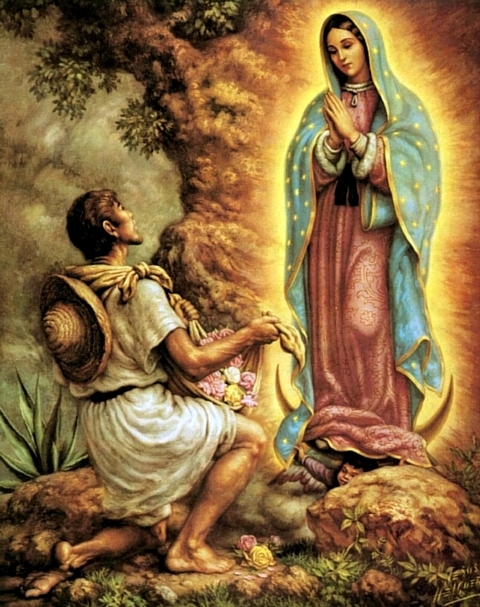
Juan Diego (57) was a farm worker and mat maker who had lost his beloved wife and had only one surviving relative, an uncle, Juan Bernardino. He was one of 15 million Aztec Indians who had new freedoms after the Spanish conquistadors had overrun the ruthless Aztec chieftains. On December 9, 1531, he was traveling his daily route past the hill of Tepeyac when he saw a cloud encircled with a rainbow of colors and heard strange music. A woman’s voice was calling above the music. Ascending the crest of the hill he encountered a strikingly beautiful woman standing there, beckoning to him. She radiated such light and joy that he dropped to his knees and smiled at her in wonderment. The leaves of plants were aglow; the bushes and trees shone like polished gold. She spoke seriously yet lovingly with him:
“You must know and be very certain in your heart, my son, that I am truly the perpetual and perfect Virgin Mary, holy Mother of the true God through whom everything lives,the Creator and Master of Heaven and Earth. I wish and intensely desire that in this place my sanctuary be erected so that in it I may show and make known and give all my love, my compassion, my help, and my protection to the people. I am your merciful Mother, the Mother of all of you who live united in this land, and of all mankind, of all those who love me, of those who cry to me, of those who seek me, of those who have confidence in me. Here I will hear their weeping, their sorrow, and will remedy and alleviate their suffering, necessities, and misfortunes. And so that my intention may be made known, you must go to the house of the bishop of Mexico and tell him that I sent you, and that it is my desire to have a sanctuary built here.”
Virgin Mary appears to Juan Diego
He immediately went at that early hour of dawn to the bishop’s house and was reluctantly received. The bishop, Don Zumarraga, listened respectfully but did not really believe him and told him to return in a few days after he thought about it. Juan Diego could sense his disbelief and became disillusioned when he left. But on the road home, the Lady appeared a second time. He was ashamed and suggested that she get somebody more influential for this job. But she smiled and reassured him that he would be successful. Holding his trembling hands in hers, she said,
“My little son, there are many that I could send to the Bishop. But you are the one whom I have chosen for this assignment. One day all will know my love for you and all my little children. Tomorrow morning you must return to the Bishop and express again my great desire for a church in this place.”
On the next day after Mass, he returned to the bishop’s house but was told to now provide proof that this was indeed the Virgin Mary and that she really wanted a church built on Tepeyac Hill. The bishop sent two servants to secretly follow him but they said he disappeared into thin air before their eyes. Juan Diego had actually entered the mystical realm of Mary as she appeared to him a third time and agreed to give him that desired “proof” on the next day.
“My little son, am I not your Mother? Do not fear. The Bishop shall have his sign. Come back to this place tomorrow. Only peace, my little son.”
He was overjoyed — but that was short-lived as he found his uncle — his only living relative — gravely ill upon returning home. As he could not leave his uncle’s side the next day, he was forced to not show up for Mary to receive the sign of proof she had promised. He felt horrible, but when he did manage to get out on the following day, he took a different route, hoping to not run into her. However, he suddenly ran into her, face-to-face. He begged her forgiveness and told her about his sick uncle. She reassured him with these words:
“Listen and be sure, my dear son, that I will protect you. Do not be frightened or grieved or let your heart be dismayed however great the illness may be that you speak of. Am I not here, I who am your Mother, and is not my help a refuge? Am I not of your kind? Are you not under my shadow and protection? Do not be concerned about your uncle’s illness, for he is not going to die. Be assured, he is already well. Is there anything else you need?”
Miraculous roses growing in Winter
She directed him to climb to the top of the barren Tepeyac Hill where he would find roses growing miraculously among the thistles and thornbush in the winter. There was a lush abundance of every color of rose. He picked them and carried them to the Blessed Mother, and she arranged them in his cloak, which he then folded shut for his journey to the bishop’s house.
“My little son, this is the sign I am sending to the Bishop. Tell him that with this sign I request his greatest efforts to complete the church I desire in this place. Show these flowers to no one else but the Bishop. You are my trusted Ambassador. This time the Bishop will believe all that you tell him.”
This was the fourth and last time he would see her. The bishop was actually eager to see what miracle had been brought to him, but not even Juan Diego was prepared for what was about to happen. As he unfolded his cloak to dump the multi-colored winter roses before the bishop, they were all stunned to see a beautiful image of the Virgin Mary imprinted on the rough cactus fiber of his cloak! The bishop fell to his knees in reverence and from that moment forth, all worshipped and adored this treasure.
When Juan Diego returned home, he found his uncle completely healed and telling of a visit that he had had with the Virgin Mary. She told of a temple that would be built on Tepeyac Hill and that her image should be called “Our Lady of Guadalupe” — although the uncle did not know yet what image she was talking about.
Ordinarily, the cloth of Juan Diego’s tilma or cloak should have deteriorated in twenty to thirty years. It is made from the maguey cactus plant and is something like burlap, rough and lattice-like. The material is called ayate and is ill-suited for use as a canvas for painting. It is actually made up of two pieces sewn together lengthwise and held together by a single cotton thread. An effort to make a replica of the cloth and image to test its true durability failed miserably — as it deteriorated badly within 15 years. The original cloth and image will be nearly 500 years old soon! And the image is as fresh as ever.
Cloak reveals miraculous image
The Indians in Mexico saw something in the image of Our Lady that the Spaniards did not comprehend. In that period, the Indians did their writing in hieroglyphics, so to them the image was a “hieroglyphic letter.” The fact that the natives “read” the picture is most important in understanding the purpose of Our Lady’s apparition. To the Indians, the image depicted a beautiful Lady standing in front of the sun – a sign to them that she was greater than the sun god (Huitzilopochtli), whom they worshipped. The crescent beneath her feet showed that their moon god (Tezcatlipoca) was less than nothing since she was standing on it. The Indians noted that the Lady was not of this world, for a young child with wings was holding her aloft with his two arms. At her throat was a brooch with a small black cross in the center, reminding them that this was the emblem of the Spanish Friars – and there was One greater than she. The “reading” of this sacred image brought whole tribes from all over Mexico, led by their chiefs and rulers, to be received into the Faith. The significance of her words, the meaning of her garments, and her whole appearance on Juan Diego’s tilma were perfectly clear to the Indians. And so it happened that the worship of pagan idols was overcome.
The Spaniards were quick to notice that Our Lady was the woman of the Apocalypse – “clothed in the sun and the moon under her feet.” The Spanish word “Guadalupe” is similar in sound to Aztec words meaning “she who will crush the serpent.” “Coatl” means snake; “llope” means tread on – or “Who treads on the snake.”
Miguel Cabrera, a famous Mexican artist, was commissioned along with six other artists to examine it in 1750. After a very careful examination in great detail, they concluded that it had been created in a “miraculous” fashion – not by any human artist!
Original 1531 image on cloak today
In 1754, Pope Benedict XIV wrote,
“In it everything is miraculous: an Image emanating from flowers gathered on completely barren soil on which only prickly shrubs can grow; an Image entrusted to a fabric so thin that through it the nave and the people can be seen as easily as through a trellis; an Image in no matter deteriorated, neither in her supreme loveliness, nor in its sparkling colors, by the niter or the neighboring lake, which however, corrodes silver, gold, and brass … God has not done likewise to any other nation.”
For the first 116 years, it was unprotected by glass. People freely kissed it, rubbed it, and touched objects to it. In 1753 it was removed from its glass protection for just two hours. But at least 500 people filed by and touched the frail cloth with many objects like sharp-edged crosses, medals, swords, and rosaries – yet no harm came to it.
In November of 1921, a bomb was secretly planted in a bouquet of flowers that was placed on the altar – just beneath the divine image hanging above it. The bomb exploded with such force that it blew out windows in the old Basilica, shattered the marble altar, and twisted a large bronze crucifix. Yet, the image of Our Lady and the glass enclosing this sacred treasure were completely unharmed and safe – despite its location right above the bomb.
Father James Meehan and Dr. Charles Wahlig examined the sacred image in 1975. They reported that the image does not impregnate the threads of the cloth, but lies on top – something like the emulsion of a photographic print. They state, “The picture defies human explanation. Its artistic source is outside human capabilities. It is a miracle.”
In 1979 — 448 years later — Dr. Philip Callahan, an infrared specialist and biophysicist, scientifically analyzed the Guadalupe image. He found the pigments to be authentic for that period in time but amazingly well preserved, whereas later added embellishments were fading, cracking, and deteriorating while the original image appears to have never aged at all. There were no preliminary sketched lines underneath the painting as could be expected in a hoax. Careful examination with a magnifying glass revealed NO brush marks and no deterioration or cracks in the coloring material.
His greatest discovery came with the enlarged photos of her eyes, revealing the reflection of a man’s image — that resembling the image of Juan Diego! An esteemed opthalmologist, Dr. Javier Torella-Bueno, noted that this image is located and distorted in the precise position that such a real reflection would have occurred on the curvature of an eyeball. Dr. Rafael Torija-Lavoignet adds,
“It is impossible to attribute to chance, to a textile accident or the pictorial matter this extraordinary coincidence between the localization of the reflections in the Virgin’s eyes and the most elaborate and up-to-date laws of optical physiology…”
Over the years, many healing miracles have been documented regarding those who came before her image. The image has also been observed to have been weeping tears.
Pope John Paul II beatified Juan Diego in 1990 and raised him to sainthood in 2002. The great Basilica of Mexico City was built on Tepeyac Hill and houses the divine image today. Our Lady of Guadalupe inspired over nine million conversions in Mexico!