Dong Lu (or Tong Lu) was a very poor village, formerly called “the place of beggars.” It was probably the poorest place in the whole region near Peiping, China. The Vincentian Fathers started a Poor Mission in Dong Lu. By 1900, there were about seven hundred to one thousand Christians gathered about the little hamlet.
The terrifying Boxer Rebellion sweeps across China in a deadly manner.
Suddenly, the Boxer Rebellion swept through China and grew to such proportions that even small places like Dong Lu could not escape its fury. In April of 1900, a force of 10,000 hostile soldiers attacked Dong Lu. The Chinese priest of the village, Father Wu, prayed to Mary, asking for her help and protection. Suddenly, a “woman in a white robe, surrounded by light” appeared in the sky. It was the beautiful glowing image of the Virgin Mary. The soldiers, in a senseless rage, started to fire their bullets into the sky at her. But the apparition was not harmed and would not fade.
A simulation of what the Chinese saw in the sky: “a woman adorned with the sun”
When the apparition did not fade, the attackers did not have any time to reorganize because a “fiery horseman,” probably St. Michael, came charging towards them, surrounded by “blazing flames of fire.” The strange horseman put fear into the 10,000 rioters, and they scattered and fled – never to return. After they disappeared over the horizon, Father Wu then confessed to his flock that he had invoked the help of Mary.
But, being barbaric fools, they shot into the sky at the Mother of God.
A new church was built on the site, and Father Wu placed a picture of Our Lady on the main altar. He asked the painter to dress Our Lady in the royal robes of the dowager Empress Tzi-His. The image of the Blessed Virgin in the royal robes of the pagan Empress with the Christ Child on her knees is a vivid expression of Chinese tradition. Though her robes be pagan, she belongs to every age, to all people, and to every race.
St. Michael the Archangel appears on a flaming horse with a fiery sword.
The beautiful church was built in her honor as a constant reminder to the people of Mary’s loving and motherly protection. The church became a famous place for pilgrimages, starting in 1924. Pope Pius XI approved it as an official Marian Shrine in 1932. But, during World War II, it was destroyed by Japanese bombs.
Fear scatters the 10,000 rebels as St. Michael charges at them.
Yet, the Blessed Virgin would return to Dong Lu in dramatic fashion in 1995 before 30,000 worshippers.
The grateful Chinese honor Our Lady of China in Dong Lu.
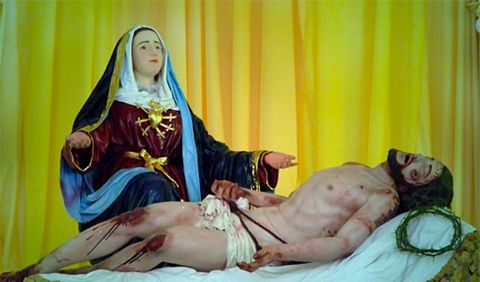
On March 22, 1888, the day before the Feast of the Compassion of Our Blessed Lady, two peasant women were shepherding their sheep on the hills in Southern Italy near the village of Castelpetroso. Fabiana Cicchino (35-year old virgin) and Serafina Valentino (34-year old married woman) belonged to Pastine, a hamlet in the diocese of Bojano. One of their sheep had strayed onto a hill nearest Castelpetroso. Fabiana found the lost sheep in a ravine near some rocks. But a strange light was coming from a crack in the rocks. The rays of the bright light formed a clear image of Our Blessed Virgin on her knees with her eyes gazing toward heaven. Her arms were outstretched in an act of imploring and offering of her Son, full of wounds and lying dead beneath her. It was the image of the Pieta.
Mary appeared as Our Lady of Sorrows, wearing a deep red dress and a dark mantle. She was a very beautiful, fair-skinned, young woman with disheveled hair and bleeding from wounds received from seven swords. The Blessed Virgin never spoke. When Serafina caught up to Fabiana, she could not see anything.
They returned home, crying, sobbing, trembling, and terrified. People naturally inquired as to the cause of their emotions. But very few believed them, and nobody paid much attention to their statements.
During the Solemnity of Easter on April 1, 1888, the same vision occurred again to these two women in the same location. This time, Serafina also witnessed the apparition. More people became curious after this encounter and began to believe that something was truly happening there. People began to go to the mountain and visit the spot of the alleged apparitions, some 2,600 feet above sea level. First, a child saw Mary; then an avowed heretic witnessed her also. Others affirmed that they saw Our Blessed Virgin bearing her dead Son in her arms.
Statues mark the site of the apparitions in 1884 near Castelpetroso.
Pilgrimages began, and within a few days, some four thousand persons visited the spot – which was double the number of those living there. Soon, this place which had been generally unknown, suddenly became the center of attraction to countless crowds from the neighboring countryside. Of those who went, some testified that they saw the Blessed Virgin as Our Lady of Carmel, Our Lady of Grace, and also Our Lady of the Most Holy Rosary. But most of the time, she appeared as Our Lady of Sorrows. She was usually alone but was also accompanied at times by St. Michael, St. Anthony, or St. Sebastian. Among those who testified to these apparitions was a well-known disbeliever, who received the grace of seeing Our Lady four times in half an hour.
The apparitions were accompanied by another phenomenon; in May of 1888 the body of water at the foot of the mountain began bestowing miracles. Soon, believers from other countries came in masses to behold and experience the extraordinary events and the fountain of miracles. Angelo Verna, a six-year old mute boy, was given a drink of this water by his father and was completely healed by receiving the gift of speech.
The priest in the diocese treated the whole affair as delusional and preached against it. A second priest, Don Luigi Ferrara, was also a disbeliever – until he saw her, too!
“I had many times derided those who visited the mountain on which these wonderful apparitions took place. On May 16, 1888, however, I felt a desire to visit the place. When I arrived, I began to look into one of the fissures, and I saw with great clearness Our Lady, like a statuette, with a little Child in her arms. After a short interval I looked again at the same spot, and, in place of the Most Holy Virgin I saw, quite clearly, the dead Savior bearing the crown of thorns and all covered in blood. Whenever I think of these visions on this mountain, I am moved to tears and cannot speak.”
News of the occurrences reached Msr. Francesco Macarone-Palmieri, Bishop of the diocese of Bojano. While in Rome on business, he updated Pope Leo XIII on the events near Castelpetroso, adding that he should have liked the apparitions to have been confirmed by “some clear sign.” The Pope replied by asking the Bishop if he did not think the apparitions in themselves were signs. Pope Leo XIII asked the bishop to return to the site of the apparitions and make a further investigation.
Replica of what witnesses observed in the cave rocks.
On the morning of September 26, 1888, the Bishop returned to the site and had the privilege of witnessing the vision of Mary as Our Lady of Sorrows – just as Fabiana and Serafina had described. After observing Our Lady on three occasions, he proceeded to file his official report:
“The Blessed Virgin appeared daily more frequently as the Mother of Sorrows, and, at other times, as Our Lady of Mount Carmel or the Queen of the Holy Rosary. A number of persons affirmed that they saw apparitions of St. Michael, St. Anthony, St. Joseph, St. Sebastian, together with the Blessed Virgin, and also the Holy Face of Jesus surrounded by angels.
As the event became more widely known and acquired a high degree of credibility, I deemed it expedient to have an account reduced to writing and certified to by the depositions, under oath, of those who had been eye-witnesses of the prodigy. The preparation of this report occupied several months. When it was completed, I took it in person to Rome to submit it to the Sovereign Pontiff that the Holy See might pronounce authoritatively and definitely in the matter.
I, myself, can bear witness that I visited the sacred spot, and, after some time spent in prayer, saw the Apparition of the Blessed Virgin. At first the image of Our Lady appeared faint and indistinct, but at length she appeared in the attitude and proportions of the representation of the Mother of Sorrows published in one of the numbers of the Servo di Maria. Besides myself and the very large number of persons whose names are recorded in the official report, there are the Vicar-General of the diocese, the Archpriest of the Cathedral, and many other ecclesiastics, who also beheld the miraculous Apparitions. With joyful heart, I affirm that the wonders happening in Castelpetroso are the last touches of the Divine Mercy, to call those who have gone far from the right way.”
In November of 1888, Count Charles Aquaderni, director of the magazine, Servo di Maria, went to the blessed rocks with his son, Augusto, who was sick with a serious bone tuberculosis. Miraculously, the boy was healed at the site!
On December 18, 1889, Father Joseph Lais, a physicist, medical doctor, and sub-director of the Vatican Observatory, examined everything and was convinced that no optical illusion could be responsible for what people had been seeing.
“The observations I made of the character of the people lead me to recognize that they are profoundly convinced of the event having taken place. Their simple and ingenuous demeanor does not suggest the suspicion that the fact should be, to some extent, fanciful or the effect of imagination. The natural formation of the rocks excludes the theory of trickery.”
Castelpetroso cathedral today in Italy.
The Bishop of Bojano formed a committee in 1889 to begin collecting funds for a church to be built on the site of the apparitions. Pope Leo XIII blessed their work, imparting the Apostolic Blessing to the members of the committee and to all those who contributed to the fund. The cornerstone for a beautiful Gothic church was laid in May of 1890 in front of 30,000 faithful. The layout symbolizes a heart with seven chapels at its center representing the seven sorrows of Mary, the seven swords piercing her heart.
On December 6, 1973, Pope Paul VI proclaimed the Blessed and Sorrowful Virgin Mary as Patroness of the region – upon a request by the Bishop of Molise. Pope John Paul II visited the sanctuary as a pilgrim on March 19, 1995. A community of friars and sisters has been established since 1993 — called the Franciscans of the Immaculate.
Bartolo Longo was the son of a doctor and a devout Catholic mother. He went through a crisis of faith in his university years as he studied to become a lawyer. He joined a sect and was ordained as a priest of Satan! He publicly ridiculed Christianity and did all in his power to subvert Catholic influence.
A good friend, Vincent Pede, eventually showed Bartolo the gentleness of Christ and arranged for him to meet a saintly Dominican priest, Alberto Radente. The Dominican had a deep, personal devotion to Mary and fostered the devotion of the Rosary. Bartolo saw Mary as a “Refuge of Sinners” and attributed his own miraculous conversion to her. Now he wanted to do penance for his past life and serve the Church that he had so viciously slandered. He made a promise to work for the poor and destitute.
In 1872 he arrived in marshy, impoverished Pompeii, accompanied by two armed escorts for protection against bandits. He was shocked and filled with great pity at the ignorance, poverty, and lack of religion of the inhabitants. Discouraged and full of doubts, he distinctly heard a voice speak to him on October 9. The voice said clearly that if he sought salvation, then he should promulgate the Rosary. The voice said that this was Mary’s own promise. He promised Our Lady in return that he would do everything in his power to do so: “I will not leave this valley until I have propagated your Rosary.”
St. Dominic and St. Catherine of Siena honor the Virgin Mary in a vision that healed Fortuna Agrelli.
Bartolo began teaching the catechism, spreading rosary devotions, and holding Rosary Festivals with games, races, and even a lottery. From 1873 to 1875 he restored an old church, held an annual festival on the Feast of the Holy Rosary in honor of Our Lady of the Rosary, and obtained and restored a worn painting of Mary from a convent in Naples for this church. The large painting was tattered, torn, cracked, and “worm-eaten,” arriving on its back in a wagon of manure.
The new shrine of Our Lady of the Rosary was completed in 1883. Within the month, miraculous events began to take place at the shrine. Four healings were recorded, including the following:
Fortuna Agrelli, a very ill young girl suffering three incurable diseases that most doctors had given up on, was joined by her family in saying a novena of Rosaries starting on February 16, 1884. The Virgin Mary then appeared to her on March 3rd, sitting upon a high throne, profusely decorated with flowers. She held the Divine Child on her lap and a Rosary in her hand; both were clad in gold-embroidered garments. St. Dominic and St. Catherine of Siena accompanied them. Fortuna asked Mary — as “the Queen of the Rosary”—for a cure for herself.
“You have invoked me by various titles and have always obtained favors from me. Now, since you have called me by the title so pleasing to me, Queen of the Holy Rosary, I can no longer refuse the favor that you petition – for this name is most precious and dear to me. Make three novenas, and you will obtain all.”
Fortuna did as Mary said and was completely cured.
Mary appeared to her again and said,
“Whosoever desires to obtain favors from me should make three novenas of the prayers of the Rosary in petition and three novenas in thanksgiving.”
And this is how the Rosary Novena devotion to Mary originated. Many healings are attributed to Our Lady of Pompeii. Between 1891 and 1894, hundreds of miracles have been officially recorded at the sanctuary.
The image of Our Lady of Pompeii represents Our Lady of the Rosary as Queen of Heaven. In the image she and Jesus are handing out Rosaries to Saint Dominic and Saint Catherine of Siena.
The neoclassical pontifical shrine and Basilica of Our Lady of the Rosary of Pompeii, in all of its frescoed, marble splendor, was dedicated in 1891. This happened sixteen years after Bartolo Longo began to collect pennies from the peasants to build this temple to Blessed Mary.
On October 21, 1979, Pope John Paul II visited Pompeii in a national pilgrimage to Our Lady of Pompeii. He beatified Bartolo Longo on October 26, 1980. Blessed Bartolo, a Third Order Dominican, founded the Sisters of the Holy Rosary of Pompeii. He established homes for the poor, for orphans, and for the children of people in prison.
Bartolo Longo was called the “Man of the Madonna” and the “Apostle of the Rosary.”
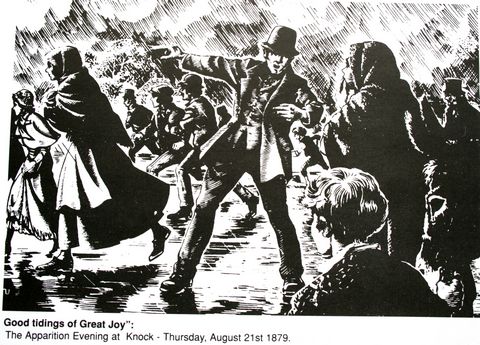
On August 21, 1879, it was a very rainy day in the little village of Knock in the County Mayo. Margaret Byrne (21) was walking in the torrential downpour to lock up the parish church nearby when she saw something brightly lit at the south end of the church near a large gable. Because of the harsh rainfall, she did not investigate further. She did not know that 30 minutes earlier, Mary McLoughlin (45), housekeeper of the parish priest, had casually noticed the same light. In the unusual glow she saw three large figures silhouetted — and guessed that maybe some new statues had been delivered to the church. It just so happened that Mary McLoughlin stopped by the Byrne household to visit. When she decided to leave around 8:00 p.m., another Mary (29), sister of Margaret Byrne, decided to walk with the housekeeper as she returned home, and both saw the same unusual glow. But Mary Byrne was more curious about these “new statues.”
People in Knock, Ireland hear of supernatural lights at the church.
When she investigated more closely, she jumped back and was startled.
“They’re not statues! They’re moving! It’s the Blessed Virgin!”
She identified them to be of the Blessed Virgin, St. Joseph, and St. John. Mary Byrne ran back home to tell her mother and her brother. Word spread quickly, and fourteen people gathered in the pouring rain to see this supernatural display. Here is a combined account from those witnesses:
Villagers witness three bright figures floating above the ground.
“The entire back wall of the church was bathed in a brilliant light, which could be seen from quite a distance away. Everything was raised about two feet off the ground. There was an altar, on top of which stood a Lamb with a Cross. The altar and Lamb were surrounded by Angels, hovering above. Around them were golden stars or small brilliant lights, glittering like glass balls.”
“To the left of the altar were the three figures: St. Joseph on the left, Our Lady in the middle, and St. John the Evangelist on the right. St. Joseph’s hair and beard were gray and he leaned in a respectful manner toward Mary. St. John was dressed in Mass vestments with a bishop’s miter on his head, a book in his left hand, and his right hand raised in blessing. Our Lady was life-sized; the other two were smaller.”
“The Virgin’s eyes were raised toward heaven with hands outstretched. Mary was beautiful. She wore a white gown and sash. A veil flowed from the back of her head to her feet. On top of her head was a gold crown. Between the crown and the edge of the veil was a gold rose. Mary was almost iridescent.”
The Virgin Mary casts her eyes toward heaven at Knock.
At first, no one dared to go very close to the images. They stood or knelt at a distance in the rain, becoming soaked, but not caring. Patrick Hill, age 14, dared to venture much closer and added even more detail:
“The figures were full and round, three-dimensional, as if they had a body and life. They were about 2-3 feet out from the church wall. They said nothing, but as we approached, they seemed to go back a little toward the gable. I could see the pupils and iris of Our Lady’s eyes. I could see the smooth texture of her milky skin. I was so close that I could see the lines and letters inside the book that St. John held. I also saw the wings of the angels fluttering!”
Witnesses kneel in the rain to honor the supernatural scene.
A 74-year old lady was so filled with joy that she tried to embrace Mary’s feet, but could not find anything to touch – because Mary moved back a bit. All of the witnesses agree that they saw the figures move in that hour and a half that they knelt before them.
All noted that, despite the pouring rain, the three figures all remained dry. The ground beneath them and the church wall also remained completely dry. All who passed by were blessed with the ability to see this event. The glow from the church could be witnessed as much as a mile away – as farmer Patrick Walsh testified on the following day.
One year later, more people gather in hopes of a return
One of the participants, Judith Campbell, left the scene around 9:00 p.m. to check on her ailing mother at home. Finding her mother lying on the floor passed out, she feared that her mother had died, trying to go out to see the vision at the church. At 9:30 p.m., Judith summoned the others at the church to come help her, and they all ran to see what had happened. But when they arrived at her mother’s home, she was okay now. The people ran back to the church only to find that the lights and images were gone now.
Many healings and miracles have been documented at this shrine that honors family life. Miracles began as early as ten days after the apparition. A young girl, Delia Gordon, had experienced deafness and pain in her left ear. While visiting the apparition site, her mother put a small piece of cement from the wall of the church into her ear. Afterward, during Mass, Delia experienced an excruciating pain in her ear, followed by a complete healing of her deafness and no further pain.
Knock, Ireland today.
In a publication regarding the Miracle of Knock, Father Tom Neary reports that 687 miraculous cures were documented in that first year from 1879-1880. People were using the cement or grout from that church wall. Eventually wooden planks had to be placed over the wall to preserve it. Later a bigger church was built and raised to basilica status.
Pope John Paul II came to Knock, Ireland, for the 100th anniversary of the apparition in 1979. He held Mass in the Basilica, anointed the sick, and prayed at the Shrine. He presented a gold rose to the Shrine, in commemoration of the gold rose that Mary wore during the apparition.
Today statues mark the actual site of the visions in 1879.
An investigative commission returned a positive verdict, and this apparition was officially approved in 1936.
On Wednesday, June 27, 1877, Justyna Szafrynska was coming home from church with her mother, having just passed the Catechism exam. Just as the evening church bell rang, the Holy Mother appeared between two withered boughs. She had long hair. The Child Jesus descended from Heaven in white-yellow clothing and came to rest on the left side of his mother, Mary.
The second apparition occurred on June 28th to two girls, Justyna Szafrynska and Barbara Samulowska. The “beautiful lady” appeared above a maple tree near the church, sitting on a throne with the Child Jesus and surrounded by angels. Jesus held a brilliant ball with a small cross at the top. Mary was crowned by the angels.
Visionaries are in awe of the appearance of Blessed Mary in Gietrzwald
During the third apparition on June 30th, Justyna asked what Mary required of them, and Mary replied, “Pray the Rosary every day.”
The fourth apparition happened on the day of Justyna’s first Holy Communion, July 1st. When Justyna asked who she was, Mary replied, “I am the Most Holy Virgin Mary Immaculately Conceived.”
The fifth visit happened on July 3rd. The girls asked Mary if sick people would be healed. Mary indicated that a miracle would happen, and, after that, sick people would be healed. Mary implored for sick people to pray the Rosary.
Our Lady of Gietrzwald, Poland
On July 28th the girls asked her about swearing falsely. Mary replied that Satan induces those to do this, and that such a person does not deserve to go to Heaven.
The seventh visit was on August 1st. Barbara asked about when the “orphaned parishes” might be receiving priests. Mary said that zealous prayers will help.
The eighth visit happened on September 8th. Holy Mary blessed a spring of water and then declared, “Now the sick people can take this water for their healing.”
The ninth and last apparition took place on September 16th, 1877. At 5:00 p.m. Mary blessed a statue of herself in a small chapel. After that she blessed all the people who asked for it.
She parted with these words, “Pray the Rosary zealously!”
The sanctuary where Our Lady’s painting hangs today.IF
These apparitions were fully approved by the Holy See a hundred years later in 1977.
“Our Lady of Pellevoisin,”
PELLEVOISIN, FRANCE (1876)
Estelle Faguette, age 33, lay dying from pulmonary tuberculosis, acute peritonitis, and an abdominal tumor. On February 10, 1876, a doctor declared that she only had hours left to live. On February 14, during the night, a demon appeared at the foot of her bed. But then she also saw the Blessed Virgin at her bedside, rebuking the demon – which immediately departed.
“Fear nothing, you are my daughter. Have courage for you are to suffer for five more days in honor of the five wounds of Christ. On Saturday, you will be either dead or cured.”
The Blessed Virgin appears at the bedside of dying Estelle.
The next night, on the 15th of February, both the Devil and Virgin appeared at the same moment.
“Be not afraid, for I am here. This time my Son is showing His Mercy. He will let you have life; on Saturday you will be healed.”
But Estelle said that she was ready to die, if she could choose, because she felt ready. Mary responded with a smile,
“Ungrateful, if My Son gives you life, it is because you need it. What other more precious thing can He give the people on Earth other than life? Don’t think that you will be free from suffering. No! You will suffer and not be free from troubles. This is what life brings. You have touched My Son’s heart by your self-denial and patience. Don’t lose those fruits by making the wrong choice. Did I not say that if He lets you live, you shall make My glory known?”
Our Lady of Pellevoisin as seen by Estelle.
Estelle saw a marble tile wrapped in white silk paper, but found it impossible to pick up. Then Mary said it was time to look into the past. Estelle’s past mistakes were reviewed. Stunned at what she had done over the years, she felt great sadness. Mary just remained silent and then left with an expression of goodness on her face.
The third apparition was on February 16th, and this time the Devil was a long way away. But Mary reassured her that her wrongdoings were in the past, and her self-denial has “put right the wrongs.” Then Mary reviewed the good things Estelle had done. Mary was touched by a letter Estelle had written last September in which she compared her parents’ suffering to Her Son’s suffering.
The fourth apparition was brief and uneventful on February 17th. The fifth one was the next night, the 18th. Mary came closer to her and let her see the large tile in greater detail. On each corner was a golden rosebud, in the middle a golden heart pierced by a sword with a crown of roses. Written on it were these words:
“I called to Mary in the depth of my despair. She pleaded with Her Son for me and gained my total healing for me.”
Estelle had many visits by the Virgin Mary and many messages.
Then Mary asked her to let her deeds prove her words. She said that Estelle could gain blessings wherever she goes by proclaiming Mary’s glory. Then Mary said, sadly,
“It saddens me the most to see that people have no respect for My Son in the Holy Eucharist, and the way people pray whilst their minds are on other things. I say this to those who pretend to be pious.”
Estelle began to feel dreadful pains in her stomach and abdomen. Holding her rosary in her left hand, she gave her suffering up to God. Little did she know that she was in the process of being healed. Soon she felt rested, well, and healed – except for the lack of functioning in her right arm. But the Parish Priest believed that when he brought her Holy Communion later that she would be able to make the sign of the cross with her right hand – and it was true that she was able to, later.
The sixth apparition occurred four and a half months later on July 1st. As Estelle was kneeling in her bedroom, saying prayers, Mary appeared, unexpectedly, dressed in white and surrounded by light. She looked at something, crossed her hands over her chest, and smiled, saying,
“Stay calm, my child, patience, it will be difficult for you, but I am with you. Courage, I shall return.”
One of the visions given to Estelle.
She left abruptly, but appeared a seventh time the next night, July 2nd. Bright light streamed forth from her hands. Then, she crossed her hands over her chest and said,
“You have already proclaimed my glory. Carry on. My Son has gained more souls who have devoted themselves more deeply to Him. His heart is so full of love for My heart that He can never refuse me anything. For me he will touch and soften the hardest hearts.”
Estelle wished for some sign of her power that she could prove to others, but Mary reminded that her own miraculous healing was evidence enough – and to let it be known.
The eighth apparition was uneventful on July 3rd.
The ninth apparition was two months later on September 9th, and Mary appeared with the same white light, looked around the bedroom in silence, and then said,
“You deprived yourself of my visit on August 15th because you were not calm enough. You have a real French character: they want to know everything before learning, and understand everything before knowing. I could have come again yesterday – you deprived yourself of my visit because I was waiting for an act of submission and obedience from you.”
Another vision given to Estelle.
The tenth apparition on September 10th was very short and uneventful. The eleventh visit was on September 15th. Mary said, sadly,
“I can stop My Son no longer. France will suffer. Take courage and have confidence. It is so much the worse for those who will not believe.”
The twelfth visitation was six weeks later on November 1st. Mary appeared, arms outstretched, wearing a scapular, staring at something invisible in the room, looking around, saying nothing, but gazing finally at Estelle with “a look of much goodness.”
During the thirteenth visit on November 5th, Mary said that she chooses the meek and mild for Her glory. She told Estelle to be brave as many trials are coming soon.
During the fourteenth appearance on November 11th, Mary praised Estelle for making a scapular and asked that she make many more.
The fifteenth and final apparition occurred on December 8th, 1876. Mary appeared “more beautiful than ever” and said,
“You will see me no more. I shall be with you, but invisible. You need not be afraid.”
Visionary Estelle Faguette
Estelle asked Mary if she could have the scapular Mary was holding. Mary just told her to come and kiss it. The Blessed Virgin bent down towards Estelle so she could kiss the scapular – a most memorable and wonderful moment for Estelle. Mary added that she wanted her to go to higher authorities and have a model of this scapular reproduced.
“Tell him that helping you do this pleases Me more by seeing my children wear it – while they turn away from everything else which insults My Son while people receive the Sacrament of His Love – and do all they can to repair the damages already done. See the graces which I shall pour out over all who wear it in trust of me and while spreading this devotion.”
Mary spread her hands, and rain fell very generously. Within each drop was clearly written a grace – health, trust, respect, love, holiness – all the graces which one could ever think of.
“These graces are from my Son. I take them out of His heart. He can refuse me nothing.”
She made a semicircle around Estelle’s room and disappeared.
The apparitions were quickly recognized by Monsignor de La Tour d’Auvergne, the Archbishop of Bourges. He authorized the making and distribution of the scapular and allowed public worship of Our Lady of Pellevoisin. The Archbishop ordered two canonical inquiries into the apparitions, which resulted in a favorable verdict on December 5, 1878. Later, in 1883, the parish priest of Pellevoisin, Fr. Salmon, accompanied by Fr. Auvrelle, the Vicar General, journeyed to Rome to present Pope Leo XIII with a bound record of the apparitions and a picture of Our Lady of Pellevoisin. The Pope was pleased to grant indulgences to encourage pilgrimages to the shrine.
Estelle was privileged to visit Pope Leo XIII on two occasions, during which the Pope promised to submit her scapular of the Sacred Heart to the Congregation of Rites. A decree was issued two months later approving the scapular
Estelle Faguette died in Pellevoisin at the age of 86 on August 23, 1929 – 53 years after her miraculous healing from death at the age of 33.
“Our Lady of St. Bauzille-de-la-Sylve”
HERAULT, FRANCE (1873)
Auguste Arnaud, age 30, was a regular participant in Holy Mass on Sundays. He was a father of two, having been married for six years, and a respected member in his community. And he worked on Sundays.
On Sunday, June 8, 1873, the Feast of the Holy Trinity, he attended Holy Mass and then went to work in his vineyard to tend the vines. After working for two hours, Auguste sat down to rest, eat his packed lunch, and smoke his pipe. Suddenly, he saw before him a beautiful young woman dressed in white. She wore a white veil that reached to her feet. She had a fringed belt and a tall crown. He jumped to his feet and asked, “Who are you?”
“I am the Blessed Virgin. Do not be afraid.”
Auguste was reassured by her words and listened with great emotion as she continued,
“You have the disease of the vine. You left St. Bauzille. We must celebrate his feast on the day it falls. Next Thursday you must go in procession to St. Anthony and hear Mass. In a fortnight you must go in procession to Notre Dame, to the Canton of Gignac, Montpellier, and the city of Lodeve. You must place a cross here, changing it later to another. Come in procession each year. Go tell your father and your pastor all of this. In a month I will come to thank you.”
At that, Blessed Mary rose vertically into the air and gradually disappeared. Auguste left the vineyard immediately for home, where he excitedly told his father what he had seen. When they went together to tell the village priest, the priest met their remarks with coldness and skepticism. He found it hard to believe that the Virgin Mary would make that effort just to tell one man not to work on Sundays.
But Auguste remained inspired to perform his mission given to him by the beautiful Lady. He had a carpenter build a wooden cross which he then placed in the vineyard where Mary had indicated. It was just a temporary one as the Virgin had asked for a wrought iron version with her image in the middle in his next effort.
On June 12, he and his family visited the chapel of St. Anthony. On June 22, he made it to Our Lady of Grace in Gignac. He made it to all the places that she had requested. On July 4, he finally replaced the wooden cross with the wrought iron one and set it on a stone pedestal.
Believers, skeptics, and the curious all gathered on July 8, 1873, in his vineyard for the predicted second appearance of Mary. Auguste’s wife worried about what might happen if the Virgin failed to appear and this crowd of five hundred would become disappointed and perhaps angry. But Auguste had plenty of faith and no fear at all.
After a few minutes, Auguste removed his hat and raised both arms high in the air. He seemed transfixed by what he was able to see, while everybody else saw nothing. With his arms still raised, he was suddenly carried with uncommon speed by some invisible force to the cross about forty yards away. He prayed silently while gazing at the Blessed Virgin, dressed now in gold and holding a rosary in her right hand. In a sweet voice:
“Do not work on Sundays. Blessed is he who believes and unhappy the man who does not believe. You must go to Our Lady of Gignac in procession with your whole family.”
She slipped the rosary to her left hand and, raising her right hand high, she blessed Auguste and the whole crowd. Before disappearing, she spoke one more time:
“Let us sing hymns.”
Auguste turned to the crowd and, in a low voice, told them to sing. The crowd began singing the Magnificat. After this day, many visitors frequented the area, leaving many flowers, candles, rosaries, and ex-votos. The activity interested the local bishop to the point of appointing a Commission of Inquiry. After witnesses were questioned and the committee filed its conclusions, the bishop recognized the authenticity of these appearances by Mary with a proclamation in 1876.
A chapel was built near the site and cared for by nuns. Auguste Arnaud died on
February 8, 1936, at the age of 92. He was buried in this chapel where his tomb reads:
“At the feet of the Virgin he so loved and so faithfully served, here lies in wait for the blessed resurrection the body of Augustus Arnaud, piously asleep in the Lord’s peace.”
On January 17, 1871, Eugene Barbadette (12) and brother, Joseph (10) heard the priest pray through Blessed Mary at Mass for mercy to come to the area. Paris was already besieged by Prussian forces, and war-torn France was in complete disarray. The little town of Laval nearby would be the next to fall to the invading Prussians.
That wintry night, looking outside the family’s barn at 6:00 p.m., Eugene noticed in the cold starry night that a section of the sky was without stars. Suddenly, in that very area, a young woman of 18 years old appeared to be hovering in the sky and smiling down at him. She was strikingly beautiful and wearing a dark blue dress covered with stars and a black veil with a golden crown on top. He gasped a yell of surprise, and brother, Joseph came to him and stared up at the apparition as well. Their parents then came to see what was going on but could not see what the boys continued to marvel at. The mother boxed their ears, scolded them, and then forced them to come in and eat dinner.
The visionary children who were able to witness the spectacle in the sky.
They ate hastily, rushed back outside, and again saw the beautiful lady in the sky. Joseph records the details later in his writings as follows:
“In the air above Augustin Guidecoq’s house, I saw a woman of extraordinary beauty. She appeared to be young, about 18-20 years of age and tall of stature. She was clad in a garment of deep blue. When we were told to describe exactly the shade of blue, we could only do so by comparing it to balls of indigo such as laundresses use for rinsing linen. Her dress was covered with golden stars, pentagonal in form, all of the same size and brilliant, but without emitting rays. They were not very numerous and seemed scattered over the blue without regard to method. The blue garment was ample, showing certain strongly marked folds, and without girdle or compression of any kind from the neck to the feet. The sleeves were ample and long, falling over the hands.
On the feet, which the dress left uncovered, were chaussons (shoes), the same blue as the dress, and ornamented with golden bows. On the head was a black veil, half covering the forehead, concealing the hair and ears, and falling over the shoulders. Above this was a golden crown resembling a diadem, higher in front than elsewhere and widening out at the sides. A red line encircled the crown at about the middle. The hands were small and extended toward us as in the ‘miraculous medal’ but without emitting rays.
The face was slightly oval. To the freshness of youth was added exquisite delicacy of feature and of tint, the complexion being pale rather than otherwise. Smiles of ineffable sweetness played about the mouth. The eyes, of unutterable tenderness, were fixed on us. I give up further attempting to describe the beautiful figure of her who looked down upon us and smiled. Like a true mother, she seemed happier in looking at us than we in contemplating her.”
The vision in the sky of the Virgin Mary in Pontmain, France, 1871.
But when a local nun heard the startled mother’s story, she reminded her that Mary often comes to young children. Going on the theory that maybe only children could see Mary, she brought two young girls, Francoise Richer and Jeanne-Marie Lebosse (ages 9 and 11) from the convent school to the family’s farm. The nun made certain to not tell the young girls anything. Although not having heard what the two brothers had seen, the two young girls immediately began describing, excitedly, the exact same image of the Virgin Mary down to the last precise detail.
Clusters of people began to gather — within 20 minutes after this vision had begun — yet, none of the adults could see anything. Three more small children began pointing at the sky and describing the same apparition of Mary. Even a two-year old in her mother’s arms started clapping with joy, looking up into the sky, and holding out her arms as if wanting Our Blessed Mother to come pick her up. A total of about 60 villagers gathered before the barn and knelt in the snow to begin praying. Sister Mary Edward began leading the Rosary. The children reported that Our Lady smiled throughout the Rosary, appearing very much alive and showing the dazzling whiteness of her teeth.
Many people gather to observe the children in awe of the image.
Afterward, Father Guerin led in singing hymns and reciting other prayers. The children reported that the Lady became more beautiful and her garments more intense in illumination in proportion to the devotion of the people. “Oh, there are so many stars (on her dress) that the Blessed Virgin will soon be gilt (golden) all over.”
The four young children who could describe what was happening said that three bright stars formed a triangle around Mary. A darker blue oval backdrop appeared and formed around her. Two candles appeared inside the oval on either side of her shoulders. Two more candles appeared inside the oval on either side of her knees. A small red heart appeared on her left side. About forty stars only visible to the children gathered beneath her feet. The villagers were all able to witness the formation of the three stars in a triangle.
As Sister Mary Edward began the Magnificat, the children cried out that the image was changing again. A white band about a yard wide unrolled itself under her feet and extended across the roof of Guidecoq’s house. These words appeared on the banner:
“Mais priez, mes enfants.” (But pray, my children.)
As the Magnificat continued, the dreadful news arrived that the Prussians were now at nearby Laval and heading soon toward Pontmain. More letters appeared on the banner:
“Dieu vous exaucera en peu de temps.” (God will hear you in a little while)
“Mon fils se laisse toucher.” (My Son permits Himself to be moved)
So she was telling them that God had heard their prayers and fears about the invasion of soldiers, and that he would answer their needs shortly. He would answer because he is a God who allows himself to be touched by pleading and prayers. The crowd sang hymns, but when “My Sweet Jesus” was sung, the children reported that she looked sad. A blue band, the same color as the sky, began passing over the words and erasing them. As the white banner rolled away, the Virgin lifted her hand to the level of her shoulders. She seemed to be moving her fingers and speaking, but nothing was heard.
The small crowd prays and sings to honor the Blessed Virgin in the sky.
Her hands were then joined over her heart and a large red cross with a darker red image of Jesus appeared in her hands. A star seemed to move and light four candles about her. When the crowd sang Ave Maris Stella, the red crucifix disappeared and a small white cross about eight inches high appeared on each of her shoulders. Mary looked upward. Prayers continued and Mary smiled as the crosses disappeared. She opened her arms outward and downward. A white veil appeared at her feet and rose slowly upward until Our Lady was completely concealed by it.
It was now about 9:00 p.m.; the experience had lasted a total of three hours!
Our Lady of Hope tells them that God hears their prayers.
By the next morning the town learned that the Prussian soldiers had witnessed a vision of the Virgin Mary on the outskirts of their town. The startled and frightened soldiers had told their Prussian superiors,
“Madonna is guarding the country and forbidding us to advance! We can go no further – an invisible Madonna is barring the way.”
Within eleven days the Prussian soldiers had mysteriously retreated and abandoned the country they had planned to invade and occupy. A truce was signed and the war ended.
The next morning, the Prussian army is halted by the Virgin Mary.
After a thorough investigation, the ecclesiastical authority fully approved in February of 1875 the appearances of the Virgin Mary in Pontmain. The Barbadette barn first became a chapel, and then a large basilica, years later in 1900, for “Our Lady of Hope.”
Today this grand basilica honors the apparition of Pontmain, France.
Joseph Barbadette became a priest and a member of the Congregation of the Oblates of Mary Immaculate. Brother Eugene became a priest of the archdiocese. Francoise Richer became a housekeeper for a priest, and Jeanne-Marie Lebosse became a nun.
On May 12, 1874, two young shepherds, Angela Berruti (12) and Vincent Scossiera (13), were leading their flock up the hill Pra` when, suddenly, to the east, appeared a lady high in the air. But she was supported by the cloud that she stood on. She wore a coffee-colored outfit, and her head was covered by a veil. She stood with a child in her arms. Frightened, Angela ran to her boss and reported what she had seen, but she was disbelieved and derided for “acting stupid.”
Vincent managed his feelings better and calmly viewed the scene. Something white like a sheet was behind the figure of the beautiful lady. Two others were with her — one on each side – but were not identified at this time. Her hands were at her sides. On her head she wore a gold crown. Her dress was a blue and white color. There was a brightness about her, and she stared at the young boy. It caused him to cry out in awe and shock. A very loud cry startled him, and he ran all the way home, crying.
A man, Olivieri Magdalene, was praying in the little wooded valley when he encountered the same appearance of the Virgin Mary that Angela had. On May 16, Teresa Burnengo (36) was praying at the site of the first apparition. She saw the Madonna at a short height above the ground and almost in a niche. She described the same coffee-colored outfit, veil covering her head, and baby Jesus in her arms.
On October 25, a thirteen year old and her friend, Maria Valley Pegollo visited the site of the apparitions and saw the Virgin Mary dressed in black. They lowered their eyes and prayed. After a while, they saw angels surrounding the Blessed Mother, who now wore a blue cape, fastened on her chest with a shining star. Her hands were folded on a cross upon her breast. Two people were at her sides, benign and friendly. The girls began asking questions. The Virgin stated that she was “the Immaculate Conception.” The two people with her were Saint Clare and Saint Elizabeth. The angels were reported as having come to assess the innocence of the girls. Mary explained that the star on her chest which served as a clasp for her cape was given by Her Son, Jesus, to recognize his mother as the “Queen of Heaven and Earth.”
After this encounter, the parents of a blind boy and a girl with a paralyzed left arm asked the two girls to help present their two suffering children to the Virgin Mary for hopeful healing. The two visionary girls took a hand of each of the suffering youths and led them to the apparition site. As they approached the youthful image of Mary all decorated in white, who had reappeared at the door of a large chapel, Maria Pegollo held back and allowed her friend to approach Mary.
A pardon was requested for the two. Our Lady said that the blind person must first receive Holy Communion and learn well the truth of the faith. The girl with paralysis only needed to come to this place and her hand would heal. Then Our Lady requested that a church be built in this place. Despite the opposition of the authorities of Feglino, the church was finally built.
“Our Lady of Good Help”
CHAMPION, WISCONSIN, USA (1859)
The Brice family emigrated from Belgium to the United States on July 23, 1855. On August 7, 1855, Lambert and Marie Brice purchased 240 acres of land in the Red River, Wisconsin region to establish their family farm. Daughter Adele would walk the 11 miles by herself to the nearest church every Sunday.
In early October of 1859, Adele Brice, age 28, was taking some wheat to a grist mill along a four-mile Indian pathway. Just as Adele came to a clearing between a maple tree and a hemlock tree, she saw someone standing between the two trees. As she approached, her heart filled with fright, and she froze as she looked at the woman. The woman was all white with a yellow sash at her waist. Around her head was a crown of twelve stars. She was standing on a small cloud. She had yellow hair, blue eyes, and was surrounded by a bright light. Adele watched until the woman disappeared, and then she saw the cloud disappear as well. When she arrived at the mill, the miller could tell that she was very upset. She was also very nervous on her return trip home, but nobody was between the trees this time. When she arrived home, she told her parents what had happened. Her father suggested that it might be a poor soul that needed prayers, “so pray for her if you see her again.”
Adele Brice encounters a ghost-like, glowing lady in the woods in 1859.
On October 9, 1859, Adele, her sister Isabelle (age 24), and their good friend, Mrs. Theresa Vander Niessen, were walking the eleven miles together to the Sunday Mass at the nearest church in Bay Settlement. As the three women approached the spot where the two trees stood, Adele again saw the lady in white. She got excited and told her sister what she was seeing. Adele froze, staring at the woman, but the other two could see nothing. But they could see that Adele was indeed staring at something, and they could see fear in her eyes. Then the lady disappeared, and they all agreed to pray for the “poor soul.” Adele confessed to the priest what she had seen, and he spoke to her about the matter, suggesting that she ask the lady who she is and what she wants. Adele felt comforted and believed by Father Verhoeff. On the way home the three women were joined by a man who was clearing the land for the Holy Cross Fathers.
When they came to the place with the two trees, Adele stopped because she saw the lady again. She could clearly see that she was dressed in a white gown which fell to her feet in graceful folds. There was a yellow sash around her waist. Long wavy golden hair fell loosely over her shoulders. On her head was a crown of twelve stars. The bright light surrounding her made it difficult for Adele to look at her for very long. Adele saw that the lady had a very sweet, gentle face. Surprisingly, she felt no fear this time. Instead, she was completely filled with joy and peace. She walked closer and fell to her knees before her.
Promising to teach children about religion, Adele keeps her vow to the Virgin.
A: “In God’s name, who are you, and what do you desire of me?”
VM: “I am the Queen of Heaven, who prays for the conversion of sinners, and I wish you to do the same.” (She spoke in a soft, sweet voice – “the sound was heavenly.”) “You were at Holy Communion this morning.”
A: “Yes, dear lady.”
VM: “You have done well, but I wish you to do more. Pray for nine days. Go and make a general confession and offer your Holy Communion for the conversion of sinners. If they do not convert themselves and do penance, my Son will be obliged to punish them.”
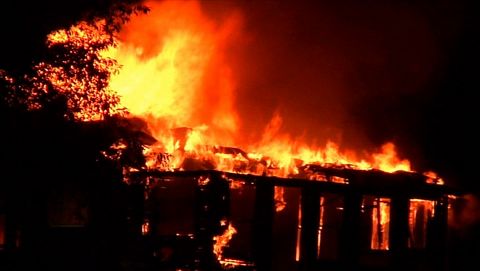
A horrible fire breaks out in 1871, enhanced by tornado-like winds.
Meanwhile, the others could tell that Adele was seeing someone and talking with her. They kept asking her, “Who is she? What is she saying? Is she the poor soul from Belgium? Who is it?” Adele heard her friends and told them to kneel because “she said she was the Queen of Heaven.” When Theresa complained about not being able to see her, Adele saw the Virgin Mary look kindly at Theresa and say,
VM: “Blessed are they that believe and do not see. (then back to Adele:) What are you doing here in idleness, while your companions are working in the vineyard of My Son?”
A: (crying) “What more can I do, dear Lady?”
VM: “Teach the children.”
A: “How can I teach them when I know so little, myself?”
VM: “I do not mean the science of the world. Teach them their catechism, how to sign themselves with the sign of the cross, and how to approach the sacraments, that they may know and love My Son; otherwise, the people here will lose their faith.”
A: “With God’s grace, and the help of your intercession, I promise, dear Lady, to be faithful to what you bid me.”
VM: “Go and fear nothing. I will help you.”
Nobody can escape the horrible blaze as it heads toward “Mary’s Five Acres.”
With that said, the Blessed Mary raised her eyes and hands toward heaven and slowly rose upward. She was surrounded by a light smoke-like incense. She looked like she was asking for a blessing for all of those kneeling before her. Adele, overwhelmed with emotion, collapsed to the ground in exhaustion. The man brought a cloth, soaked from a nearby stream, to help revive her from unconsciousness. Then the four walked home, and Adele told everyone about her encounter. Because of her character, most people believed her words. Her father had always believed her because she had always been a truthful girl. To show his support for his daughter and his love for the Virgin Mary, he decided to honor the location of the apparitions with the building of a very small chapel (10 feet x 12 feet) on that very spot. Father Verhoeff gave Adele a picture of Mary to hang there.
Adele offered to work hard for the busy pioneer families if they would let her teach their children the catechism and the rosary in spare moments. She did so for seven years, bringing each child that was ready to Father Daems in Bay Settlement to test their knowledge before each one’s First Communion. In 1861, the community built a larger chapel (24 feet x 24 feet) that could hold a hundred people – and often did. Mrs. Isabella Boyer donated the five acres that contained the holy site.
Sister Adele Brice leads a night-long praying of the Rosary, pleading for heavenly help.
When doubters began to give Adele a hard time, miracle healings began occurring in the chapel when Adele asked for divine assistance. Blind visitors regained their sight, deaf people regained their hearing, the desperately sick were healed, and cripples would walk again, leaving their canes and crutches behind as evidence. Word spread across the Midwest of these divine healings near Robinsonville (later called Champion). Adele acquired a beautiful, hand-carved statue of Mary from Belgium, and there was a glorious procession from the boat to its final resting spot in the chapel. However, some time later, the statue was severely damaged when it caught fire from candles placed too close to it. But farmers and other settlers took up a collection to replace it with a new statue.
In 1864 Adele and the other religious women helping her became the Sisters of Good Health – and were accepted by the Bishop of Green Bay. In 1867, Adele opened a school next to the chapel and a boarding school, the St. Mary’s Academy, in 1869.
Devastation is everywhere the next day (actual photo).
On Sunday, October 8, 1871, a most deadly fire was created by a gale force wind that turned the prairies and forests of Wisconsin into a raging inferno. Fire tornadoes ripped through the area causing death and destruction everywhere. Flames jumped rivers, embers rained down, and small fires were whipped up into a giant fireball that destroyed homes, buildings, farms, factories, and entire towns. It was described as “a wall of flame a mile high, five miles wide, traveling 90-100 m.p.h., hotter than a crematorium, turning sand into glass.” The heat was so strong that it killed people before the fire ever got to them. Approximately 2,500 people died, 12 towns destroyed, and 1.2 million acres devastated – the deadliest fire in American history. The ground was burned to a depth of two feet deep in some places. Hiding in brick homes or underground basements did not help. Only those hiding in rivers had the best chance of survival.
Father Pernin of a local church made every effort to save the tabernacle from his church, but at the river his cart dumped, and it floated away as he watched helplessly. Many people lined the river banks, but the only ones who survived were those who jumped in the water with Father Pernin. Three days later, among the blackened terrain and black ashes of everything destroyed, a pristine white tabernacle was discovered sitting upright on a log in the river. Its contents were unharmed from water or heat, and the people saw it as a miracle and a sign of hope.
Only Mary’s five acres remains green and untouched by the disaster; all there lived.
Sister Adele decided it was impossible to flee the fire, so the sisters, the school children, and frantic neighbors gathered in the chapel on the five-acre grounds and prayed to Mary for help. Then Adele led a procession around the perimeter of the chapel grounds, carrying a statue of Mary. The procession continued all night, praying the Rosary, all around the grounds. Everyone believed a miracle had occurred: the wind cooled, a heavy downpour drenched the fires, but this was longafter the fires had stopped right at the fence line surrounding the five acres. The outer side of the fence posts were charred while the inside was untouched. Everything surrounding their five acres, including the lush green forest, farm buildings, and homes were blackened, obliterated, and gone. Only the people and animals that had come to these grounds survived. The five-acre grounds that had been dedicated to Mary were green and untouched – “a glorious sight.” Exhausted from their fears and night-long processions of prayers, the people praised God and retired to sleep. Twelve years ago, on this exact day, Mary had warned of a potential punishment.
he Bishop of Green Bay approves these apparitions in 2010.
Another miracle on the chapel grounds had to do with the chapel well. The weather had been extremely dry all summer with the deepest of wells in the region barely containing any water left. The chapel well was only a few feet deep, and yet it was always providing plenty of water. All the neighbors, their surviving livestock which they had brought to the grounds, and everyone else living on Mary’s five acres had plenty of water from this shallow well. There was no explanation or logic for this small well to serve so many for so long under the dry conditions. People started taking some of the well water home as it was believed to have led to some healing miracles.
Many other miracles were documented. A seventeen year-old boy developed pleurisy from double-pneumonia. Despite his lungs becoming extremely weak, he said a novena at the chapel, and he was completely healed. Another boy, Michael Fonde, age nine, fell from a barn and was crippled. Four years later, a group of women prayed a novena with him at the chapel, and he walked out healed, leaving his crutches behind. A little girl with bleeding sores, who had been treated by doctors for years, was completely healed after she and her Mom made the pilgrimage to this chapel. Another small girl had become blind from a severe case of measles. When her mother brought her to this chapel to pray, she was instantaneously healed. And a deaf boy brought by his Mom to the chapel completely regained his hearing.
A statue of Mary gazes at pilgrims on the site; many healings occur.
On December 8, 2010, a historic event took place in this Shrine of Our Lady of Good Help near Champion, Wisconsin. Bishop David Ricken of Green Bay formally announced the approval of these apparitions:
“I declare with moral certainty and in accord with the norms of the Catholic Church that the events, apparitions, and locutions given to Adele Brice in October of 1859 do exhibit the substance of supernatural character, and I hereby approve these apparitions as worthy of belief by the Christian faithful.”
This becomes the first approved Marian apparition in the United States of America.